
you
I was getting depressed about
photography because I really wasn’t
interested in spending time on a
computer so I found a person that knew
how to do the tintype process and I
wouldn’t took a tutorial in about three
hours into a three day tutorial I was
hooked I mean it was an experience that
was very tactile it smelled like
photography you your fingers got wet
they got dirty and you know the
attractive thing was each one was a
one-of-a-kind Emmett
you know that really kind of took it 180
degrees away from digital photography
ever since then I’ve been pretty hooked
on it
thank you for having me here tonight and
thank all of you for coming I’m going to
explain the tintype process first just
so we can kind of get the technical
stuff out of the way so you understand
what’s involved in taking a tintype when
I go out on these assignments I’m taking
a seven foot by 12 foot trailer that’s
behind my truck and so for this
particular story
I drove forty-one thousand miles I went
to 14 states in the US I went to Mexico
and two provinces in Canada and so in
that trailer is a portable darkroom with
water silver nitrate and potassium
cyanide and about 600 pounds of
photography gear so this is what I pull
up and at every ranch and when these
ranches I tried to prep them as best I
could about the time that was going to
be necessary and what I would be driving
and what all it would entail but I still
don’t think most of these people were
prepared for me to come with all of this
but I was always welcomed and I use an 8
by 10 camera I use 19th century lenses
so all these lenses have actually taken
photographs back during the 1850s 60s
and 70s so it’s a when you pull out a
camera like this it’s a totally
different experience I got hooked on
tintype about eight years ago and I
really haven’t looked back with any
regret it’s every time I pull this out
and have an experience with the subjects
it’s it’s always like I walk away with a
unique experience a unique look into
somebody’s life because they have to
spend anywhere from one to eight hours
you know to get the job done so it’s a
total intimate situation that that is
more than just about taking photographs
it’s about keeping memories
making memories and getting to know
people and having new acquaintances and
sometimes new friends the the exposures
tend to be 7 to 45 seconds long so you
could you can’t with these lenses you
can’t move a quarter of an inch or a
half inch if you’re doing a close-up
portrait and still maintain sharpness so
it’s it’s really something that people
have to get into a state of mind to be
still and focus their efforts and I
think that’s why a lot of times the eyes
and the photographs look so revealing
this because they’re so concentrated on
making sure they’re still and focused on
not blinking and that’s hard to do in 20
seconds try it sometime
you know the days would start at about
5:00 a.m. and they would end at about 10
o’clock 11 o’clock at night so every day
was you know 15 to 18 hours long a lot
of driving this is Holly who assisted me
on the job so we just took every chance
to take interesting pictures in the
middle of the day and on our way and
after the shots were done we actually
took pictures that people wanted you
know some of the people we photographed
wanted pictures were they actually
smiled and so we ended up shooting
digital pictures and sending them back
to people so they could have a picture
that actually looked like them you know
the unique thing too about having this
trailer is that people can I’m supposed
to point this out there’s the ten type
right there so that’s the five by seven
inch ten type and a lot of times the
Cowboys were always invited to come in
the trailer and watch the whole process
which again puts it on a different level
I mean the relationship between myself
and the subject I mean I get to spend a
lot of time with them but then they get
to watch the whole thing process so it’s
almost like a Polaroid because at the
end of two minutes after we take the
picture two minutes later they get to
see the picture and if they choose to
come in the darkroom they get to watch
the whole process which is pretty
magical
and so you again you get a different
level of commitment and enthusiasm from
the people
and probably at this point they’re not
in the darkroom because they’ve made
several trips in and there’s a lot of
you know chemicals that are best as they
can be vented out ether and potassium
cyanide so a lot of them they kept you
know a lot of guys would say you’re
getting high in there I know that and
and it was just because of the ether so
you know this is probably towards the
end of the day and they’re all tired of
the smell so they’re waiting for me to
come out and share it with them on the
trip I did audio recordings will hear a
selection tonight so you can hear some
of the amazing voices and stories from
some of these people and I also shot
video alongside so here we see a picture
of 19th century technology on the right
and 21st century technology on the left
and I would just hit the play button and
have the the subject stare into the lens
and I just did a video portrait so while
I was off processing the plate they
would stand there for 2 minutes and look
into the video camera so it was kind of
an interesting relationship they were
having with this unmanned video camera
the only thing I would do is I would
recruit a cowboy to push the stop button
and this is pat up at the padlock ranch
he’s trying to figure out where the stop
button is so here’s another picture two
side-by-side of the two things I was
doing and every one of these plates you
have to make the plate you first you
pour the emulsion on a metal plate when
emulsion is gun cotton and ether and you
put it in silver nitrate for four
minutes and then you load it into a
plate holder and then you have to take
it out to the camera and from that point
depending on the time and temperature
you have basically six to eight minutes
to make your exposure get back and
process the plate that’s why it’s called
wet plate process so everything has to
be done in a certain time period so
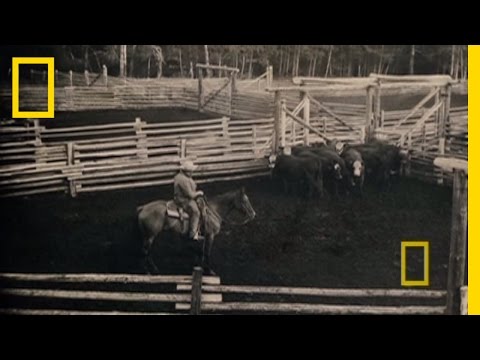
crawling on top of this barn to shoot a
picture down into the corral of cattle
and horses and stuff was a big
commitment not only because every time I
shot a picture I had to climb down off
the barn to go process it and then every
time I wanted to shoot another plate I’d
had to take the plate and carry it up
this
fence I’m going to jump back on the roof
and shoot a picture so it’s a big
commitment and same same angle just a
different variation just quickly a map
to show the different regions the cowboy
basically breaks into four different
types the Vaquero
which is the traditional roots of the
cowboy in North America and then the
buckaroo region which is west of the
Rockies and that’s basically a
bastardization of the word Vaquero but
the Anglos there couldn’t say the word
so they buckaroo stuck and these people
are easily identified by flat brim tats
fringed leather chaps that they call
chinks and then their saddles are very
ornate and stamped with what they call
flower stamping it’s tools leather
Cowboys are kind of east of the Rockies
and cowpunchers are Arizona New Mexico
Oklahoma Texas and that’s a very kind of
rougher utilitarian looking cowboy it’s
not decorative at all
and it’s because the area they work
tends to be brushy thorny and it’s
pretty rough on their gear and so each
region kind of is has its own pride each
region will tell you the best but they
all respect the way the other works
that’s kind of an interesting subculture
within the culture as these four
different regions so anyway we’ll start
talking about the pictures here so this
this would be somebody that’s in the
cowpuncher region on this he’s got very
simple utilitarian chaps and nothing
fancy about what he’s wearing just jean
jacket and a felt hat and big round
Spurs are kind of something that you’ll
see in the cowpunchers but again every
one of these images is you know one of
and I don’t sit there you know when I
used to shoot I mean the reason I got
into ten types was I was kind of having
a midlife crisis I guess eight years ago
and was frustrated with digital
photography just seemed to be something
that was very sterile to me you shot a
picture you look at the
your camera and it’s kind of over with
at that point other than the computer
work and this is just personally how I
feel about it
and so you know when I got into
photography was all about black and
white and you got your hands wet in the
darkroom you smell things it was a real
tactile experience and so I started to
see that my love of photography was kind
of diminishing because it became a very
two dimensional experience and and I
think also for me at your level of
pushing yourself is is diminished as
well because you if you’re working 10 12
14 hours and you’ve been out for several
weeks you look at the back of the screen
and it looks good
but does it look great you know when we
shot slides we continued to push
ourselves at least I did because you
never knew if you had it so you just
pushed and pushed until you were just
you know give out and so with the the
Tim type it’s really pushing yourself in
a different way and one thing that I’ve
come to appreciate is you can’t ever
control the tintype I mean it’s too
primitive and reacts to temperature and
humidity it’s very sensitive to these
things so you never quite have a handle
on it and I like that because it always
keeps you guessing but also I think you
learn that patience and serendipity or
wonderful gifts and some things that you
wouldn’t necessarily do happen because
it’s just everything’s handmade so it’s
it’s kind of you’re letting things
happen kind of intuitively and I kind of
like that process you’ll notice on some
of the corners where there’s not any
image that’s not vignette inform the
lens it’s just the way I pour the
emulsion so if there’s inconsistencies
it’s just because I tend to pour each
plate differently and sometimes try to
not cover all the plate so the blue
staining that you see is a reaction from
the silver nitrate not being washed out
after the plates gone through the
developer and when you put it into the
potassium cyanide it has a
reaction and it stains this blue stain
so you know I kind of think it’s very
beautiful
makes it a color image this is Bret
reader his I did two plates of Brett and
Brett so wife was really pissed off and
I couldn’t get all his mustache in and I
backed up and did a third plate and his
head became so small that I just said it
just doesn’t work that way and but she
just loved that mustache I wanted to ask
her you know what it was like to kiss a
guy with that kind of a mustache but I
never got around to it and I think we’re
going to play these audio so you can
hear and it doesn’t necessarily relate
to the person in the shot so when you’re
hearing the voice
don’t put it with this person
necessarily there’s only one that goes
because sometimes the audio is really
great but the pictures not my favorite
so Justin if we could play number one
that would be great
Rose Hansen is the money name Osbourne
eastern South Dakota born raised in a
farm went to work at early age Missouri
River breaks from there on just cowboy
no life several states shot go to
Wyoming Montana Idaho Nevada now back
here in Montana at just a way of life
that come easy
solitude God nature and animals
yeah raised family and probably didn’t
do to get a job on that at Ten made a
lot of good people and a very good wife
probably ruined her with all this
business but she stood it well um I like
to who I work alone try to solitude
animals
we’re all land a big country it it’s
just a way life feud
some people for some don’t makes you
really feel alive or me anyway getting
caught in a big storm out there alone
it’s up to you come out and do this you
know it’s just a vast emptiness of it
and it’s just the you really feel alive
or I do in that sort of environment
right I never been in a bad place ever
place to me that you make a living and
stay horseback is a good place for
fairies breaks mountains and desert I
guess maybe I prefer where I started
Missouri River breaks I think is as good
as they come but they’re all good the
people wonder how you can live by
yourself and not get out and not go out
so on this nut that’s it’s really pretty
easy if you can’t live with yourself
you’re not can be easier to live with a
lot of people around you okay well I
think I mean for me this was the first
story I’ve ever done where I took audio
with me and probably never be able to do
another project without it because you
know the pictures are nice the memories
I have of the experiences I had with
these people I I can have those but the
voices really make the pictures come
alive for me and and just the way he the
pauses and the things he tells us but
you know the the cowboy I mean really
represents a wide spectrum of people
this is the duck Valley Reservation
these are Shoshone buckaroos up in Idaho
and Native Americans have played a big
part in the west of course and with
ranching and so it shouldn’t be a
surprise to us but a lot of people are
surprised that Native Americans actually
cowboy today and have a legacy of doing
this and so it was great to see so many
handsome Native Americans still doing
this work this is up in Oregon and this
plates pretty scratched up you can see
and the recent scratched up is I’ll do
that with secondary plates but this
plate actually was involved in an
accident when we left Oregon we were on
our way to another range that was seven
hours on a primitive Road and when I say
primitive that’s glorifying the road
conditions and it ripped the entire
upper cabinets of my darkroom trailer
out of the wall and when I opened up I
had 85 plates on the ground which if you
can imagine three days worth of your
work one at a time being scattered all
over the floor and these had not been
varnished yet and so it had some pretty
big scratches anyway so I I went ahead
and just distrust it further to to try
to enhance the scratches that were
already there so and this is tyrone old
tucker he’s up in wyoming and you know
another thing for me that’s nice about i
stay in touch with a lot of these people
still Tyrells brother Blaine who’s also
a cowboy that I photographed just a few
weeks ago was shot in a hunting accident
and you know just stay in touch with the
families had seven surgeries I’ve talked
about doing a fundraiser to help with
some of the medical costs or I’ve done
that with three or four other Cowboys
over the past four years and it’s nice
because you know I’m connected to these
people beyond having taken the picture
and for me that’s that’s really
rewarding so this is in Kansas you know
I find it amazing I guess in the u.s.
that here we live in one of the most
high-tech richest countries in the world
and these people have been able to hold
on to their culture because then
the lifestyle I mean a lot of these guys
have done other jobs or tried other jobs
Merlin told me that I asked him if he’d
ever worked as anything other than a
cowboy and he said yeah he worked at the
railroad for one day and he quit and he
worked at a gold mine for one day and he
quit he just didn’t make him happy and
money’s not going to make make you happy
so why not just do what you’re happy so
you know a typical single guy at one of
these ranches makes anywhere from eight
to twelve hundred dollars a month and
get housing and three meals a day but
they’re working 70 to 100 hours a week
so when you do the math on it you know
three to four dollars an hour you better
love what you’re doing but I find it
amazing that there’s some cultures that
really almost disappear within one or
two generations when they’re exposed to
progress or so-called progress and these
people have for 150 years basically
continue to do what they’ve done a lot
of the gear they use hasn’t changed I
mean what it takes to cowboy is good
horse skills skill with a rope and a
real understanding on how to work cattle
on a horse and that’s the way it was 150
years ago and it hasn’t changed those
are the same skills that are needed
today and so a lot hasn’t changed the
gear hasn’t changed I mean everything
they wear has a function and a purpose
otherwise they wouldn’t wear it and so I
think it’s interesting that so many of
these people still try to maintain this
lifestyle though they could make a lot
more money doing something else and I
find that refreshing you know in today’s
climate a few other people I met on the
job that worked from the US this is a
guy Pete Wagner from Germany when his
when he was four years old his
grandfather would read Western stories
to him and at age six he decided he
wanted to be a cowboy and so when he
graduated at age 18 he took a one-way
ticket to Arizona got hired by the Oro
ranch and worked
barn for two years cleaning out stalls
and in that two years the Cowboys took a
liking to him taught him how to rope how
to ride how to saddle and at age 20 he
was hired on as a cowboy and he’s 59 so
39 years he’s lived this life and so it
does kind of tell you about the mystique
isn’t just a u.s. mystique it has
grabbed people from other parts of the
world and sucked a man this young man I
photographed up in Oregon met a big
working ranch rodeo where it’s all
working Cowboys and he came up he’d
heard I was over there taking pictures
and I asked him where he was what his
background was and he asked me to guess
and I told India or Bangladesh
he didn’t look Hispanic or Native
American and he’s from Calcutta he was
adopted as a three year old by an Oregon
ranching couple and was raised on a
ranch so it kind of gives this story a
little bit of a global look I guess this
is up in British Columbia that’s more
buckaroo influenced again you can see
the brush cuffs and the big wild rag and
they also like the big round Spurs up
there as well yeah why don’t we go ahead
and play number two here my name’s
Ronnie Melton I grew up in Odessa Texas
on the western side of Texas first job
ever really had as a nice 12 trooper
cattle company and from there on it’s
been a life now I’m working on ranches
and grew up down there in Texas worked
on a lot of big ranches and some small
ranches and come to Nebraska that’s long
the last few big ranches in Nebraska and
still a cowboy outfit use horses
everyday one of the last few places
actually still feed with horses with
teams and it’s cow country that’s about
the only thing here
and enjoy get cold but you can live in
it you put me in office or building with
a bunch of people not throwing that part
and somebody or myself okay anyway yeah
I mean you can be you can tell if these
guys love the outdoors I mean love being
by themselves love working in these
environments even though you know some
of these guys Ronnie told me that in the
winter sometimes they’ve worked when
it’s 50 below you know 10 hours on a
horse 50 below and if he says it’s cold
but you can live in it I can’t imagine
being out there on a horse
it was st. Hills at 50 below but again
they do it because they’re happy they
they’ve found some kind of happiness in
doing something that fulfills the moral
level that you know you just don’t hear
too many people talk about that kind of
love and passion for what they do every
day this young man right here is in
Arizona and this is the cowpuncher reach
and then they these are called batwing
shafts that’s something that’s horn in
the cowpuncher region and I mean big ego
big pride goes in how big your bat wings
are you know and so this guy Kyle stone
he’s got the biggest bat wings at the
Oro ranch and one of the other guys who
will see you later told me that he was
getting a pair made that were four
inches bigger than his and so it’s a
little bit of one-upping but again it’s
all just kind of everybody’s having fun
they’re working hard and they’re having
fun and they’re always giving each other
grief another aspect of cowpunchers
would be these what they’re called
tie-down strings and that’s they deal
with a lot more wild cattle because
they’re in really thorny brushy canyon
areas like in Arizona this is the place
where my cabinets got ripped off the
wall one time it happened twice but on
this ranch and so they’ll be working
some cattle
they’ll come across some cattle if I
haven’t seen a person in a year and so
those cattle tend to be a little wilder
and so they’ll have these tie-down
strings because if they have to doctor
them they wrote them and they go out and
they tie their feet together so they can
work on them without getting gored by
the horns but another thing is this
swept-back hat that’s more of a
cowpuncher style it’s not flatbread like
we saw in the buckaroo region so again
just stylistically a little bit
different if if these guys wore a flat
hat where they’re at it would get caught
up and some of the brush and the low
trees or it’s a lot dustier out here and
it would get blown off so it does have
function this is also in Arizona and
this is uh the Oro ranch so these guys
are out in the fall in the spring they
do their work gathering cattle branding
cattle and rounding cattle up and so
they live in these range DPS for six
weeks typical on this ranch is six weeks
other ranges it’s two weeks have been
Nevada there’s places it’s twelve weeks
long that they’ll live and these eight
foot by eight foot range teepees and you
know it’s it looks pretty primitive but
it’s actually pretty comfortable this is
also in Arizona and this is the mal pie
ranch and it’s so rocky and rough on
this ranch that they use mules instead
of horses because mules are more
sure-footed so this guy’s name is Warner
Glen he’s actually been in the
geographic before because he’s the first
person to sign a Jaguar in North America
and he’s had three sightings since I
believe the 80s he had one last year
probably six weeks before I showed up
he’d uh signed another Jaguar on his
ranch
this is in Nevada and this this plate
this guy could not sit still this was 50
50 seconds long and he just could not
sit still for but I ended up liking this
kind of ghosted image of him and this is
the first plate I ever scratched on
purpose just to try to to make it a
little more interesting and the third
time I shot I shot probably eight plates
of this guy trying to get warm that was
sharp and one of the plates that I
scratched I actually cut my finger open
on the edge of the metal plate and I
ended up bleeding all over the plate and
and then I torched it with the lavender
varnish in it I thought the color would
leave but it ended up staying on and so
I told told Steve if I cut my finger
again that or if I took another picture
of him using that to cut his finger put
his own DNA on the picture so this is in
Texas and again you can see the big
swept back hats in Texas they do
something called a taco hat
you know the guys up in the buckaroo
region laugh at these hats but it’s kind
of a style thing I mean the guys in
Texas just ended up rolling their hats
and it caught on and so it’s you know
they do have access to TV and and
magazines where this stuff shows up and
going to ranch rodeo as they see how
other guys look and they’re always
trying to outdo the other guy when it
comes to dressing up so this is in Idaho
and you don’t see a lot of women working
as Cowboys and they they don’t mind
being described as Cowboys it’s kind of
a working title of what they do you know
generally you see young girls or girls
women that are past childbearing age
because you know family is like the most
central thing in these people’s lives I
mean that’s everything to them and so
when the family starts and there’s kids
in the picture the women stop working
and helping out for the most part until
the kids get old enough so at 21 to 34
year old woman working as a cowgirl or a
cowboy is pretty pretty rare I mean this
woman didn’t have
any kids and so she was still working
and this is you know a landscape shot of
course you know mainly I did just
close-ups of the people because it’s
hard to communicate with these people
from a long distance and the exposures
are you know probably six seconds long
and so you just let things happen so we
tried several things this would happen
to work nicely you can see the dog move
during the exposure but everybody else
stayed relatively uh still and they just
went to approximately where I asked them
to go and it just we ended up going with
what what happened these are two
brothers raised on the ranch and the
young kid on the Left had just gotten
hired by the wipey ranch in Nevada which
is basically like the Harvard of of
ranches in the buckaroo Great Basin
region if you get hired at the wipey
there’s nothing up from there that’s
chemical and so he had just been hired
four days before I got there and he was
leaving the next day to go to work there
so he was pretty excited um this
particular plate I mean this is a guy
Brent from the triangle ranch in Texas
and you know here this is the chemical
stains from the blue the burn from the
torch and then silver nitrate stains on
the right so again just a lot of times
with secondary plates I just play around
with them distress them see what I can
do to make the plate more interesting
because I’ve already got one plate
that’s good and so I’ll do this just to
experiment with the secondary plates I
think you know for a lot of these guys I
mean you know especially the single guys
I mean they’re out there there’s not a
lot of women and a lot of girls to meet
and I’ve actually been asked oh if I if
my picture gets published can you help
me find a girlfriend
and actually there’s a guy in Texas that
was that I photographed and he was on
the cover of a book I did a couple years
ago and he he told me he’s that I’ve got
to give it get him a girlfriend because
that’s what the price of being on the
cover the book to me was and so last
fall I introduced him every I had
several museum openings with that work
and he would come to all of them and I
would find every attractive single girl
I could and introduced him as the cover
boy and last fall we were at this big
rodeo and tom was up there and I took
this one girl over Holly who was quite
attractive and her father had 22,000
acres that’s not a bad deal for a cowboy
either and so tom was real nice to her
because she good-looking and had lots of
ground and so a little later that day I
took another young girl over there 26
and her name was Devon and Tom wasn’t so
nice to her he was cordial but he wasn’t
real overly excited and I told him I
said I’m not bringing any more girls
over until he treat him all nice I said
that’s the deal here and so I had her go
back over it needless to say he was real
nice to her now they’re getting married
next Maggie so I told him I was done
pimping for him and if you blew it from
if you’d if he blew it from here it was
his own fault so I’m off the hook of
time but but anyway this is a buckaroo
up in Oregon and this is again very much
the buckaroo it’s called an eagle built
a pod arrow and so these these tapping
arrows you know keep the brush out of
your Stewart but also keep your feet
warm but I don’t know if you can tell
but it’s got all kinds of fancy flower
stamp tool the carvings in it and it’s
very ornate and just gorgeous but this
this saddle this the tappet arrows that
the leather chaps that they call chinks
this is all very buckaroo looking and
the stain right there is also from the
potassium cyanide so this is from the
color photos when I was on top of the
barn this was the picture I was trying
to get which was cattle to sit still for
six to ten seconds and a horse to sit
still and I probably crawled up and down
that that shed six or eight times trying
to get this picture so we got one and
you know I was just proud to get a
picture that everything wasn’t just
blurred because most doesn’t look like
nothing was going on except to corral so
these were three women at the hay thorn
ranch up in Nebraska all these women are
single they have a hard time is funny
the guys have a hard time eating the
girls the girls have a hard time eating
the guys because mitzi the the woman in
the middle who was quite attractive was
married to one of the cowboys on the
ranch but turns out she’s a better hand
than her husband does and her husband
couldn’t take it and so they ended up
getting divorced and she still works at
the ranch but she’s are her own deal now
and all the other guys are probably
intimidated by her so it’s kind of funny
I mean there you know there’s attractive
women around but yeah they can threaten
some of the guys I guess this is down in
Mexico so in Mexico a lot of the cowboys
today I mean
there look more like Texas Cowboys
because a lot of them have worked in
Texas New Mexico and a lot of their
families travel legally and illlegal
across the border and they bring back
the influence so really all that flat
brimmed exquisite luck hero culture
doesn’t exist too much more much longer
in Mexico it’s where you see it as the
Great Basin region so these guys tend to
look a little more Texas cowboy this is
up in British Columbia the guy on the
right John he’s in his late 50s and I
asked him how you know how it was to
winter up in British Columbia and he
told me that he quit wintering there
four years ago because his bones just
got too so he works from March until
November as a cowboy and then he leaves
he goes and wind surfs down in the Baja
for for four months so if you think
these guys are predictable they’re not I
mean they’re there’s some interesting
stories I mean and I told them I said I
can’t imagine you out in some Bahama you
know trunks when surfing out in the Baja
he just did not fit the profile but he
loved it so interesting stories and
again I think these stories come about
more because of the time that we’re
spending together and what are you going
to do when you’re spending an hour two
hours with somebody you share stories
and and you learn a lot of quirky
interesting things they know a lot about
me that not a lot of people know and and
so it’s kind of a nice you know the
shooting the tintypes
I get a lot more memories than I did
before because I’m spending this time
with these people so it’s it’s something
that I just really love about the whole
process this is Jim Myrick he’s in
Nebraska african-americans played a big
part in the cowboy culture and I think
20% is the estimate that 20% of working
Cowboys in the 19th century were African
Americans so it’s another surprising
thing but again we probably shouldn’t be
surprised because again these people
have roots with you know in the
livestock industry or livestock business
and and so and they’re hard-working and
this guy here is just a lover of horses
he’ll tell you a lot of these guys will
tell you that you’ll catch the disease
if you’re around horses you know it’s a
disease it’s a sickness and he told me
that if they cut his head open that it
would just be full of dancing horses as
well it’s full of so this is one of the
Vaqueros from coelho Mexico and he’s
seventh generation working on the same
ranch and has he just have a son five
months ago and he’s living in town until
his son turns nine months old and then
they’re going to move back out and his
son if his son continues he’ll be eighth
generation on this ranch
can we play number three please
okay well I just in case I was born in
Idaho and moved Oklahoma and just kind
of come back up here just cowboyed
around a little you know I’ve worked in
several feed yards and outfits all over
and well you know just just like to
aggravate cows you know I eat beef to
get even so kind of a good job but I
like this northern country are quite a
bit I’ve I’ve been down to Texas in
order to Kansas and Nebraska and all
that and this is just kind of where I
like to go I always end up back here in
Wyoming so nice piece of country I’ve
never really had any other job other
than you know I grew up on a pretty
small outfit dad raised some gals and
you know plenty of Colts and around
for me to do and I just kind of never
did grow up just kept going you know and
I rodeo it a little bit through high
school but you know let’s just do
something to paid everyday and this
works works for me just my lifestyle you
know it’s quiet you know you don’t get
too excited
I don’t have to see a lot of people you
know about got away from everything
I just want to aggravate you know some
cows and didn’t keep kick a dog every
now and then you know just stay happy
mmm
if you’re not happy you’re wasting time
ever now then you know a fella wants to
rope something just to hear it Beller
you know and you don’t get you can’t do
that in town you know and I don’t know I
don’t really have any certain you know
greatest old day ever you know I’ve did
they’re all kind of run together okay so
that’s that’s the perspective of a 22
year old single cowboy little carefree I
guess this this again is a buckaroo so
you can see how detailed the saddles are
those are those big long Eagle bill taps
and a wild rag that’s about as big as a
tablecloth so this is a father and son
up in Oregon
these kids I mean the kids are very
impressive on these ranches I mean they
give them the kids have a lot of duties
on a ranch a working ranch and kids get
to see the full lifecycle of you know
spring summer when fall in winter and
they see you know cattle come and go and
go through the whole process and you
know I was very impressed with the kids
being given such such tasks as you know
going out and gathering up at 8 years
old 16 or 18 horses and a string and
bringing them back I mean I’ve got a 8
and 10 year old boy and I don’t boys and
I don’t think I’d ever put him on a
horse by themselves let alone to go out
you know several miles away and bring
back you know a bunch of big animals I
mean so these kids learn a lot of
responsibility and a lot of them aren’t
told oh you did a good job you know they
know when they’ve done a good job and a
lot of these kids will tell you oh yeah
my dad used to tell me that was a good
job but when I turned eight or when
turn 10 you just got to know that you
did your best he said because you know
that’s the way it’s going to be in real
life and so you know they learned these
things not to always be patted on the
back which they’re very mature for for
you know most eight to ten year olds
this is a cowpuncher this is in Texas
this guy had been pawed by a horse which
means the front foot got him in the face
the horse reared back and caught him in
the face and they were doing some work
and you know he just said you know you
can’t shut down when you’re doing this
kind of work and so the vet came two
days later and sewed him up and gave him
a shot and it’s just part of part of the
job description and a lot of these guys
will tell you that you know they’re
going to do this until they get so
crippled up if they can’t do it or they
die you know one of the – so okay this
is a cowboy from Quebec I mean Quebec
doesn’t have any Cowboys but this guy is
from Quebec and works in British
Columbia on the gangue ranch which is
buckaroo influence so he’s got the whole
flat hat and a big wild rag but this guy
had been in college for four years and
you know just very interesting now I’m
going to play this is the last audio so
you this will be the last audio but you
just have to listen to his voice and you
have to listen closely because he’s
French is his first language English
just a second so if we could play number
four that would be great and my my name
is Max and goatee from Quebec no I never
saw a boy my daddy work in paper mills
back home my uncle had loved for maybe
58 and always been at his place and pass
all summer day work for him hey and and
that gave me taste I guess be farmer
goes back home we don’t get cowboy and
one my friends you work here and just
every month she just called me told me
all the story about place here I was
right he was riding the horse and push
horses and always looked nice and just
can piss me off every time he called me
I said I want to go there
and one winter he just came back and
when birthing happened I would just poke
piss and my girlfriend was there it’s a
nice one come with me to school said I
don’t know Pete my girlfriends and she
just look at me and said yeah if one go
go ahead
I just around Pete yeah call your boss
I’m going back say goodbye my girlfriend
yeah oh I suppose just come here for a
few months six months a year because go
back my girlfriend but I guess five
thousand miles the turtles and cakes of
long ways for a religious relationship
and that never work out and so why I’m
stay here now they’re years I mean that
big meadow for the winter I’m just watch
take care what 800 cow and just by
myself it’s two months straight I don’t
get I got these up for Christmas but I
don’t come out every week sore for a
week enough I passed by myself two
months straight there take care of them
come out like that
there’s a wolf try killed calf and cow
and I scared them but to face me up but
died so 14 that day and day after I
tried get go back there and shoot them
and that they were out there 14 again
and cowboys in that time if you that day
and he come 23 wolf tyke 23 wolf in the
middle that’s not ok this this ranch was
by far the most spectacular one that I
went to
it’s a the gang ranch up in British
Columbia to 1.3 million acres and 18
miles of Fraser River going through it
but this place is max works they’ve got
four different cow camps they’re what
they call cow camps and I don’t know if
you could understand what he was saying
but he goes and spends two months by
himself takes him 8 hours of driving
with four horses and two pack mules
loaded down and it takes him eight hours
to drive on the ranch he parks his truck
and his trailer unloads his string of
horses in
mewls and he’s got all his supplies at
last in two months and a satellite race
at a light phone and he calls in every
Thursday but he’s out there for two
months straight by himself taking care
of 800 head of cattle with you know lots
of wolves I mean and these are big
wolves they’ve got some that are stuffed
at the ranch headquarters that got they
don’t shoot the Wolves unless they’re
killing cattle or if they get too close
to the ranch headquarters but these were
some impressive wolves and this guy’s up
there for two months
and he checks in on Thursdays he has to
check in between 8:00 and 11:00 or they
assume that there’s something wrong but
he goes in for two months and then he
comes out for a week and a half two
weeks and then he goes back in for two
months so I mean when you think of the
scale of 1.3 million acres I mean
there’s still some big ranches out in
the West and you know today I mean it’s
always been the cheapest way to fatten
cattle up is on you know grass feeding
them with native grass which exists a
lot in the West and you know since the
fencing in the ranges back in the 1890s
everybody has predicted called the
Cowboys you know a vanishing breed last
of a breed dying breed and I think it’s
really an evolving breed it’s a business
ranching to business like any other
business and businesses that are
determined to survive evolve and so they
found efficiencies but still the
cheapest way to raise cattle is by
feeding them grass and you’re not going
to do that on a four-wheeler on 1.3
million acres you’re going to do it
using guys like this this guy came
around the corner he’d been working all
day gathering cattle and he had his dog
his dog runs out and works all day but
then on the way back the dog jumps up on
the back of the horse and rides back in
and but when he first came around the
corner he had the dog on their Ruby I
said I’ve got to try you know I hadn’t
ever photographed a dog on the back of a
horse and they stood still and worked
out real nice this is a
Wes and Jodi miner up in Montana
buckaroos if you can’t tell by the flat
hat but she she goes to the grocery
store once every two months and she told
me that you know if we run out of
something you just wanted to do without
she said you don’t have to have
everything you just do with what you’ve
got and you know I just thought that’s
that’s refreshing we don’t you know I
don’t do without a lot you know when I’m
at home I mean on the road yes but not
at home so you just to hear people
accepting that you know they live a
different life and it’s not easy but
they can deal with it and this was this
is the last shot of the other group but
this is the opening spread and Holly and
I had worked probably two days at this
ranch and you know put in 16 hours a day
and we’ve broken down it was the end of
the day and she just put all the cameras
away which takes about 20-25 minutes to
do that and then he got to break down
the darkroom but I saw this guy Coulter
Schloss are leaning against the wall and
he was probably tired of being
photographed and he was leaning against
the wall and I had Holly break out the
camera because I just thought it was
such a beautiful image she kind of
moaned and groaned about doing it but we
did it and afterwards she thought you’re
right it’s it was worth it and again
this is Buckaroo the very ornate brush
cuffs this is called Armida
which is a fringed apron that goes
around the shaft that protects the
growing area and then again the giant
wild rag and flat brim hat so again if
you wanted to draw on all the things
that represent a buckaroo this guy is
wearing it but again it’s all functional
and it’s what they wear every day I mean
none of these guys have been styled
thank you very much for coming
you
Please follow and like us: