
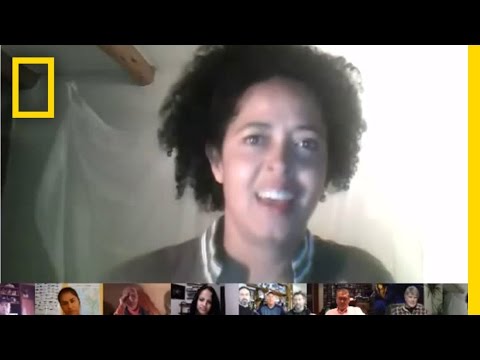
welcome to our google+ hangout
celebrating 125 years of National
Geographic a new age of exploration
starts now hello everyone we are very
excited to have you join us for this
special 125th anniversary of National
Geographic we’re celebrating with a
first or this Google hangout the first
time we’ve been linked to all seven
continents we’ve got National Geographic
explorers around the world would be
talking to and you will have a chance to
ask them questions we’ve got Africa with
Paula Cahoon boo currents in India we’ve
got our critter cam team live in
antarctica Bob Ballard undersea explore
the United States Jane Goodall in
England primatologist we got my culture
you’ve heard from a paleontologist in
Australia Cecilia Mauricio
archaeologists in Peru and so we’re very
excited to have all these people
together and you might ask well what’s
left to explore we’ve been doing this
for a hundred and twenty-five years and
people were doing it even before so Bob
what’s left that we don’t know about
that we haven’t seen on this planet well
you know ironically most of the planet
itself I feel we’re just beginning our
explorations are starting to accelerate
and I expect the next generation to
explore more of earth than all previous
generations combined using this new
advanced technology but I want you to
share what it was like in the bath of
staff when you went down in the little
steel ball deep to the bottom of the
ocean and we’re looking for deep-sea
vents and things what was it like being
inside of that going down tens of
thousands of feet well it can be scary I
mean everything’s fine when everything’s
working it’s when things don’t work that
it gets scary and then all of a sudden
you realize you’re really in a coffin
with a little peep hole in it and you’re
you know you’ve got six hours to get out
of there tell me about the time that
things did not go well then you hear the
creaking and noise and you’re not sure
you’re going to get back up well we were
diving in the Cayman trough on the in a
bath of scath and we were falling very
fast and we thought the bottom wasn’t
nearest yet because we didn’t realize we
were coming down on the side of a giant
volcano and we weren’t picking it up on
our sonar and we actually just crashed
into it and that ruptured our flotation
tank and all of our floatation gasoline
started coming out we were basically
bleeding and we had to get out of there
as fast as we could but it took us six
hours to escape and that whole time we
were we were pretty quiet Jane I think
Bob should go look at the chimpanzees
don’t you well I had the wonderful
opportunity to go to to where she had
done her work I mean I love Africa I’ll
go there any time I spent a lot of time
in Kenya I man I’m an earth scientist so
I love all of Earth just happens that
seventy two percent of its underwater so
you can get me to Africa anytime and
Paula you’re looking at our current
environment in Kenya about it’s sort of
like what’s going on in India how people
and wildlife can coexist in Africa of
course the big part of the economy in
Kenya is making sure that the tourists
come and they want to make sure they’re
still Alliance there how do you convince
the people that it’s good for you to
have lions is a neighbor working just
outside of the city of no rain I
interact with a local community of mosca
traditionally lowlands and just
yesterday we met a family that had lost
one of their sheep to lions and we’re
engaging with this community and
encouraging innovation from the people
themselves and we have a 14 year old boy
who has invented this amazing simple
light flashing system that keeps lands
away from his father’s homestead in this
simple mechanism that cost him ten
dollars to put together when he was 11
years old has now just fed right across
Kenya so what we’ve done is actually not
just provided a solution but
demonstrated that the local community
themselves actually has delusions and so
we’re moving towards really encouraging
recognizing and rewarding local
innovation to an asian community that we
live with wallah sounds like he may be
one of our newest National Geographic
explorers a 14 year old boy used
developed uh on his own with no
instructions or school books or computer
access to learn how to do this develop a
light system to scare away the Lions in
one place that we haven’t done a lot of
exploring just because of the harsh
conditions is Antarctica so we were
trying to get up the connection we have
now got the guys our Crittercam team I
see them sitting down in Antarctica we
just got back from our first leopard
seal recapture and we recovered our
first perk and appointment so what or a
little a little hot and sweaty even
though it’s very cold down here this is
just a little jogging is that the critic
am that you had on the leopard seal that
you’re holding up is that the size of
what you put on it this is yeah this is
the one we just recovered and it ran
over night last night we’re trying to
look at her underwater behavior at night
or hunting behavior at night uh I’ve got
a question of 43 he’s came in from a
Julia and Portugal julia says I’m 18 I
want to work with animals but my parents
consider it a hobby rather than a career
do you find that people don’t understand
what you do now you’ve got a little
advantage Kathy because your father was
also a conservationist you India yeah so
I’m not the typical wildlife biologist
could I saw tigers and leopards when I
was two years old but I would you know I
think this is the typical reaction most
young people face and particularly young
women because you know you’re not taken
seriously for a long time so I would you
know I would like her to just go up to
this and do it if this is what she wants
to do and Jane but when you started you
were you were pioneering that and
National Geographic gave you a grant did
you find it difficult one to convince
the other scientists and researchers
that you could do the job and and the
and the people at home like your parents
well first of all my dream of going to
Africa and living with animals again
when I was 11 everybody laughed at me
girls couldn’t do that sort of thing we
didn’t have any money except my mother
who said if you really want something
and you work hard and you never give up
you find a way
so I got two hands Ania I met Louis
Leakey but the other scientists just
thought of me as a National Geographic
cover girl and I only did what I did
because I had nice legs fortunately I
didn’t really want to be a scientist I
wanted to learn about the chimpanzee and
Hugo and now it came and of course the
geographic founded his amazing
photography and filmmaking cebu finally
the scientist at to agree my worst fight
was persuading people that it wasn’t
only humans who had personalities and
minds and emotions Cecilia well if you
could talk if you could join one of our
other explorers here who would you most
want to follow around for a week and see
what they’re doing if you weren’t doing
archaeology and Peru can I can I can I
choose all of them yes one we go with
everyone this is amazing Eminem and I’m
very excited and very honored to be part
of this really I’m enjoying enjoying
this very much and Mike in Australia is
your favorite place in Austria you spend
a lot of time living in the United
States where’s your favorite place yeah
yeah I couldn’t say it is the United
States I’m gonna do I grew up in
Appalachia and I certainly have
wonderfully fond memories of making
moonshine and plank and banjos in
Appalachia alright have to play the the
places that really plug my heart strings
with Patagonia the remote areas in
Patagonia northern China the rainforests
in Borneo are magical but at the end of
the day when my nose is buried in in
prehistoric worlds that are 25 million
years old and the strangest creatures
are peeping back that’s what gets my
adrenaline running Albert Lin Albert are
you there Albert Lin research scientist
and engineer you’ve done a lot of
climbing and fieldwork what’s the
longest you’ve gone without a shower uh
you know probably about a month it’s
kind of difficult because in Mongolia
you know and when some
hello to you they want to give you a
kiss a lot of times instead of giving
you a kiss they’ll they’ll smell you
they’ll sniff your face because your
soul is represented in you know in your
smell according to the traditions of the
Mongolian people so after a month of not
showering your soul smells a little bit
more authentic there they’re getting the
true essence of you they they’re looking
deep within you you know I would be
being a lot of trouble if I if I didn’t
take this moment or opportunity to tell
Jane that my 12 year old neighbor across
the street ran out this morning
specifically to make sure that I told
you that you’re her hero and you know
her name is pearly oh and she she spends
most of her time volunteering at the
wildlife communities around our
neighborhood and it really makes me you
know think about why for example why I
spend my time as an engineer running
around not showering in Mongolia trying
to do things that are based is based in
exploration and it has to do with that
same moment of inspiration for me when I
was a kid and for her you know she’s
going to go into conservation and
wildlife research because of you know
the influence that you had on her but
for me it’s the heroes of National
Geographic like Alexander Graham Bell
one of the founders national graphic was
an engineer and replying technology out
you know in interesting ways Aziz now
this is a complete new kind of
exploration of what you’re doing and you
would some people say it’s impossible
bringing Jews and Palestinians together
to go learn about each other what’s your
reaction there in Jerusalem to this idea
as you say that’s a new it’s a new
exploration I think you know we talked
about saving the world saving the planet
but we also have to remember if we don’t
save our values and morals and who we
are as a people and kill each other and
we have failed in our exploration so I
see Palestinians and Israelis I grew up
here grab Palestinian and we so similar
yet we don’t know anything about each
other and my first time meeting Israelis
I grew up Palestinian I was so
fascinated by learning different things
and having that interaction you know you
can call it exploring the enemy in
some ways and being able to know each
other makes you less likely to wanna
kill each other basically looks likely
to want to do something against each
other so this is this is what I’m trying
to do and it goes great I’ve had
Israelis and Palestinians kids playing
soccer with each other we’ve had them
going and learning about each other
history visit each other homes eating
with each other learning about each
other and it’s fascinating to see how
people become friends so quickly and you
may have the most amazing story of how
anyone became an explorer I don’t know
if anyone else was brought to it by
country music or explain how that
happened how country music made you an
explorer yes I love country music and it
makes me the weirdest Palestinian ever
over the meat we have this Middle
Eastern at all nobody relates to me here
with that no I I grew up in a family
that was very we didn’t meet anybody on
the other side my brother was killed
when I was 10 years old and so that made
me very much gone to extreme when i was
18 i went to study Hebrew in an open
which is where Jews who moved to Israel
bill to study and we started talking I
didn’t want to talk to anybody i was
sure i’m gonna learn hebrew without
talking to the people there which was
very smart but slowly you know they
force us into conversations and made us
ask questions about what we like and i
was a big fan of country music and i
talked a couple people there who knew
who Johnny Cash is which to me it was
already awesome thing and it was a
through music knotted through politics
not it through you know when we started
talking about music and that took us so
going out for coffee and then getting to
know each other and it was amazing it’s
it’s totally opposite of what you think
often we think it starts with we have to
agree in politics we have to agree and
how things work and who you are who I am
to state once day it’s not it’s relating
to people as a human being that comes
first we’ve gotten as I said we’ve
gotten a lot of questions in on there
that people can send in via Google or
Twitter or Facebook a one of them Kenya
specifically from you from Andrea who
wants to know in these caves need
night situations if you ever been stuck
yeah I’ve been stuck a couple times
never obviously for for too long we dive
alone quite a bit but I try to dive with
other people and I try to dive with
people who are bigger than me I try to
know that can push yeah they go in the
hole first ah that’s that’s even better
they guess if they made it through then
I know I’ll have no problem i just got
to get in front of them on the way out
makes you want to dive with me yeah
that’s right I’m looking I’m looking I’m
always looking for a large framed I
Parkers hey thank you all of you for
joining us for this google+ hangout it’s
been a great step of session talking to
people on all seven continents and
google+ national geographic we do this
every month so guys thank you for
spending a little time with us on this
sunday and getting us inspired to
explore more Jane you’ve been an
inspiration to all of us for many years
and and then Aziz you’re starting out
right more recently but just as
inspiring the stories of of what you’re
doing and what’s your accomplishment so
thanks to all of you see you on the next
one of these thank you bye everybody bye
bye Oh James Jane yes you still there I
can’t let you go sorry give us a chimp
greeting this is the big moment
everybody wants to hear you do the chimp
say goodbye in chimpanzee well it’s a
greeting really they don’t say goodbye
but the greeting to all of you
celebrating 125 years of National
Geographic a new age of exploration
starts now hello everyone we are very
excited to have you join us for this
special 125th anniversary of National
Geographic we’re celebrating with a
first or this Google hangout the first
time we’ve been linked to all seven
continents we’ve got National Geographic
explorers around the world would be
talking to and you will have a chance to
ask them questions we’ve got Africa with
Paula Cahoon boo currents in India we’ve
got our critter cam team live in
antarctica Bob Ballard undersea explore
the United States Jane Goodall in
England primatologist we got my culture
you’ve heard from a paleontologist in
Australia Cecilia Mauricio
archaeologists in Peru and so we’re very
excited to have all these people
together and you might ask well what’s
left to explore we’ve been doing this
for a hundred and twenty-five years and
people were doing it even before so Bob
what’s left that we don’t know about
that we haven’t seen on this planet well
you know ironically most of the planet
itself I feel we’re just beginning our
explorations are starting to accelerate
and I expect the next generation to
explore more of earth than all previous
generations combined using this new
advanced technology but I want you to
share what it was like in the bath of
staff when you went down in the little
steel ball deep to the bottom of the
ocean and we’re looking for deep-sea
vents and things what was it like being
inside of that going down tens of
thousands of feet well it can be scary I
mean everything’s fine when everything’s
working it’s when things don’t work that
it gets scary and then all of a sudden
you realize you’re really in a coffin
with a little peep hole in it and you’re
you know you’ve got six hours to get out
of there tell me about the time that
things did not go well then you hear the
creaking and noise and you’re not sure
you’re going to get back up well we were
diving in the Cayman trough on the in a
bath of scath and we were falling very
fast and we thought the bottom wasn’t
nearest yet because we didn’t realize we
were coming down on the side of a giant
volcano and we weren’t picking it up on
our sonar and we actually just crashed
into it and that ruptured our flotation
tank and all of our floatation gasoline
started coming out we were basically
bleeding and we had to get out of there
as fast as we could but it took us six
hours to escape and that whole time we
were we were pretty quiet Jane I think
Bob should go look at the chimpanzees
don’t you well I had the wonderful
opportunity to go to to where she had
done her work I mean I love Africa I’ll
go there any time I spent a lot of time
in Kenya I man I’m an earth scientist so
I love all of Earth just happens that
seventy two percent of its underwater so
you can get me to Africa anytime and
Paula you’re looking at our current
environment in Kenya about it’s sort of
like what’s going on in India how people
and wildlife can coexist in Africa of
course the big part of the economy in
Kenya is making sure that the tourists
come and they want to make sure they’re
still Alliance there how do you convince
the people that it’s good for you to
have lions is a neighbor working just
outside of the city of no rain I
interact with a local community of mosca
traditionally lowlands and just
yesterday we met a family that had lost
one of their sheep to lions and we’re
engaging with this community and
encouraging innovation from the people
themselves and we have a 14 year old boy
who has invented this amazing simple
light flashing system that keeps lands
away from his father’s homestead in this
simple mechanism that cost him ten
dollars to put together when he was 11
years old has now just fed right across
Kenya so what we’ve done is actually not
just provided a solution but
demonstrated that the local community
themselves actually has delusions and so
we’re moving towards really encouraging
recognizing and rewarding local
innovation to an asian community that we
live with wallah sounds like he may be
one of our newest National Geographic
explorers a 14 year old boy used
developed uh on his own with no
instructions or school books or computer
access to learn how to do this develop a
light system to scare away the Lions in
one place that we haven’t done a lot of
exploring just because of the harsh
conditions is Antarctica so we were
trying to get up the connection we have
now got the guys our Crittercam team I
see them sitting down in Antarctica we
just got back from our first leopard
seal recapture and we recovered our
first perk and appointment so what or a
little a little hot and sweaty even
though it’s very cold down here this is
just a little jogging is that the critic
am that you had on the leopard seal that
you’re holding up is that the size of
what you put on it this is yeah this is
the one we just recovered and it ran
over night last night we’re trying to
look at her underwater behavior at night
or hunting behavior at night uh I’ve got
a question of 43 he’s came in from a
Julia and Portugal julia says I’m 18 I
want to work with animals but my parents
consider it a hobby rather than a career
do you find that people don’t understand
what you do now you’ve got a little
advantage Kathy because your father was
also a conservationist you India yeah so
I’m not the typical wildlife biologist
could I saw tigers and leopards when I
was two years old but I would you know I
think this is the typical reaction most
young people face and particularly young
women because you know you’re not taken
seriously for a long time so I would you
know I would like her to just go up to
this and do it if this is what she wants
to do and Jane but when you started you
were you were pioneering that and
National Geographic gave you a grant did
you find it difficult one to convince
the other scientists and researchers
that you could do the job and and the
and the people at home like your parents
well first of all my dream of going to
Africa and living with animals again
when I was 11 everybody laughed at me
girls couldn’t do that sort of thing we
didn’t have any money except my mother
who said if you really want something
and you work hard and you never give up
you find a way
so I got two hands Ania I met Louis
Leakey but the other scientists just
thought of me as a National Geographic
cover girl and I only did what I did
because I had nice legs fortunately I
didn’t really want to be a scientist I
wanted to learn about the chimpanzee and
Hugo and now it came and of course the
geographic founded his amazing
photography and filmmaking cebu finally
the scientist at to agree my worst fight
was persuading people that it wasn’t
only humans who had personalities and
minds and emotions Cecilia well if you
could talk if you could join one of our
other explorers here who would you most
want to follow around for a week and see
what they’re doing if you weren’t doing
archaeology and Peru can I can I can I
choose all of them yes one we go with
everyone this is amazing Eminem and I’m
very excited and very honored to be part
of this really I’m enjoying enjoying
this very much and Mike in Australia is
your favorite place in Austria you spend
a lot of time living in the United
States where’s your favorite place yeah
yeah I couldn’t say it is the United
States I’m gonna do I grew up in
Appalachia and I certainly have
wonderfully fond memories of making
moonshine and plank and banjos in
Appalachia alright have to play the the
places that really plug my heart strings
with Patagonia the remote areas in
Patagonia northern China the rainforests
in Borneo are magical but at the end of
the day when my nose is buried in in
prehistoric worlds that are 25 million
years old and the strangest creatures
are peeping back that’s what gets my
adrenaline running Albert Lin Albert are
you there Albert Lin research scientist
and engineer you’ve done a lot of
climbing and fieldwork what’s the
longest you’ve gone without a shower uh
you know probably about a month it’s
kind of difficult because in Mongolia
you know and when some
hello to you they want to give you a
kiss a lot of times instead of giving
you a kiss they’ll they’ll smell you
they’ll sniff your face because your
soul is represented in you know in your
smell according to the traditions of the
Mongolian people so after a month of not
showering your soul smells a little bit
more authentic there they’re getting the
true essence of you they they’re looking
deep within you you know I would be
being a lot of trouble if I if I didn’t
take this moment or opportunity to tell
Jane that my 12 year old neighbor across
the street ran out this morning
specifically to make sure that I told
you that you’re her hero and you know
her name is pearly oh and she she spends
most of her time volunteering at the
wildlife communities around our
neighborhood and it really makes me you
know think about why for example why I
spend my time as an engineer running
around not showering in Mongolia trying
to do things that are based is based in
exploration and it has to do with that
same moment of inspiration for me when I
was a kid and for her you know she’s
going to go into conservation and
wildlife research because of you know
the influence that you had on her but
for me it’s the heroes of National
Geographic like Alexander Graham Bell
one of the founders national graphic was
an engineer and replying technology out
you know in interesting ways Aziz now
this is a complete new kind of
exploration of what you’re doing and you
would some people say it’s impossible
bringing Jews and Palestinians together
to go learn about each other what’s your
reaction there in Jerusalem to this idea
as you say that’s a new it’s a new
exploration I think you know we talked
about saving the world saving the planet
but we also have to remember if we don’t
save our values and morals and who we
are as a people and kill each other and
we have failed in our exploration so I
see Palestinians and Israelis I grew up
here grab Palestinian and we so similar
yet we don’t know anything about each
other and my first time meeting Israelis
I grew up Palestinian I was so
fascinated by learning different things
and having that interaction you know you
can call it exploring the enemy in
some ways and being able to know each
other makes you less likely to wanna
kill each other basically looks likely
to want to do something against each
other so this is this is what I’m trying
to do and it goes great I’ve had
Israelis and Palestinians kids playing
soccer with each other we’ve had them
going and learning about each other
history visit each other homes eating
with each other learning about each
other and it’s fascinating to see how
people become friends so quickly and you
may have the most amazing story of how
anyone became an explorer I don’t know
if anyone else was brought to it by
country music or explain how that
happened how country music made you an
explorer yes I love country music and it
makes me the weirdest Palestinian ever
over the meat we have this Middle
Eastern at all nobody relates to me here
with that no I I grew up in a family
that was very we didn’t meet anybody on
the other side my brother was killed
when I was 10 years old and so that made
me very much gone to extreme when i was
18 i went to study Hebrew in an open
which is where Jews who moved to Israel
bill to study and we started talking I
didn’t want to talk to anybody i was
sure i’m gonna learn hebrew without
talking to the people there which was
very smart but slowly you know they
force us into conversations and made us
ask questions about what we like and i
was a big fan of country music and i
talked a couple people there who knew
who Johnny Cash is which to me it was
already awesome thing and it was a
through music knotted through politics
not it through you know when we started
talking about music and that took us so
going out for coffee and then getting to
know each other and it was amazing it’s
it’s totally opposite of what you think
often we think it starts with we have to
agree in politics we have to agree and
how things work and who you are who I am
to state once day it’s not it’s relating
to people as a human being that comes
first we’ve gotten as I said we’ve
gotten a lot of questions in on there
that people can send in via Google or
Twitter or Facebook a one of them Kenya
specifically from you from Andrea who
wants to know in these caves need
night situations if you ever been stuck
yeah I’ve been stuck a couple times
never obviously for for too long we dive
alone quite a bit but I try to dive with
other people and I try to dive with
people who are bigger than me I try to
know that can push yeah they go in the
hole first ah that’s that’s even better
they guess if they made it through then
I know I’ll have no problem i just got
to get in front of them on the way out
makes you want to dive with me yeah
that’s right I’m looking I’m looking I’m
always looking for a large framed I
Parkers hey thank you all of you for
joining us for this google+ hangout it’s
been a great step of session talking to
people on all seven continents and
google+ national geographic we do this
every month so guys thank you for
spending a little time with us on this
sunday and getting us inspired to
explore more Jane you’ve been an
inspiration to all of us for many years
and and then Aziz you’re starting out
right more recently but just as
inspiring the stories of of what you’re
doing and what’s your accomplishment so
thanks to all of you see you on the next
one of these thank you bye everybody bye
bye Oh James Jane yes you still there I
can’t let you go sorry give us a chimp
greeting this is the big moment
everybody wants to hear you do the chimp
say goodbye in chimpanzee well it’s a
greeting really they don’t say goodbye
but the greeting to all of you
Please follow and like us: