
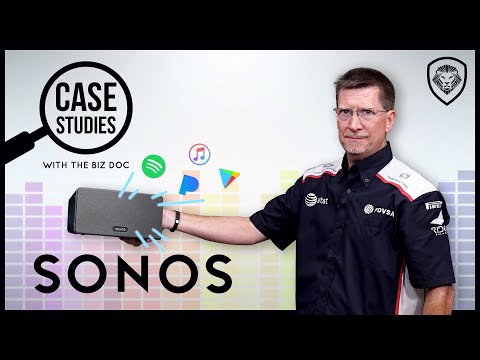
this week on key studies with the biz
doc it’s so knows the wireless speaker
company that just went public on the
stock market and as you saw they had a
pretty good first day I’m gonna take you
through the history tell you where I
think they’re going and the pitfalls
along the way so knows I’m going to take
you through number one the history of
the company
number two the product line and what led
to the IPO and number three the pitfalls
that I think they’re gonna face in the
future let’s start with the history the
company was founded out in Santa Barbara
California
not exactly Silicon Valley and not
exactly Boston where a lot of very
famous audio companies are based for
guys got together John McFarlane Craig
Shelburne who is currently still the CFO
Tom Cohen with vice-president sales
marketing at the moment and Trung my
those four guys got together Santa
Barbara California with a vision to
create a wireless company they made what
I call an insta pivot now what a pivot
is is when a start-up company take six
expertise you know the people the
founders of people at the brains and the
technology that they built and they
apply that in a slightly different
direction it happens a lot with startups
in this case they started with the dream
to build a wireless technology that
quickly became wireless audio so bit of
what I would call an insta pivot how did
they do with that pivot I’m glad you
asked they went to the CES which stands
for Consumer Electronic Show which is
the annual gathering of all things
consumer electronics in Las Vegas where
speakers TV all kinds of things mobile
phones come together with the latest
designs and technologies that you and I
are going to be seeing at Best Buy
Amazon and all those places very soon at
the CES show they got an award in a for
for the best new audio product quite a
thing to get when you’d only founded the
company back in 2002 but after that
pivot into wireless speakers the success
was there proven by the award at CES
like most young companies they followed
that up with additional entrance into
their product line and raising money
along the way let’s take a look how the
history played out in 2005 they actually
raised thirty five million dollars in
additional venture capital and
introduced the zp 100
the CP 100 was an amp that was Wireless
in its reception but then would connect
to your existing wired speakers in your
house it would later be known as the
connect amp and then the CP 80 which
would later be known as the connect
device which is a wireless distribution
module that goes into your house in 2007
they raised six more million dollars and
that was about the time that these two
products were rebranded with their new
product name so they’re still around
today and you may have those in your
house I have a connect amp in my house
connected to some very high-end speakers
that I bought long ago that I don’t want
to give up but thanks to this app all my
wireless music comes into it and then it
feeds out to the speakers and I control
it from the app right on my phone really
cool stuff where old meets new and stays
useful and relevant and more importantly
I keep enjoying music they followed
those products up with a speaker that
I’m sure is recognizable to everyone in
2010 that play 5 about that same time
they raised 25 million dollars from
Index Ventures so now not only they
putting out phenomenal products they’re
dealing with Tier one venture capital
money the play 5 speaker may recall was
about this big and helped connect you to
music services like Spotify and Pandora
so from your phone you could control the
music source you wanted and it would
play through the speaker that would
offer it incredible highly resonant bass
beautiful beautiful tones and just
filled the room with sound where you
said I can’t believe that’s just a
wireless speaker
you got great speaker quality and a
wireless package and that became what
Sonos brand would be known for as they
move forward a year later they
introduced the play 3 which is a little
bit smaller then the sub the subwoofer
fantastic product I have one in my home
theater room and it is absolutely
amazing the deep bass that comes out of
it best of all there’s no wires because
I plug it in connect it to the wireless
network it Tunes through the app to the
audio qualities of the room which is an
incredible feature that Sonos offers on
that app and you’re off and running
fantastic fantastic product they also
raised a fantastic amount of money that
year almost two hundred and thirty four
million dollars in two separate rounds
and
with KKR Kohlberg Kravis Roberts again
high-end money coming forward and
dropping in to be part of the overall
picture a year later they introduced the
play bar the play bar is meant to sit in
a room with the TV and a couple other
sonal speakers give you kind of a home
theater experience in addition to the
sub they also raised twenty five million
dollars that was 2013 a year later in
2014 they raised another hundred and
thirty million dollars also led Kohlberg
Kravis Roberts so KKR is now got a lot
of money in this thing and they’re gonna
want to see that money come out which is
one of the purposes of an IPO for the
investors get paid back as the company
floats on the public market about that
same time that you’re introduced the
play 1 which is a small speaker which is
more affordable and also a lot of the
volume sales to go up because now people
with apartments or smaller homes we get
to play ones and put them with a medium
sized flat-screen TV or in a small
bedroom now I’m going to transition for
a moment from talking about the venture
capital money and the product
introductions and look at this blue and
orange line here that talk about the
unit sales per year and the number of
households that had more than one Sonos
product I got this information out of
the s-1 the s-1 is a very important
document that’s available for public
inspection you me we can go to dub dub
dub SEC gov and read it we can read what
they say about the market what they say
about their product their history and
the risk going forward the link to the
Sonos s1 at sec gov is contained down in
the description so go take a look at it
I think it’s a great piece of Education
for any entrepreneur to read an s-1
about a company that interests you why
because it helps you understand on a
grand scale because that’s one’s usually
about this thick what your 10 page pitch
deck should look like because you need
to be answering those same types of
questions for the investors that you’re
inviting to come along for the ride in
your company so what are those unit
sales look like well in 2013 they sold
about 2 million individual units and
they had a little bit more than 2
million households that had more than
one but watch what happens in the future
years in 2014
they moved a little over two and a half
million units and they were getting
close to three million households with
more than one then as you can see
take a look remember I talked about the
play one a smaller more affordable
speaker looks what happens to volume
play one comes out more affordable
products on the market more people buy
it unit sales gets up to almost four
million and we’ve got a little over four
million households with more than one
then we stay at four million in 16 and
17 and the Sonos one and the play base
come out along with the play five series
two additional products out opening up
the product line and suddenly we are at
over four million annual units remember
this orange line is the annual units
when you sell products hardware products
every year you start over was zero and
then you get the end of the year find
out how many is sold it’s not like
subscription music where you keep
putting subscribers on top of
subscribers this is a tough trick
hardware is a bloody business and it’s
very tough to be a hardware company as
GoPro Fitbit and Roku have found out now
regardless of the flatness of the line
than a little peak up here in annual
unit sales by the time they reach 2018
there are 7 million households that have
more than one Sonos device as a matter
of fact there’s also information they
published of exactly what that
distribution is and let’s take a look at
it right here
I built this chart here shows that 39%
of the households that have a Sonos
product have one 21% have two 13% of
three 10% have for 17% at five or if you
look at the ones that have two or more
6040 about a 60/40 split which is pretty
amazing must be nice to have a hardware
company where 60% of your customers
actually bought more than one I think
that’s a good thing and probably one of
the things that’s really driving Sonos
going public let’s think about that for
a second when you get repeat customers
if you’re selling soda pop or bubblegum
okay that’s okay but what about when
you’re selling speakers that are
hundreds of dollars your products got to
be good your brands got to be good the
whole thing has to come together and
when you consider that 60% of the SONA
customers have two three four or five
products in their house not just one I
think there’s only one word for that and
that is damn that is phenomenally good
brand loyalty
as for the biz doc household I have
eight now let’s step a little bit into
the financials we’ve now seen the unit
sales we would expect some financials to
be up and if you’re going to go public
we expect those financials to be strong
well again going back to the s-1 we get
a lot of detail let’s look at revenue
operating income net income which
includes taxes and debt payments if
there are any and then ebody and I’ll
talk about how they present a bit up
because in the Sonos s1 they very
carefully say that this is adjusted
ebody I tend to look at those things
very carefully revenue pretty straight
forward 843 – 900 – 992 in each of the
years 15 16 17 and right now here in
2018 as they’re getting ready to go
public here in July they have trailing
12 months TTM of 1 billion meaning
looking back 12 months they’ve achieved
a billion dollars in sales so you would
assume that for this fiscal year they’re
probably going to come in at 1 point 1
billion or something like that
that’s what the markets gonna be looking
for especially the way they presented
revenue in the s1 operating income well
you see these red parentheses that means
loss but as you can see the loss is
decreasing over time so what thinking is
once they go public and they keep
getting revenue up like this and unit
sales go up you would expect this to go
away to be a positive healthy company
that’s making money operating income so
they lost 55 on 8:43 net income when you
add in taxes and everything that was a
loss of 68 because from operating income
the net income this usually gets bigger
when you apply taxes operating income
here lost 30 on 938 at net income line
then 992 lost 15 operating income but
they made interest here and it came in a
little less at losing only 14 these are
all in millions by the way now EBIT up
they did the adjusted e but us saying
they had minus 4 million adjusted Iveta
but then 29 million in e better here and
56 million
EBIT of here which seems to bode well
but as we step back and look at
this doesn’t feel like a company running
like a freight train of growth now 11 to
18% growth is what we’re looking at here
is pretty healthy but we’re also not
seeing the scaling of profits that would
indicate this is really going to be
churning out profits on an EPS earnings
per share basis of course there’s been
companies like Twitter that went out
there with multi-billion dollar
valuation
having losses for years and years Amazon
did that too and most recently they had
a quarter with 2.3 billion dollars in
profits after all those years with the
market saying when are you ever gonna
make a profit
who knows where Sonos is going to go but
as I said a minute ago
Fitbit Roku and GoPro have all found
that being in the hardware business with
Chinese competition knockoffs and
pressure from retailers hardware is a
tough market to be in so what do I think
about their potential let’s go take a
look on the positive side is the brand
you talk to anybody that owns a so knows
product they’ve got great brand affinity
they also have great product quality and
a very broad product line from a small
room to a big room to a beam or play bar
for your TV to a subwoofer they have a
nice selection of products that seems to
fit however they’re also there at Best
Buy and online at Amazon where they’re
getting a lot of pressure one of those
pieces of pressure isn’t necessarily in
pricing but I found it in the s-1 they
were talking about the new Sonos one
which has Alexa integration with Amazon
where you could say hey Alexa reorder me
that shirt hey Alexa changed this song
to this song so you have the full
integration and the Sonos speaker
similar to what the Amazon echo product
line has but in the s-1 it said our
agreement with Amazon enables Amazon to
basically cancel the smart integration
with our hardware products without
notice meaning very limited notice they
could simply say hey we don’t want to do
this anymore
and in a matter of a month or two months
apparently Sonos has to pull it back off
the market that’s a big risk especially
if Amazon just decides it wants to make
its own line of wireless speakers it
already has
wireless speakers not necessarily
high-end audio speakers like Sonos is
making but it doesn’t seem to be a large
leap for Amazon to think like that
nonetheless that’s one of the risks and
that’s why reading an s-1 can be so
important and so educational because by
law you have to faithfully present all
of the risk factors in a fair and
understandable way for public inspection
so the document can be read before you
actually float the offering on the stock
market so on the surface you would think
that’s a pretty strong set of positives
and I do think it is from brand to
product quality to product line then you
get down to the negatives I just talked
about smart speakers and I looked at
weak financials so what happens if they
face pricing pressure they don’t exactly
have super strong financials over those
first couple quarters we’re gonna want
to see good unit sales that drives
revenue nice flat expenses that scale
nicely enabling them to turn in good I
beta and net income performance nice
earnings per share profits on the market
or are they going to be pushed a little
too hard by these competitive storms and
have losses it’s hard to be a hardware
company on the stock market these days
and it takes a special CEO just ask
GoPro I did a case study about him and
if you want to see that there’s a link
down below as a matter of fact a year
ago John McFarlane stepped aside to
allow Patrick Spence to become the new
CEO in anticipation of going public it
was also an anticipation of these
investors wanting to get money back part
of an initial public offering is really
the next financing and that next
financing is where when it’s sold on the
stock market the proceeds that come in
come to the company but also people
selling stock out onto the market where
investors like you and me and
institutions are buying it that’s where
they get their return or all of these
four hundred and fifty five million
dollars that were put into the company
will come back as those investors sell
their stock onto the market for new
investors bhaiyya
and that completes sort of the circle of
life from what they call end to end from
a start up receiving investment from
investors to the investors recouping
either through the company being sold or
at going public
that’s what I think but I want to know
what you think leave me a comment below
and let me know your thoughts on Sonos
and their IPO or suggest a company that
I could do a case study on in the future
you can also find me on social media on
Facebook Twitter or Instagram please
subscribe the value tainment we love you
and we’re on a mission to a million
subscribers and when we get there it
will be the first annual value tainment
entrepreneur conference featuring
Patrick Beth David yours truly the biz
doc and other leaders bringing great
lessons to you to make you better your
company better and the people that you
touch better still until next time I’m
Tom Merritt the biz doc and I hope I left you better than I found you
doc it’s so knows the wireless speaker
company that just went public on the
stock market and as you saw they had a
pretty good first day I’m gonna take you
through the history tell you where I
think they’re going and the pitfalls
along the way so knows I’m going to take
you through number one the history of
the company
number two the product line and what led
to the IPO and number three the pitfalls
that I think they’re gonna face in the
future let’s start with the history the
company was founded out in Santa Barbara
California
not exactly Silicon Valley and not
exactly Boston where a lot of very
famous audio companies are based for
guys got together John McFarlane Craig
Shelburne who is currently still the CFO
Tom Cohen with vice-president sales
marketing at the moment and Trung my
those four guys got together Santa
Barbara California with a vision to
create a wireless company they made what
I call an insta pivot now what a pivot
is is when a start-up company take six
expertise you know the people the
founders of people at the brains and the
technology that they built and they
apply that in a slightly different
direction it happens a lot with startups
in this case they started with the dream
to build a wireless technology that
quickly became wireless audio so bit of
what I would call an insta pivot how did
they do with that pivot I’m glad you
asked they went to the CES which stands
for Consumer Electronic Show which is
the annual gathering of all things
consumer electronics in Las Vegas where
speakers TV all kinds of things mobile
phones come together with the latest
designs and technologies that you and I
are going to be seeing at Best Buy
Amazon and all those places very soon at
the CES show they got an award in a for
for the best new audio product quite a
thing to get when you’d only founded the
company back in 2002 but after that
pivot into wireless speakers the success
was there proven by the award at CES
like most young companies they followed
that up with additional entrance into
their product line and raising money
along the way let’s take a look how the
history played out in 2005 they actually
raised thirty five million dollars in
additional venture capital and
introduced the zp 100
the CP 100 was an amp that was Wireless
in its reception but then would connect
to your existing wired speakers in your
house it would later be known as the
connect amp and then the CP 80 which
would later be known as the connect
device which is a wireless distribution
module that goes into your house in 2007
they raised six more million dollars and
that was about the time that these two
products were rebranded with their new
product name so they’re still around
today and you may have those in your
house I have a connect amp in my house
connected to some very high-end speakers
that I bought long ago that I don’t want
to give up but thanks to this app all my
wireless music comes into it and then it
feeds out to the speakers and I control
it from the app right on my phone really
cool stuff where old meets new and stays
useful and relevant and more importantly
I keep enjoying music they followed
those products up with a speaker that
I’m sure is recognizable to everyone in
2010 that play 5 about that same time
they raised 25 million dollars from
Index Ventures so now not only they
putting out phenomenal products they’re
dealing with Tier one venture capital
money the play 5 speaker may recall was
about this big and helped connect you to
music services like Spotify and Pandora
so from your phone you could control the
music source you wanted and it would
play through the speaker that would
offer it incredible highly resonant bass
beautiful beautiful tones and just
filled the room with sound where you
said I can’t believe that’s just a
wireless speaker
you got great speaker quality and a
wireless package and that became what
Sonos brand would be known for as they
move forward a year later they
introduced the play 3 which is a little
bit smaller then the sub the subwoofer
fantastic product I have one in my home
theater room and it is absolutely
amazing the deep bass that comes out of
it best of all there’s no wires because
I plug it in connect it to the wireless
network it Tunes through the app to the
audio qualities of the room which is an
incredible feature that Sonos offers on
that app and you’re off and running
fantastic fantastic product they also
raised a fantastic amount of money that
year almost two hundred and thirty four
million dollars in two separate rounds
and
with KKR Kohlberg Kravis Roberts again
high-end money coming forward and
dropping in to be part of the overall
picture a year later they introduced the
play bar the play bar is meant to sit in
a room with the TV and a couple other
sonal speakers give you kind of a home
theater experience in addition to the
sub they also raised twenty five million
dollars that was 2013 a year later in
2014 they raised another hundred and
thirty million dollars also led Kohlberg
Kravis Roberts so KKR is now got a lot
of money in this thing and they’re gonna
want to see that money come out which is
one of the purposes of an IPO for the
investors get paid back as the company
floats on the public market about that
same time that you’re introduced the
play 1 which is a small speaker which is
more affordable and also a lot of the
volume sales to go up because now people
with apartments or smaller homes we get
to play ones and put them with a medium
sized flat-screen TV or in a small
bedroom now I’m going to transition for
a moment from talking about the venture
capital money and the product
introductions and look at this blue and
orange line here that talk about the
unit sales per year and the number of
households that had more than one Sonos
product I got this information out of
the s-1 the s-1 is a very important
document that’s available for public
inspection you me we can go to dub dub
dub SEC gov and read it we can read what
they say about the market what they say
about their product their history and
the risk going forward the link to the
Sonos s1 at sec gov is contained down in
the description so go take a look at it
I think it’s a great piece of Education
for any entrepreneur to read an s-1
about a company that interests you why
because it helps you understand on a
grand scale because that’s one’s usually
about this thick what your 10 page pitch
deck should look like because you need
to be answering those same types of
questions for the investors that you’re
inviting to come along for the ride in
your company so what are those unit
sales look like well in 2013 they sold
about 2 million individual units and
they had a little bit more than 2
million households that had more than
one but watch what happens in the future
years in 2014
they moved a little over two and a half
million units and they were getting
close to three million households with
more than one then as you can see
take a look remember I talked about the
play one a smaller more affordable
speaker looks what happens to volume
play one comes out more affordable
products on the market more people buy
it unit sales gets up to almost four
million and we’ve got a little over four
million households with more than one
then we stay at four million in 16 and
17 and the Sonos one and the play base
come out along with the play five series
two additional products out opening up
the product line and suddenly we are at
over four million annual units remember
this orange line is the annual units
when you sell products hardware products
every year you start over was zero and
then you get the end of the year find
out how many is sold it’s not like
subscription music where you keep
putting subscribers on top of
subscribers this is a tough trick
hardware is a bloody business and it’s
very tough to be a hardware company as
GoPro Fitbit and Roku have found out now
regardless of the flatness of the line
than a little peak up here in annual
unit sales by the time they reach 2018
there are 7 million households that have
more than one Sonos device as a matter
of fact there’s also information they
published of exactly what that
distribution is and let’s take a look at
it right here
I built this chart here shows that 39%
of the households that have a Sonos
product have one 21% have two 13% of
three 10% have for 17% at five or if you
look at the ones that have two or more
6040 about a 60/40 split which is pretty
amazing must be nice to have a hardware
company where 60% of your customers
actually bought more than one I think
that’s a good thing and probably one of
the things that’s really driving Sonos
going public let’s think about that for
a second when you get repeat customers
if you’re selling soda pop or bubblegum
okay that’s okay but what about when
you’re selling speakers that are
hundreds of dollars your products got to
be good your brands got to be good the
whole thing has to come together and
when you consider that 60% of the SONA
customers have two three four or five
products in their house not just one I
think there’s only one word for that and
that is damn that is phenomenally good
brand loyalty
as for the biz doc household I have
eight now let’s step a little bit into
the financials we’ve now seen the unit
sales we would expect some financials to
be up and if you’re going to go public
we expect those financials to be strong
well again going back to the s-1 we get
a lot of detail let’s look at revenue
operating income net income which
includes taxes and debt payments if
there are any and then ebody and I’ll
talk about how they present a bit up
because in the Sonos s1 they very
carefully say that this is adjusted
ebody I tend to look at those things
very carefully revenue pretty straight
forward 843 – 900 – 992 in each of the
years 15 16 17 and right now here in
2018 as they’re getting ready to go
public here in July they have trailing
12 months TTM of 1 billion meaning
looking back 12 months they’ve achieved
a billion dollars in sales so you would
assume that for this fiscal year they’re
probably going to come in at 1 point 1
billion or something like that
that’s what the markets gonna be looking
for especially the way they presented
revenue in the s1 operating income well
you see these red parentheses that means
loss but as you can see the loss is
decreasing over time so what thinking is
once they go public and they keep
getting revenue up like this and unit
sales go up you would expect this to go
away to be a positive healthy company
that’s making money operating income so
they lost 55 on 8:43 net income when you
add in taxes and everything that was a
loss of 68 because from operating income
the net income this usually gets bigger
when you apply taxes operating income
here lost 30 on 938 at net income line
then 992 lost 15 operating income but
they made interest here and it came in a
little less at losing only 14 these are
all in millions by the way now EBIT up
they did the adjusted e but us saying
they had minus 4 million adjusted Iveta
but then 29 million in e better here and
56 million
EBIT of here which seems to bode well
but as we step back and look at
this doesn’t feel like a company running
like a freight train of growth now 11 to
18% growth is what we’re looking at here
is pretty healthy but we’re also not
seeing the scaling of profits that would
indicate this is really going to be
churning out profits on an EPS earnings
per share basis of course there’s been
companies like Twitter that went out
there with multi-billion dollar
valuation
having losses for years and years Amazon
did that too and most recently they had
a quarter with 2.3 billion dollars in
profits after all those years with the
market saying when are you ever gonna
make a profit
who knows where Sonos is going to go but
as I said a minute ago
Fitbit Roku and GoPro have all found
that being in the hardware business with
Chinese competition knockoffs and
pressure from retailers hardware is a
tough market to be in so what do I think
about their potential let’s go take a
look on the positive side is the brand
you talk to anybody that owns a so knows
product they’ve got great brand affinity
they also have great product quality and
a very broad product line from a small
room to a big room to a beam or play bar
for your TV to a subwoofer they have a
nice selection of products that seems to
fit however they’re also there at Best
Buy and online at Amazon where they’re
getting a lot of pressure one of those
pieces of pressure isn’t necessarily in
pricing but I found it in the s-1 they
were talking about the new Sonos one
which has Alexa integration with Amazon
where you could say hey Alexa reorder me
that shirt hey Alexa changed this song
to this song so you have the full
integration and the Sonos speaker
similar to what the Amazon echo product
line has but in the s-1 it said our
agreement with Amazon enables Amazon to
basically cancel the smart integration
with our hardware products without
notice meaning very limited notice they
could simply say hey we don’t want to do
this anymore
and in a matter of a month or two months
apparently Sonos has to pull it back off
the market that’s a big risk especially
if Amazon just decides it wants to make
its own line of wireless speakers it
already has
wireless speakers not necessarily
high-end audio speakers like Sonos is
making but it doesn’t seem to be a large
leap for Amazon to think like that
nonetheless that’s one of the risks and
that’s why reading an s-1 can be so
important and so educational because by
law you have to faithfully present all
of the risk factors in a fair and
understandable way for public inspection
so the document can be read before you
actually float the offering on the stock
market so on the surface you would think
that’s a pretty strong set of positives
and I do think it is from brand to
product quality to product line then you
get down to the negatives I just talked
about smart speakers and I looked at
weak financials so what happens if they
face pricing pressure they don’t exactly
have super strong financials over those
first couple quarters we’re gonna want
to see good unit sales that drives
revenue nice flat expenses that scale
nicely enabling them to turn in good I
beta and net income performance nice
earnings per share profits on the market
or are they going to be pushed a little
too hard by these competitive storms and
have losses it’s hard to be a hardware
company on the stock market these days
and it takes a special CEO just ask
GoPro I did a case study about him and
if you want to see that there’s a link
down below as a matter of fact a year
ago John McFarlane stepped aside to
allow Patrick Spence to become the new
CEO in anticipation of going public it
was also an anticipation of these
investors wanting to get money back part
of an initial public offering is really
the next financing and that next
financing is where when it’s sold on the
stock market the proceeds that come in
come to the company but also people
selling stock out onto the market where
investors like you and me and
institutions are buying it that’s where
they get their return or all of these
four hundred and fifty five million
dollars that were put into the company
will come back as those investors sell
their stock onto the market for new
investors bhaiyya
and that completes sort of the circle of
life from what they call end to end from
a start up receiving investment from
investors to the investors recouping
either through the company being sold or
at going public
that’s what I think but I want to know
what you think leave me a comment below
and let me know your thoughts on Sonos
and their IPO or suggest a company that
I could do a case study on in the future
you can also find me on social media on
Facebook Twitter or Instagram please
subscribe the value tainment we love you
and we’re on a mission to a million
subscribers and when we get there it
will be the first annual value tainment
entrepreneur conference featuring
Patrick Beth David yours truly the biz
doc and other leaders bringing great
lessons to you to make you better your
company better and the people that you
touch better still until next time I’m
Tom Merritt the biz doc and I hope I left you better than I found you
Please follow and like us: