
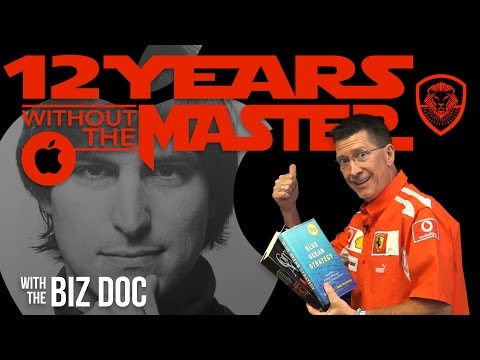
hello everyone welcome back to case
studies with the biz doc this week I’m
going to take a look at strategy and
this is a request that many people had
they wanted to know what exactly
happened to Apple during those 12 years
we’ve read this book or read that book
but what do you think was the essence of
what happened between the point that
Steve Jobs left and the point that he
got back and I call it 12 years of
searching for the right strategy and I’m
going to take a look at blue ocean
strategy and a few other things this
week as we look into strategy to the
lens of 12 years of Apple there’s two
things that I hope you take away this
week and the first thing is it’s never
too late to get strategy right it was 12
years of wandering when Steve Jobs
refocused the company while he
restructured then he refocused then
introduced new products all within a
very very laser focused strategy that he
had and before that there was just this
wandering in the wilderness which may
have been some people who saw Apple
during that time but I think you’re
going to see what I mean so there’s 0.1
says it’s never too late to get strategy
right and point two is as we’ve learned
from Steve Jobs and others product
visionaries are rare and at times we
need to find ways that we can manage
them better they may not conform to pure
corporate culture but if you find the
way that you can get your horse
whisperer as I used to say get the
whisperer that can work with gifted
product strategists that know what
they’re doing then you strike gold in a
corporate environment that may be hard
to do so let’s take a look at Apple
first of all for those of you who maybe
weren’t even born when it happened way
way back in 1983 Steve Jobs goes and
recruits John Sculley who at the time
was the CMO of Pepsi and if you’ve read
the books there’s the familiar thing
where Steve Jobs says to John Sculley do
you want to just sell sugared water or
do you want to change the world
now I’m paraphrasing the quote but it
was a very bold statement that he made
the Scully and Scully says ok I’m in
well within two years in the middle of
85
if Steve Jobs was pushing the Macintosh
division this way the Apple 2 division
was kind of going this way John Sculley
had you know thoughts he had and the
board says man you got to get control of
Steve Jobs because he’s innovating he’s
trying to do new product bub up up up up
we’ve all read the book John Sculley
says to Steve Jobs you’re done
restrictive duties and everything and he
Jobs says well if I’m that’s it then I
quit and that was June of 85 John
Sculley now the market had been sensing
what was going on and they thought
fantastic this guy that made Pepsi Cola
do this and marketing and everything
he’s going to run he’s going to get it
going well you know he is credited with
coining the term personal digital
assistant some people credit him with
that and he was champion a thing called
the Newton interesting enough the Newton
replaced a larger tablet that had a
stylus that looks a lot like my you know
iPad today and nonetheless that was that
lost and here came Newton so at first
the market reacted pretty well the Steve
Jobs being gone was looking forward to
Apple charging forward and it went up to
a peak of 80 within two years of Steve
Jobs leaving and so that would be the
highlight of the next 12 years
so the highlight is achieved on the
stock market two years after Steve Jobs
leaves from there you can go back and
take a look at what happened I believe
that this was a textbook exercise in red
ocean and after eight long years the
board fires Scully
then they bring in Michael Spindler who
was the president of national
semiconductor a chip company
he wasn’t that’s not a consumer facing
front end guy to be thinking about
innovative products well nonetheless he
didn’t last long at three years and
losses including one noteworthy
situation where I think the sales were
about six billion for the year and he
went to the board and told them that
they had
over a billion dollars in unsold
inventory that had to be written off
wait six billion in sales and 1 billion
dollars of unsold inventory and you’re
coming in to tell the board about that
if I was a board you know what I would
have said damn you’re fired
you know I would have said both I don’t
want to said it again damn and be gone
today you know that’s what it would have
been nonetheless you had this guy for
national semiconductor if you go back
look at the history of Apple find in any
of the interesting relevant
forward-thinking strategy on product and
distribution as a matter of fact they
jumped into what’s called a red ocean
now what’s a red ocean a red ocean would
be like me deciding that I’m going to
sell a caramel sugar mystery flavored
soda that competes with Coke and Pepsi
maybe like Tom you’re nuts you know Coke
and Pepsi are beating each other’s
brains out and have you noticed that
Coke and Pepsi the core products on the
decline diet beverages are here you know
that mother there’s a whole bunch of
sugar cubes in that coke what the hell
are you doing Tom well that would be me
making a foolish decision to try to jump
into a red ocean and boy I like to know
where I’m going to find the money to do
that because anybody was cents wouldn’t
fund that company nonetheless a red
ocean is where you have all this
competition on top of each other
Apple actually tried to make Mac clones
and you know compete head-to-head with
the PC by making this thing called the
Power PC version of the Mac that could
run software like the IBM PC which was
the original and then all the clones and
everything that came after it a dawn of
Compaq and Dell and a lot in gateway and
a lot of other noteworthy brands some of
which are around some of which are not
around anymore but nonetheless you’re
jumping in and you’re competing with
everybody basically on their terms
so what did they do well Spindler gets
fired and hired Gil Amelio well Gil
Amelio had been on the board of Apple
he’d seen some of the carnage and he
looked around a little bit and he was
looking for ways to innovate to his
credit you know about a year after he
got there and Gil Amelio there was there
for like five
days and he wrote a book called by his
500 days of Apple interesting read help
you out a little bit but you know just
skim it don’t go by it just skim a copy
if you can get your hands on it and he
bought next computer because what was
Steve Jobs during all this time well
Steve founded a company called next
computer and he was you know learning a
lot he got his own mentorship I think we
know that by now but we want to focus on
the strategy here so they bring that in
and believe it or not this acquisition
which I think was like 429 million
dollars I think so it wasn’t like a big
billion dollar acquisition it was done
in the spring it’s gonna be right before
spring February and then Steve Jobs will
come back right there in September of
1997 and you know it’s interesting to
point out that when he came back the
stock was right around 17 to 20 you can
go look up the historical stock ticker
close rates blue close prices excuse me
and within two years to the day that he
was back it was at 60 so he had
basically tripled the price of the stock
and by the end of that year the end of
1999 the stock was at a hundred and then
shortly thereafter it did a stock split
two-for-one so being at a hundred within
two years of jobs being back would be
higher than where it was two years after
Scully join so you can kind of see once
jobs focused where things went well I
love talking about blue ocean strategy
so let’s talk about blouson strategy now
that you have the backdrop Apple
meandered Apple wasn’t being unique and
that was what it was all about and Apple
was trying to sell against everybody and
they actually thought their competitor
was market share of the IBM PC well
interestingly enough they did get market
share for Macs in this area up to about
10% and shortly after Jobs got back he
cancelled the clone program in the name
of Mac strategy and the Mac market share
went down to 3% but there was great
things that he was thinking about and
we’re going to dive into that a little
bit if you’re ever really thinking about
starting your own company I know many of
your entrepreneurs are you got to read
blow some strategy because right at the
beginning of the book is basically what
they call the four actions framework the
four action framework right there page
29 of the hardcover both you get it
talks about the path to innovation in a
blue ocean where there are no sharks
chomping each other competitors just
eating at each other for the last nickel
a profit and by the way in red oceans
they’re usually red oceans because
everybody’s getting cut wide open by
discounting promotions price competition
there’s nothing unique and you’re just
in a sea of blood as the sharks are
actually attacking each other whereas a
blue ocean as you have found a new place
a new value a new opportunity to drive
and they talk about and this for action
frameworks basically the following what
can you reduce below the industry
standard that would represent
improvement what can you raise above the
industry standard that would bring
improvement what can you just freakin
eliminate that is not necessary that
people don’t appreciate or don’t need or
don’t want or drives them nuts and what
could you create that’s brand-new that
brings it to it and those four action
frameworks that Kim and Mauborgne who
wrote blue some strategy put together
they hit the nail on the head now this
book wouldn’t be published until I could
mid two thousands I think it was 2005
something like that so it wouldn’t be
published but Steve Jobs was acting very
much in the in the vein of the blue
ocean let’s take a look at it he
indicated that the way you buy computers
was flawed there needed to be a
different relationship between Apple and
the customer when the computer was
bought and he felt that the way that the
Mac was represented in retail was wrong
that we need to redo
the poor presentation of computers
almost presented like at a bazaar we
need to reduce that and we need to raise
the standard of interaction with the
customer at the point-of-sale and we
just need to eliminate being in me to
clone with no differentiation to it and
we need to create there for a new buying
experience and a new product experience
and you remember the colored maxi came
out the IMAX and they were all colored
and they were powerful they did things
great and all of a sudden you saw them
in a lot of dorm rooms and then followed
by MacBook the iPod and music and the
first Apple store where was the first
Apple store helped me out was in a
Virginia that’s right Falls Creek
Virginia and it was one was it open 99
2001 so shortly after your jobs gets
there you know he’s looking at a lot of
things but in terms of blouson framework
you can see the ultimate blue ocean came
and things like you know the iPod and it
was the iPod came first and you put
music on it you could buy music through
an online Apple store followed by the
iPhone and think about here it reduced
you know some of the me2 clonus of
mobile phones it raised the standard for
what how that phone should operate in
the touchscreen and what should be there
it eliminated the flip factor and an
inconsistent keyboard layout and it
created the App Store and a new category
of products now they call them apps on
PCs so you can see the product visionary
that was Steve Jobs didn’t just come
back and get Apple on track he was a
blue ocean thinker from the beginning
and what’s interesting about that is
when you put blue ocean together along
with another classic book competitive
advantage by Michael Porter this is an
old copy of this book that I dearly love
that I got from my dad who passed away
way back in 90
but that book is the Bible and
competitive strategy and when you put
those two things together and you think
about your startup or you think about
maybe a company that you’re at right now
that needs entrepreneurial thinking it’s
never too late to get that strategy
thinking back in place a lot of you have
sent comments to some of these dizdar
case studies and you’ve said you give us
history but also tell us how you know
give us some explanation how I hope
these two books and the four actions
framework ablution tells you how to
challenge in to refine your own thinking
about what you’re going to do with your
startup idea or your friend says will
you come join me at my company and you
get to join a mid stage and I love mid
stage companies because there’s
opportunity to bring change to them but
there also is opportunity to still
experience growth you know you would not
probably find me dragged into a legacy
company that been there 30 years I’d
probably be well I don’t know I don’t
know if I’d be on the roof with a rifle
that’s too violent but that metaphor
used to be used to be like you know I’m
going to throw a chair through a window
and jump through the hole you know I
wouldn’t be able to take like a you know
a steady Eddy long-term corporate
position but that’s me and if that’s you
it’s never too late look what happened
at Apple it’s never too late to think
about the abilities that your company
has core competencies the beat heads
that your company has and to come back
and look at life a little different and
when you look at all the things it
wasn’t one thing that Steve Jobs did it
was a way of thinking and it recovered
Apple to the point that you may recall
the day the iPhone was released Steve
Jobs filed papers that change the name
of Apple Computer to Apple just Apple it
was a brand about great experiences and
products that made life easier think
about that that’s all it was it was an
Apple computer anymore everything was a
computer it was a brand that represented
beautiful electronic digital products
that made her life easier
and added productivity to us so it could
be a phone it could be a music device
could be the MacBook Air or your your
iPad all of that but he was all about
blue ocean but he was doing that before
the book was even written you and me
have the opportunity to read that book
today and we had the opportunity to dive
back into it and to see how all this
shook out so as we back up through it
number one you know it’s never too late
to get strategy right and number two
when you find a product visionary the
key thing is to find someone to be the
whisperer so you can keep them focused
so they’re not out like this being
distracted by every idea but they take
their genius and to focus so don’t be
afraid of product visionaries in your
company embrace them but you got to find
a way to help them focus not to stuff
them into a gray corporate cube and into
some sort of process orientation that
absolutely smothers your creativity but
to take them and to find a way to manage
them be unafraid of bringing those
people in but be sure that you’ve got
whether it’s you or somebody else the
whisperer that can work with them you
know Steve Jobs wasn’t going to be
managed by a corporate guy from Pepsi
but also even Steve said that during
this time period where he mentored with
people like Ross Perot he learned a lot
and he was a different man when he came
back but I don’t think Steve had to
leave even with all the stuff that you
read about him I think there could have
been you know an opportunity but Apple
wouldn’t be Apple if he didn’t go off
and make next computer and he didn’t go
off and do some of the things he did
what it is today
can never be undone and replicated
that’s the 12 years of searching for
strategy at Apple don’t pick up a copy
of blue ocean strategy and michael
Porter’s competitive advantage and keep
them on your shelf and test your idea
and your business plan against them
because a red ocean sucks and a blue
ocean can take you to amazing new
heights where even you look back
and are just so impressed by what you
and your company has been able to pull
off okay I need the pillow alright until
next time please subscribe to value team
the best channel on the internet for
entrepreneurial content and how to’s and
encouragement from Patrick bet David
until next time I’m Thomas Roth and I
hope I left you better than I found [Music]
Please follow and like us: