
When I first started our financial firm back in October of ’09, one of the biggest concerns
that we had originally was how we were going to compete against these other guys we were
competing against when they’ve raised tens of millions of dollars and we didn’t have
any money to raise.
It was all my money that we started off with.
How can we compete against these guys?
And we lost several agents initially when we started the company because they all came
and looked at me in my eyes and they said, “Pat, you’re going to go out of business.
Everyone is going to be affected by this.
It’s the biggest mistake you’re making.
You shouldn’t be doing this.
It’s going to hurt a lot of people.
But I stuck around.
Why did I stick around?
Because in my gut, I did not believe that financial capital was the most important form
of capital and I’ll explain to you here in a minute why that is.
I didn’t believe that.
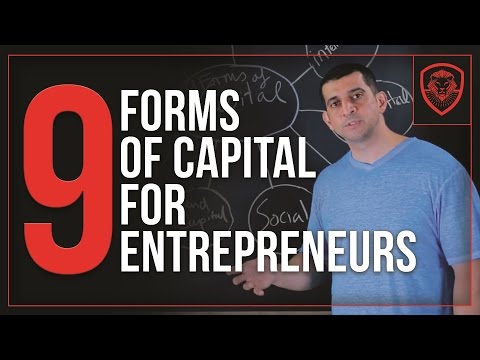
In reality, there’s 9 forms of capital and I believe one of them is the most important
one, but I’m going to explain to you what are these different forms of capital and how
it helps you as the entrepreneur.
So, first of all, the one we hear about all the time is what?
We hear about financial capital.
Right?
We always hear about financial capital.
Most people ask me, “Hey Pat, I feel like the reason why I can’t be a business owner
is because I don’t know how to raise a million bucks.
I don’t know how to raise ten million dollars.
How do I raise five million dollars?
How do I raise a half a million dollars?
I need a lot of financial capital.”
Well, when there are people who start off with a lot of money, say the person has a
lot of money, and they may have the money, they may have a decent idea, but they have
the money, there is not that level of urgency.
But that is one form of capital.
We’ll get back to that here in a minute.
The next one you don’t hear about a lot, I’m going to explain to you what this means is
spiritual capital.
What is spiritual capital?
What are you talking about, spiritual capital?
It’s literally what it means.
Spiritual capital is when a community is targeting a product that they are from that faith base,
from that religion.
There’s a lot of product in entrepreneurship that are tied to a certain faith, to a certain
religion, and that person has an advantage because they know exactly how that faith thinks
or how that community and that religion thinks so that’s what you call spiritual capital.
Next one is land capital.
Let me explain to you what land capital is.
Land capital is let’s just say for instance you have 10 acres of land in Napa Valley — hypothetically.
Your grandparents had it, they left it to you, and you want to start a wine company.
Well, you happen to have the land in a prime location that’s for what?
Wine.
Why?
Because the key to making the best type of wine is what?
The biggest difference in temperature.
The key to making the best type of wine is the biggest difference in temperature, meaning
it goes very high, and then it goes very low.
That’s exactly why Napa Valley is a prime location for land.
And that’s exactly what land capital is.
Your edge when you’re negotiating with somebody else is that you happen to have 10 acres of
land in such and such place.
Okay?
I happen to have 100 acres of land in such and such and such place that we’ve never dug
for oil, never have, and within a 10-mile radius 17 different people have and they’ve
started.
. . whatever you may be saying.
But that’s land capital.
Next one is social capital.
Social capital is a cause.
A crusade.
A group of 50, 100, 200 people that have bought into a cause.
And they want to do something about this cause to make a difference around the world.
You cannot buy social capital.
But social capital is from the heart, social capital comes from feelings.
Social capital comes from I have to make sure we correct an injustice.
I have to make sure this becomes a reality.
That’s one sort of social capital.
So, a lot of companies would love to invest in social capital.
Why?
Because their biggest problem is social capital.
It’s their biggest problem.
Land capital, they can always buy the land if they wanted to.
You know, spiritual capital is one you need this if you want to get into this, but it’s
a very small minute community of people.
The next one is cultural capital.
What is cultural capital?
So for instance, you come to me and you say, “Hey Patrick, I know this product we created
and this is mainly tailored towards the Filipino Tagalog speaking community because this is
. . . And I understand their culture.
It’s very similar to the spiritual, but it’s more cultural.
I’m going to focus on the cultural side and I know exactly what they need.
No problem.
In this family, the way they do their weddings is a three-day wedding and we wanted to start
a business because there is this business in India where it focused on the Indian community,
on how their weddings are done and we specialize in this and this is what we have and all of
our products are imports, so anybody that wants to do the wedding, here for the three
days we do this, this, this and the package is $50,000 and if we do 50 weddings a year,
that’s 2.5 million dollar revenue.
If we do 500, it 25 million dollars.
And there’s this many people that get married in America, the Indian population is let’s
just say 6.5 million people and 6.5 million people, there’s this many people between these
ages, so we’re projecting there’s going to be one million marriages in the next whatever
and let’s just say 50%.
. . so that’s the calculation, cultural.
Got it.
You make your argument for that.
The next type of capital is experiential capital.
What is that?
I’m starting a technology company and I have experience in technology.
I don’t have any money to start it with, but I’ve worked at Google, I’ve worked at Facebook,
I’ve worked with Zuckerberg, I was his number seven engineer, when Facebook first got started,
I know exactly what’s going on over here and I’ve got experience.
I’m just, you know, hypothetical.
I have experience in how to work with this area and what I know is weapons very well,
and I think with the gun laws that are taking place, and all these challenges that are going
on in America, I’m very good at selling guns and I understand who needs it and I know that
community and I have a lot of experience – whatever.
I mean, this sounds weird things I’m throwing out there to you because there’s so many ways
to make money in business.
Intellectual capital.
What’s intellectual capital?
It’s simply intellectual capital.
We’re talking about patents you may have, we’re talking about trademarks you may have,
we’re talking about know-how, knowledge, we’re talking about wisdom, but it’s intellectual
capital that they have in that area.
Then the next one is natural capital.
What is natural capital?
We’re talking about renewable energy.
We’re talking about things like that that is natural capital.
And then obviously, it’s material.
What’s material?
Tools, machinery, things like that are material capital.
This is all different forms of capital.
Most people think the most important type of capital is financial.
Again, I said this at the beginning.
Most people think this is the most important form of capital.
You’ve got to ask yourself which form of capital you have.
So if you yourself need this [financial], you better have one of these.
By the way, this [financial] is the easiest one to get.
Just so you know.
It’s the easiest one to get.
If you want this [financial], you better have one of these other forms of capital.
So what case are you making as you’re trying to raise your money?
If you want to raise your money from a company and say I need a quarter million dollars,
why?
Let me tell you what intellectual capital I have.
I have patents on the following three items.
Okay, great.
Awesome.
What else?
I have experience because I worked with . . . . and I know how to do . . . . Okay, great.
What else?
And the market I’m trying to connect with is such and such market and I fully understand
Silicon Valley culture because I’ve lived there for the last 19 years.
Okay, sounds good.
So that’s the questions they [financial] are going to be asking and you’ve got to have
an argument for it.
Another one could be, I need to raise some money.
How much money do you want?
A half a million dollars.
Why should we give you a half a million dollars?
Perfect question you ask.
Let me explain to you why it is.
One, I have 7,800 people that are part of my network who all are soccer moms and want
their kids to have uniforms for soccer and they don’t like the uniform that they’re currently
buying from everywhere because their skin itches and it gives them a rash.
And I have found this such and such material from whatever place that is an anti-itch and
it’s comfortable with kids’ skin and it can work with any type of skin and it’s more gentle
on them and our competition are the five different companies, they’re going to be doing this.
These 7,000 soccer moms that I sit as the chairman of the board for these 7,000 soccer
moms in the community of whatever state it is, every one of them has already told me
they’re interested.
And if I come out with one, they’re very interested in that.
So here’s what I have.
I have these five women that are wanting to help out with this.
They’re all in different chapters of this.
I have social capital.
Then they’re going to ask, do you really know what you’re talking about?
I brought somebody who has intellectual — they’re the ones with the uniform.
And I brought somebody who has experience because this woman that I’m talking to, her
expertise is fabric.
She’s been in the fabric business for 28 years.
And she knows what’s the best form of fabric to have.
Nike uses this, Under Armour uses it, this one uses it.
The fabric Under Armour and Nike use, they quadrupled the cost because they have names,
and we don’t have a name but we can start our own specifically for kids and our Under
Armour was more for football when they first got started.
Nike was for runners, ours is going to be mainly for kids.
I’m again, just throwing ideas out there.
You may be saying, Pat, that’s a great idea.
Great.
That’s an idea.
THEN you go get this [financial].
Now, let’s work backwards.
Some of you guys messaged me and you say, “Pat, I have 20 million dollars and I’m part
of a C fund, I’m part of this you know, small little fund that I started myself.
I think Kobe today announced that he’s doing 100 million dollars himself, but let’s just
say you have 20 million dollars.
Many of my LinkedIn audience asked me this question – Pat, I have several million, where
should I invest, can we partner with you?
These are the questions that come up.
Perfect.
If you’re on the financial capital side, your struggle isn’t money.
Either you have the money because of the sale of a company, you were part of a company,
the company went public, you had shares, you made seven million bucks.
Or you made four million dollars, three million dollars.
The death of a family, you have 17 million dollars.
You had inheritance that came to you.
You have your parents that left their will or trust to you, right?
You could have something where a contract from sports.
Several NBA players follow me on LinkedIn and send me messages about this.
What do I do with a big contract that I just got?
Perfect.
You’re here [financial], then you got to look at this [other capital] on which one makes
sense to you, but for you, as you’re assessing what companies to invest in, you’ve got to
ask the question, what type of material capital do you have?
I’m sorry, they don’t know what material capital is.
Next question.
Do you have any type of natural capital?
No.
Any type of intellectual capital?
Yes.
What is it? . . . okay, that’s good.
Do you have the patent on that?
Yes, it’s pending right now.
When did you post it?
Six months ago.
Okay.
What type of experiential capital do you have?
Oh, my cousin used to work at Google.
My cousin used to work at Goldman Sachs.
My cousin whatever.
My best friend just graduated from Harvard and he’s got four buddies.
Good.
Next.
Cultural.
What cultural connection do you have?
I’m a millennial.
What’s your point?
There are so many millennials.
Let me tell you what type of a millennial I am.
I totally understand the nightclub life right now.
I totally understand what vibes at nightclubs and what kind of music, I’m in the EDM community.
I know everyone in the EDM world.
I listen to EDM, I know EDM.
Okay, great, where are you going with this?
Well the EDM community typically likes this at the clubs and the raves and the parties
and whatever it is.
And these are the seven things.
And we wanted to start something that’s tailored to that because this, this, this.
So that’s cultural.
What’s social, what’s spiritual, what’s land capital, then make your decision.
So it’s very, very important to know this, but keep this in mind.
This [financial] is very, very, very, very, very easy to get.
Very easy to get.
That is so easy to get.
Okay?
Very, very easy to get.
Most people won’t get it because their approach — maybe another time we’ll do a video on
that — but figure out what all your forms of capital you have that’s your leverage.
In my opinion, this [social] is by far the most important one.
Social capital to me is priceless.
A company with social capital is so valuable, so valuable, words can’t even describe how
important social capital is.
Apple didn’t have financial capital.
Apple had social capital.
Facebook had social capital.
These guys had social capital.
There was a high level of belief that what we’re doing is going to impact the world in
a positive way.
Social capital.
So now, whether you’re the person with the money, or whether you’re the person without
the money, now you have a formula to use.
Now obviously, again, these are short videos.
This is not a three-day workshop that some of you guys are requesting for me to do.
Pat, will you do a three-day workshop?
I’ll pay $4,000 to come to a three-day workshop.
I’m running a full-time business.
we’re not doing any three-day workshops any time soon.
Hey, why don’t you do a three-day workshop.
If we did, I could have more time with this.
I don’t.
It’s a simple message.
You go do your own due diligence on this to find out about different forms of capital
and how they can serve you yourself.
So with that being said, if you have any questions or comments, you can post your questions on
the bottom.
You can comment on the bottom, if you have any comments or thoughts.
(You like that catch?
That was kind of like the catch from what’s the Giant’s receiver’s name?
Beckham?
Yeah, that’s what it is.
Remember that one catch he made with the stretch?
I kind of like to imagine myself like that receiver, but far from it.)
Anyways, if you have not subscribed to this channel, do so.
Click on the bottom over here to subscribe to the #1 channel on YouTube for entrepreneurs.
We are shooting for 100,000 subscribers.
Our channel in the last six months has gone on a major surge like never before.
It took us awhile to get there.
[Laughter] That almost hit the coffee — and it would have been bad, Mario drinking coffee
in the office.
Anyway, questions, comments, comment on the bottom, and if you haven’t subscribed, click
on the subscribe button there to subscribe to the channel.
And if you watch this video on a completely different website, you can always come back
to PatrickBetDavid.com to see more content on that website.
Take care everybody, bye bye.
that we had originally was how we were going to compete against these other guys we were
competing against when they’ve raised tens of millions of dollars and we didn’t have
any money to raise.
It was all my money that we started off with.
How can we compete against these guys?
And we lost several agents initially when we started the company because they all came
and looked at me in my eyes and they said, “Pat, you’re going to go out of business.
Everyone is going to be affected by this.
It’s the biggest mistake you’re making.
You shouldn’t be doing this.
It’s going to hurt a lot of people.
But I stuck around.
Why did I stick around?
Because in my gut, I did not believe that financial capital was the most important form
of capital and I’ll explain to you here in a minute why that is.
I didn’t believe that.
In reality, there’s 9 forms of capital and I believe one of them is the most important
one, but I’m going to explain to you what are these different forms of capital and how
it helps you as the entrepreneur.
So, first of all, the one we hear about all the time is what?
We hear about financial capital.
Right?
We always hear about financial capital.
Most people ask me, “Hey Pat, I feel like the reason why I can’t be a business owner
is because I don’t know how to raise a million bucks.
I don’t know how to raise ten million dollars.
How do I raise five million dollars?
How do I raise a half a million dollars?
I need a lot of financial capital.”
Well, when there are people who start off with a lot of money, say the person has a
lot of money, and they may have the money, they may have a decent idea, but they have
the money, there is not that level of urgency.
But that is one form of capital.
We’ll get back to that here in a minute.
The next one you don’t hear about a lot, I’m going to explain to you what this means is
spiritual capital.
What is spiritual capital?
What are you talking about, spiritual capital?
It’s literally what it means.
Spiritual capital is when a community is targeting a product that they are from that faith base,
from that religion.
There’s a lot of product in entrepreneurship that are tied to a certain faith, to a certain
religion, and that person has an advantage because they know exactly how that faith thinks
or how that community and that religion thinks so that’s what you call spiritual capital.
Next one is land capital.
Let me explain to you what land capital is.
Land capital is let’s just say for instance you have 10 acres of land in Napa Valley — hypothetically.
Your grandparents had it, they left it to you, and you want to start a wine company.
Well, you happen to have the land in a prime location that’s for what?
Wine.
Why?
Because the key to making the best type of wine is what?
The biggest difference in temperature.
The key to making the best type of wine is the biggest difference in temperature, meaning
it goes very high, and then it goes very low.
That’s exactly why Napa Valley is a prime location for land.
And that’s exactly what land capital is.
Your edge when you’re negotiating with somebody else is that you happen to have 10 acres of
land in such and such place.
Okay?
I happen to have 100 acres of land in such and such and such place that we’ve never dug
for oil, never have, and within a 10-mile radius 17 different people have and they’ve
started.
. . whatever you may be saying.
But that’s land capital.
Next one is social capital.
Social capital is a cause.
A crusade.
A group of 50, 100, 200 people that have bought into a cause.
And they want to do something about this cause to make a difference around the world.
You cannot buy social capital.
But social capital is from the heart, social capital comes from feelings.
Social capital comes from I have to make sure we correct an injustice.
I have to make sure this becomes a reality.
That’s one sort of social capital.
So, a lot of companies would love to invest in social capital.
Why?
Because their biggest problem is social capital.
It’s their biggest problem.
Land capital, they can always buy the land if they wanted to.
You know, spiritual capital is one you need this if you want to get into this, but it’s
a very small minute community of people.
The next one is cultural capital.
What is cultural capital?
So for instance, you come to me and you say, “Hey Patrick, I know this product we created
and this is mainly tailored towards the Filipino Tagalog speaking community because this is
. . . And I understand their culture.
It’s very similar to the spiritual, but it’s more cultural.
I’m going to focus on the cultural side and I know exactly what they need.
No problem.
In this family, the way they do their weddings is a three-day wedding and we wanted to start
a business because there is this business in India where it focused on the Indian community,
on how their weddings are done and we specialize in this and this is what we have and all of
our products are imports, so anybody that wants to do the wedding, here for the three
days we do this, this, this and the package is $50,000 and if we do 50 weddings a year,
that’s 2.5 million dollar revenue.
If we do 500, it 25 million dollars.
And there’s this many people that get married in America, the Indian population is let’s
just say 6.5 million people and 6.5 million people, there’s this many people between these
ages, so we’re projecting there’s going to be one million marriages in the next whatever
and let’s just say 50%.
. . so that’s the calculation, cultural.
Got it.
You make your argument for that.
The next type of capital is experiential capital.
What is that?
I’m starting a technology company and I have experience in technology.
I don’t have any money to start it with, but I’ve worked at Google, I’ve worked at Facebook,
I’ve worked with Zuckerberg, I was his number seven engineer, when Facebook first got started,
I know exactly what’s going on over here and I’ve got experience.
I’m just, you know, hypothetical.
I have experience in how to work with this area and what I know is weapons very well,
and I think with the gun laws that are taking place, and all these challenges that are going
on in America, I’m very good at selling guns and I understand who needs it and I know that
community and I have a lot of experience – whatever.
I mean, this sounds weird things I’m throwing out there to you because there’s so many ways
to make money in business.
Intellectual capital.
What’s intellectual capital?
It’s simply intellectual capital.
We’re talking about patents you may have, we’re talking about trademarks you may have,
we’re talking about know-how, knowledge, we’re talking about wisdom, but it’s intellectual
capital that they have in that area.
Then the next one is natural capital.
What is natural capital?
We’re talking about renewable energy.
We’re talking about things like that that is natural capital.
And then obviously, it’s material.
What’s material?
Tools, machinery, things like that are material capital.
This is all different forms of capital.
Most people think the most important type of capital is financial.
Again, I said this at the beginning.
Most people think this is the most important form of capital.
You’ve got to ask yourself which form of capital you have.
So if you yourself need this [financial], you better have one of these.
By the way, this [financial] is the easiest one to get.
Just so you know.
It’s the easiest one to get.
If you want this [financial], you better have one of these other forms of capital.
So what case are you making as you’re trying to raise your money?
If you want to raise your money from a company and say I need a quarter million dollars,
why?
Let me tell you what intellectual capital I have.
I have patents on the following three items.
Okay, great.
Awesome.
What else?
I have experience because I worked with . . . . and I know how to do . . . . Okay, great.
What else?
And the market I’m trying to connect with is such and such market and I fully understand
Silicon Valley culture because I’ve lived there for the last 19 years.
Okay, sounds good.
So that’s the questions they [financial] are going to be asking and you’ve got to have
an argument for it.
Another one could be, I need to raise some money.
How much money do you want?
A half a million dollars.
Why should we give you a half a million dollars?
Perfect question you ask.
Let me explain to you why it is.
One, I have 7,800 people that are part of my network who all are soccer moms and want
their kids to have uniforms for soccer and they don’t like the uniform that they’re currently
buying from everywhere because their skin itches and it gives them a rash.
And I have found this such and such material from whatever place that is an anti-itch and
it’s comfortable with kids’ skin and it can work with any type of skin and it’s more gentle
on them and our competition are the five different companies, they’re going to be doing this.
These 7,000 soccer moms that I sit as the chairman of the board for these 7,000 soccer
moms in the community of whatever state it is, every one of them has already told me
they’re interested.
And if I come out with one, they’re very interested in that.
So here’s what I have.
I have these five women that are wanting to help out with this.
They’re all in different chapters of this.
I have social capital.
Then they’re going to ask, do you really know what you’re talking about?
I brought somebody who has intellectual — they’re the ones with the uniform.
And I brought somebody who has experience because this woman that I’m talking to, her
expertise is fabric.
She’s been in the fabric business for 28 years.
And she knows what’s the best form of fabric to have.
Nike uses this, Under Armour uses it, this one uses it.
The fabric Under Armour and Nike use, they quadrupled the cost because they have names,
and we don’t have a name but we can start our own specifically for kids and our Under
Armour was more for football when they first got started.
Nike was for runners, ours is going to be mainly for kids.
I’m again, just throwing ideas out there.
You may be saying, Pat, that’s a great idea.
Great.
That’s an idea.
THEN you go get this [financial].
Now, let’s work backwards.
Some of you guys messaged me and you say, “Pat, I have 20 million dollars and I’m part
of a C fund, I’m part of this you know, small little fund that I started myself.
I think Kobe today announced that he’s doing 100 million dollars himself, but let’s just
say you have 20 million dollars.
Many of my LinkedIn audience asked me this question – Pat, I have several million, where
should I invest, can we partner with you?
These are the questions that come up.
Perfect.
If you’re on the financial capital side, your struggle isn’t money.
Either you have the money because of the sale of a company, you were part of a company,
the company went public, you had shares, you made seven million bucks.
Or you made four million dollars, three million dollars.
The death of a family, you have 17 million dollars.
You had inheritance that came to you.
You have your parents that left their will or trust to you, right?
You could have something where a contract from sports.
Several NBA players follow me on LinkedIn and send me messages about this.
What do I do with a big contract that I just got?
Perfect.
You’re here [financial], then you got to look at this [other capital] on which one makes
sense to you, but for you, as you’re assessing what companies to invest in, you’ve got to
ask the question, what type of material capital do you have?
I’m sorry, they don’t know what material capital is.
Next question.
Do you have any type of natural capital?
No.
Any type of intellectual capital?
Yes.
What is it? . . . okay, that’s good.
Do you have the patent on that?
Yes, it’s pending right now.
When did you post it?
Six months ago.
Okay.
What type of experiential capital do you have?
Oh, my cousin used to work at Google.
My cousin used to work at Goldman Sachs.
My cousin whatever.
My best friend just graduated from Harvard and he’s got four buddies.
Good.
Next.
Cultural.
What cultural connection do you have?
I’m a millennial.
What’s your point?
There are so many millennials.
Let me tell you what type of a millennial I am.
I totally understand the nightclub life right now.
I totally understand what vibes at nightclubs and what kind of music, I’m in the EDM community.
I know everyone in the EDM world.
I listen to EDM, I know EDM.
Okay, great, where are you going with this?
Well the EDM community typically likes this at the clubs and the raves and the parties
and whatever it is.
And these are the seven things.
And we wanted to start something that’s tailored to that because this, this, this.
So that’s cultural.
What’s social, what’s spiritual, what’s land capital, then make your decision.
So it’s very, very important to know this, but keep this in mind.
This [financial] is very, very, very, very, very easy to get.
Very easy to get.
That is so easy to get.
Okay?
Very, very easy to get.
Most people won’t get it because their approach — maybe another time we’ll do a video on
that — but figure out what all your forms of capital you have that’s your leverage.
In my opinion, this [social] is by far the most important one.
Social capital to me is priceless.
A company with social capital is so valuable, so valuable, words can’t even describe how
important social capital is.
Apple didn’t have financial capital.
Apple had social capital.
Facebook had social capital.
These guys had social capital.
There was a high level of belief that what we’re doing is going to impact the world in
a positive way.
Social capital.
So now, whether you’re the person with the money, or whether you’re the person without
the money, now you have a formula to use.
Now obviously, again, these are short videos.
This is not a three-day workshop that some of you guys are requesting for me to do.
Pat, will you do a three-day workshop?
I’ll pay $4,000 to come to a three-day workshop.
I’m running a full-time business.
we’re not doing any three-day workshops any time soon.
Hey, why don’t you do a three-day workshop.
If we did, I could have more time with this.
I don’t.
It’s a simple message.
You go do your own due diligence on this to find out about different forms of capital
and how they can serve you yourself.
So with that being said, if you have any questions or comments, you can post your questions on
the bottom.
You can comment on the bottom, if you have any comments or thoughts.
(You like that catch?
That was kind of like the catch from what’s the Giant’s receiver’s name?
Beckham?
Yeah, that’s what it is.
Remember that one catch he made with the stretch?
I kind of like to imagine myself like that receiver, but far from it.)
Anyways, if you have not subscribed to this channel, do so.
Click on the bottom over here to subscribe to the #1 channel on YouTube for entrepreneurs.
We are shooting for 100,000 subscribers.
Our channel in the last six months has gone on a major surge like never before.
It took us awhile to get there.
[Laughter] That almost hit the coffee — and it would have been bad, Mario drinking coffee
in the office.
Anyway, questions, comments, comment on the bottom, and if you haven’t subscribed, click
on the subscribe button there to subscribe to the channel.
And if you watch this video on a completely different website, you can always come back
to PatrickBetDavid.com to see more content on that website.
Take care everybody, bye bye.
Please follow and like us: