
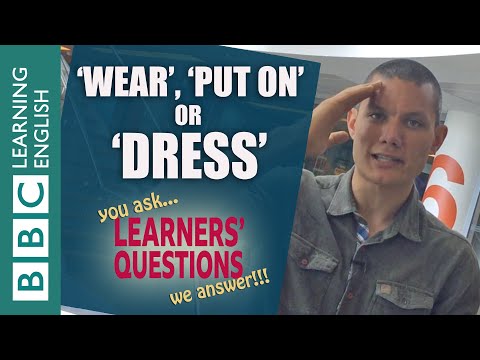
Hi guys! Dan from BBC Learning English here with this week’s Learner Question. Find out
what it is after this.
OK! This week’s Learner Question comes from Tugba from Turkey, who writes: “Hello, I would
like to know the difference between wear, put on and dress.” It’s a good question,
Tugba, and three very confusing words. I hope you like the answer. Here it comes.
So, when you wear clothes, shoes or jewellery, you have them on your body. You can also wear
your hair in a particular style. For example, I’m wearing a green shirt and a silver wedding
ring. I usually wear my hair short.
There is another meaning to wear, which is: become used and weaker over time, like the
phrasal verb wear out. For example, I need to buy some new shoes. My old ones are getting
worn out. This can also be applied to humans when they become tired. After a long day at
work, I might say, I’m worn out. I need to go home.
When you put clothes on, you place them on your body in order to wear them. Also, when
you’ve finished wearing them, you take them off. First you put on, then you wear them,
then you take them off. For example, this morning I put on this green shirt, and later
I’ll take it off.
You can also put on weight. This means to gain or accumulate kilograms. The opposite
is to lose weight. For example, I thought I was going to put on weight on holiday last
week, but I actually lost weight because I went swimming every day.
When you dress, you put clothes on. If you dress up, then you wear smarter clothes than
usual. Likewise, if you dress down then you wear less smart clothes than usual. We also
talk about getting dressed as an alternative to the verb dress. And there’s little difference
between them. For example, I need to dress. The taxi’s coming in twenty minutes. Or,
I need to get dressed. The taxi’s coming in twenty minutes. No big deal.
Other things you can dress are other people, such as children, you can dress a wound by
cleaning it and covering it with a bandage and you can dress a salad by adding oil and
vinegar to it.
I hope that answers your question Tugba. Thank you very much for writing to us. If anybody
else out there has a question for Learners’ Questions, you can email us on: learning.english@bbc.co.uk.
Please remember to put Learners’ Questions in the subject box and your name and where
you’re writing from. We get a phenomenal amount of email, guys and we can’t answer
every single one, but we do read all of them. And for more information, go to our website:
bbclearningenglish.com. That’s it for this week’s Learners’ Questions. I’ll see
you next time. Bye!
Please follow and like us: