
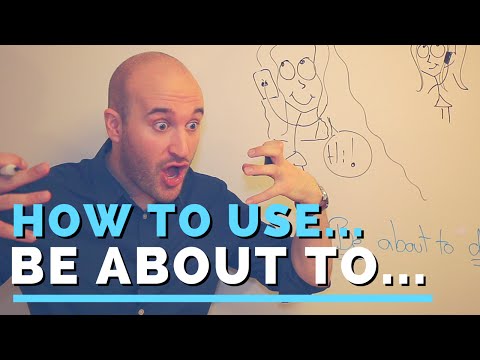
When you plan to stay with your friend at 6,
three quarters and are now 6 and this is you:
Completely asleep, and then you call your friend,
and you say: We were here five minutes, right?
And you’re still in bed,
Why can answer? Obviously contestaràs this:
If! Just now leave.
Be ready to do something,
This is very easy
What means? You will do something, but right now!
I will, but now.
The verb “to be”, “about to” never changes,
“Do” is the infinitive, so you use the verb always remains the same.
So “If I go home soon” is like saying:
Yes, my hands are the hands and I’m about to leave.
It’s a lie, I know,
but we all do it, right? Or just me?
This was present. How about in the past tense?
Well, we have all been in this situation.
When you and your best friend have that special connection
I call you to your friend and say: Hey, it’s me! And she’s like: Siiii!
Just call me before I was about to call you,
just before the call.
So how can you say it happened?
I was about to do something, just call me before.
“I”
You can add the word “fair”
I was just about to
The verb is in the infinitive: Call. Just before calling you. Unchanged.
This is simple enough right? You will do something, right now, right now.
You can not say things like:
You can not say for example I’m about to do something in five minutes.
Because? Gramàticament is correct, however,
Yes, five minutes is a short time in the future,
But when we say “about to”, we mean now, now.
5 minutes is already too far in the future as it is now
Therefore,
“Nearly” and “a more distant NOW” … can not say.
So, thanks for watching video.
I know you think: My God, this is wonderful to teacher, I am ready to subscribe.
“Right Now”
If you have requests for future lessons, leave them comments
Click here to subscribe, click here to see another video, and see the next class.
Hey! Do you know the various ways we can pronounce that?
There are like a million. It’s ridiculous! Merci English!
Please follow and like us: