
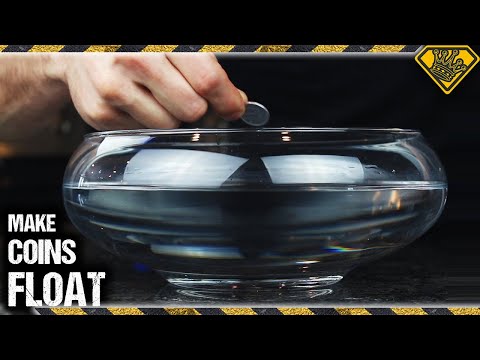
most people know that metal coins won’t
float in water but for this experiment
I’m going to show you a cool little
trick that’ll make them look like they
do for this demonstration you’re going
to need a bowl of water and a handful of
one-yen coins one-yen coins are kind of
like Japanese pennies and there’s a good
chance you can get some if you’re really
really nice to your neighborhood
Japanese exchange students these common
coins around two-and-a-half times
lighter than our pennies because they’re
minted from aluminum instead of zinc but
that doesn’t mean they can float in fact
if you try to sing a few into a bowl of
water you’ll see they instantly sink to
the bottom without hesitation but to
change all that you just need one small
paperclip simply unfold the clip by
bending the inner part back until it
makes an L shape then balance one of the
coins on the larger end and use the
other side as a handle to slowly dip the
coin into the water now pull the clip
back out of the water and amazingly the
coin will be left floating on top almost
like magic it’s kind of like the coin
Nestle’s itself into some kind of
invisible force field warping the
surface of the water and denting it down
what’s really amazing is you can float
as many coins as you want at the same
time as long as they’ll fit in the bowl
but how does this work the answer is
surface tension the attraction between
the water molecules at the surface is
just strong enough to support the weight
of an aluminum coin without letting it
break through it’s kind of like a thin
elastic layer that covers the top and
it’s a very delicate balance so as you
might imagine adding just a touch more
pressure will break the layer for a
second let the coins drop back to the
bottom again now let’s explore this
phenomenon a little further and watch
what happens if we sprinkle pepper
flakes on the water first this time as
the weight of the coin warps the water
you can see the closest flakes
immediately begin attracting toward it
then stick to the sides the mass of the
coin creates enough of a disturbance
that any flakes within range eventually
get sucked toward it until they collide
and become a part of the system which is
the way some people say gravity works
that could be the case because if you
try placing a few coins in close
proximity the two masses immediately
gravitate toward each other until the
impact and snap together like magnets
now if you really want to try this trick
but can’t find any aluminum coins don’t
worry you can still use things like
paper clips pins needles and even
staples they’ll all work just as well
even though they’re made of steel and
nearly three times
aluminum use the same paperclip trick
from before to quickly and easily set
your metal bits floating on their own
and if you’re careful and have a large
enough dish you might even be able to
get the entire box of paperclips
floating at once now the idea of
floating paperclips isn’t new and some
of your friends might think they’re
smart because they already know how it
works so if you want to mess with their
heads a bit just pour in a few drops of
dish soap when they’re not looking
soap breaks up the surface tension of
the water and weakens the hydrogen bonds
which means your victim won’t be able to
get a single paperclip to float no
matter how many times they try or how
slowly and carefully the paper clips are
set into place
well now you know a cool little trick
you can try at home at school or the
office to impress your friends and
coworkers by making random bits of metal
float on water that’s it for now if you
like this experiment perhaps you’ll like
some of my others check them out at the
king of random Calm
[Music]
float in water but for this experiment
I’m going to show you a cool little
trick that’ll make them look like they
do for this demonstration you’re going
to need a bowl of water and a handful of
one-yen coins one-yen coins are kind of
like Japanese pennies and there’s a good
chance you can get some if you’re really
really nice to your neighborhood
Japanese exchange students these common
coins around two-and-a-half times
lighter than our pennies because they’re
minted from aluminum instead of zinc but
that doesn’t mean they can float in fact
if you try to sing a few into a bowl of
water you’ll see they instantly sink to
the bottom without hesitation but to
change all that you just need one small
paperclip simply unfold the clip by
bending the inner part back until it
makes an L shape then balance one of the
coins on the larger end and use the
other side as a handle to slowly dip the
coin into the water now pull the clip
back out of the water and amazingly the
coin will be left floating on top almost
like magic it’s kind of like the coin
Nestle’s itself into some kind of
invisible force field warping the
surface of the water and denting it down
what’s really amazing is you can float
as many coins as you want at the same
time as long as they’ll fit in the bowl
but how does this work the answer is
surface tension the attraction between
the water molecules at the surface is
just strong enough to support the weight
of an aluminum coin without letting it
break through it’s kind of like a thin
elastic layer that covers the top and
it’s a very delicate balance so as you
might imagine adding just a touch more
pressure will break the layer for a
second let the coins drop back to the
bottom again now let’s explore this
phenomenon a little further and watch
what happens if we sprinkle pepper
flakes on the water first this time as
the weight of the coin warps the water
you can see the closest flakes
immediately begin attracting toward it
then stick to the sides the mass of the
coin creates enough of a disturbance
that any flakes within range eventually
get sucked toward it until they collide
and become a part of the system which is
the way some people say gravity works
that could be the case because if you
try placing a few coins in close
proximity the two masses immediately
gravitate toward each other until the
impact and snap together like magnets
now if you really want to try this trick
but can’t find any aluminum coins don’t
worry you can still use things like
paper clips pins needles and even
staples they’ll all work just as well
even though they’re made of steel and
nearly three times
aluminum use the same paperclip trick
from before to quickly and easily set
your metal bits floating on their own
and if you’re careful and have a large
enough dish you might even be able to
get the entire box of paperclips
floating at once now the idea of
floating paperclips isn’t new and some
of your friends might think they’re
smart because they already know how it
works so if you want to mess with their
heads a bit just pour in a few drops of
dish soap when they’re not looking
soap breaks up the surface tension of
the water and weakens the hydrogen bonds
which means your victim won’t be able to
get a single paperclip to float no
matter how many times they try or how
slowly and carefully the paper clips are
set into place
well now you know a cool little trick
you can try at home at school or the
office to impress your friends and
coworkers by making random bits of metal
float on water that’s it for now if you
like this experiment perhaps you’ll like
some of my others check them out at the
king of random Calm
[Music]
Please follow and like us: