
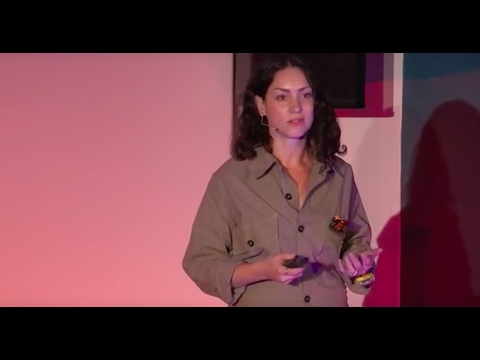
my journey as a female designer now
turned entrepreneur and my kind of
commitment to creating a generation of
digital creators so my story starts in
an unlikely place about three years ago
my husband and I found a laptop in our
trash can and as you can imagine it was
this kind of bizarre moment where we
realized that someone had just thrown
away this incredibly valuable piece of
technology because they just didn’t
understand it or just didn’t want it and
this began a very critical dialogue
between us around this lack of
relationship that we seem to have around
technology we don’t really understand it
but we absolutely don’t really know how
to create things or produce things with
it they’re not really designed for us to
do that they’re these closed systems
that don’t want us to build with them or
invent with them or fix them or modify
them and so we continued to kind of
explore this area and very soon after
that situation we had a child who’s
right there and but after having a child
and I don’t know how many people have a
child but having a child born with a
tablet is a really interesting
experience parenting in the digital age
is very different than I think parenting
in other generations as a mom I really
wanted my son to be completely digitally
literate but I also wanted him to be
able to see technology as something that
he could create with a medium to build
like Lego a medium to create with like
blocks not just this kind of consumptive
space and kids are born fearless for
them making sensors and making cookies
is the same thing they just want to make
and create and at every stage of their
development they’re learning and that
was a really important kind of part of
this development for us so we
fundamentally believe that kids are
super smart and that the industry which
is most a part of their lives as they’re
growing up is toys and we think that
those toys should really be smarter too
as we continue to kind of explore this
area
we began to really understand the kind
of micro and macro kind of things that
were leading in this space so when you
ask kids today what they want to be when
they grow up sixty five percent of kids
in primary school today will have jobs
that don’t exist which is amazing and
those jobs will absolutely be digitally
creative jobs so how do we as parents
and educators support that journey to
inventing kind of jobs of the future so
we started by creating an organization
that has a very specific purpose and the
purpose is around essentially helping
kids spark their imagination with
hands-on tech and the reason we talk
about sparking imagination is because we
think no two kids are the same kids will
get excited about very different things
and so we want to give them that
opportunity to get hands-on and to
create invent code play with technology
in a productive way we imagine a world
where kids are building and creating
technology themselves where they’re
building solar plants thirst detectors
with pencils that have servos and water
balloons that water their plants
automatically where they’re essentially
learning about circuits by creating
conductive play-doh in their kitchens
that conduct electricity to light up
LEDs to make motor spin to make buzzers
buzz and really bring creations to life
we see a world where kids actually use
sensors and lights to invent games
because they want to because they have
the capacity to do that and because they
have the tools accessible to them to do
that where they’re using electronics and
cardboard to invent speakers and sound
instruments again because they have them
at their disposal and they have the
confidence to be able to use them and
where parents don’t see tech as
something that’s scary but rather as a
media and where their kids can create
where they can be a part of that process
and where they can actually have quality
time using technology and so this world
that we’re kind of imagining is not
something that we’ve just invented it’s
actually really built on some very
important scientific and educational
methods and philosophies so we’re really
standing on the shoulders of some kind
of giants that have
develop these kind of principles and one
of the first ones that is a real
inspiration to the approach that we’ve
taken is Jean PJs so John Padua is a
scientist from Switzerland and his area
of research and exploration is very much
about brain development
he believes that kids between the ages
of 2 and 11 are developing their brains
in a really fundamental way and the way
brains are getting developed is through
learning by doing that this process of
learning by exploring and failing and
learning and and applying those
processes is just fundamental to kids
and incorporating something called
mastery so this is where you learn a
skill you’re able to apply it again and
repeat it and really that repetition of
mastery is fundamental to kids
developing those parts of their brains
at early ages the other person that we
really have informed a lot of our work
is as Seymour Pappas Seymour puppet was
a mathematician at MIT and a computer
scientist focused very much on
artificial intelligence and created a
programming language called logo which
was one of the first programming
languages that young people began to
really develop and he believed that kids
learn really differently than adults and
that they need more complex systems and
tools to really help them to explore
technology specifically and that
learning technology is actually really
different than learning other things
it’s not about I’m right or I’m wrong
it’s actually about debugging and
problem solving when you’re programming
if something doesn’t work the idea of
getting to the next stage is is it
fixable can I actually solve that
problem which now is known as
essentially and complex problem solving
which is a really important part of our
kind of method and then the last
individual that we really kind of
focused on a lot is Maria Montessori who
is very dedicated to young people being
independent thinkers in the Montessori
method they give young people small
versions of adult things and they ask
them to really find independence and
individuality in using real everyday
materials and products and that sense of
individuality is really important it’s
about kids discovering inside and
outside using real tools to find their
own agency and that’s a really important
part of our kind of philosophy and
approach and so these kinds of
philosophies informed us to really I
guess you could say kind of disrupt an
area so the toy department it looks
something like this
still um it’s a very gender split space
it’s very much led by characters and by
kind of products that are informing
young people whether the industry
celebrates that or not they are
informing the way young people are
forming a sense of self the way they
learn the way they want to learn the
things they think they’re good at the
things they think they’re bad at and
this industry we think has a lot more
responsibility to play and how kids
interact with technology and so what
we’ve created is a category it’s a
category where kids actually make play
code and invent their own toys and these
toys we’ve we’ve built a team around it
so we have 30 people in Hackney that are
really passionately helping us build
this business the organization has
inspired tens of thousands of kids in
over 97 countries to build things like
gaming devices where they have to make
play a code and invent their own games
to build synthesizers out of cardboard
boxes that it that the actual product
comes in teachers and educators are
using it globally to use as part of
curriculum and also in formal education
and again this kind of learning by doing
and this understanding of Technology
through exploring and creativity is just
fundamental to the way we think kids
will understand a sense of self they’ll
build confidence and they’ll find the
thing within technology that they really
believe in that they’re really empowered
by and that they might want to use in
future explorations to hopefully make
better decisions as they grow and as
they find their passions a really
important part of our process which i
think is very much rooted in kind of my
background is our user centered approach
to design so for us design is about
putting the user in our case the young
person at the center of our design
process so we do big research projects
to understand one yet what young people
are making in school already what they
like making and we use those as themes
and young people are part of this very
iterative process of developing and
creating products so we don’t start with
the end product we start with an idea or
an area or a theme and
people actually help us to define the
end result of what the product might be
which is really exciting we do home
testing we do a lot of testing in
schools and we have a little group
called the future inventors Club which
is about a hundred kids in the UK that
essentially volunteered to come in and
just test products with us which is
really fun and we’ve built some really
amazing partnerships with retailers and
schools education businesses as well as
businesses like the BBC so we did our
first co-created product together with
the BBC and the product is very much in
response to something that existed in
the 80s so this kind of beige tool is
something called the micro and the micro
was the first personal computer that 80%
of all schools had it really sparked a
generation of engineers and so the
premise that the BBC essentially asked
us to participate in is what does a
micro for this generation look like and
this little device that I’m wearing and
this one on the screen is the BBC micro
bits which is the Micro for this
generation it’s a pocket sized computer
kind of like a Swiss Army knife or
invention it has a screen that you can
program it has buttons that you can
program for gaming and controlling it
has bluetooth that you can use for
Internet of Things projects it has an
accelerometer for motion and tracking it
has a compass you can place yourself and
it has an edge connector so you can
connect it to raspberry PI’s Arduino is
all different kinds of other things in
the world and this product has been
given to a million 12-year olds in the
UK for free which is just an incredibly
ambitious project at the BBC and and we
and a bunch of other partners and
participated in it’s now being used by
young people all over the UK to learn
computer science and to learn about
digital creativity and kids as you can
imagine are inventing stuff with it
they’re inventing Tamagotchis they’re
inventing electronic football pitches
and baseball pitches they’re inventing
crazy golf robots and again they’re
doing this not because they necessarily
want to learn programming they’re doing
it because they want to create awesome
things that are interesting and do fun
and engaging activities and the last
product that I’m going to talk about
which again is a really a manifestation
of these philosophies
this commitment to empowering kind of
digital creators not just producers is a
an object that we just created a couple
of months ago called the mover kit and
the mover kit is a wearable that kids
essentially make and code themselves it
has eight rainbow LEDs a motion sensor
and a compass that kids can invent and
create with and our philosophies around
like right out of the box you build your
own tech and then you essentially use
digital tools to empower creation coding
craft all of these activities happen in
a digital space and kids have created
all kinds of amazing things so they
actually can go through different craft
materials and and kind of recipes that
other kids have made um in this case a
little girl got a mover kid and she had
a remote-control car that she wanted to
turn into a police car so she programmed
the LED lights to basically flash red
and blue and it responded to motion and
the faster her remote-control car went
the faster the lights would flash and
again she programmed this in a couple of
minutes and the reason she wanted to do
this was not necessarily because she
wanted to learn programming is because
she wanted to have fun she wanted to
play and we really want to see
programming and electronics and this
kind of relationship to tech to be a
part of everyday play and activities
because I think when you’re playing
that’s when you’re really discovering
what you love and the passions you have
other things that kids have created are
things like the toothbrush trainer so um
a little boy has arguments with his mom
around brushing his teeth and the when
he brushes his teeth for two minutes the
mover essentially detects the movement
and then it essentially unleashes
rainbow lights a little girl wanted to
be iron woman she wanted to attach to
her costume so the faster she around the
more it’s sparkled like white and pink
lights you can also use the
accelerometer to turn it into a bike
light so front light is one way but back
light is the other way you can do
Spooner scooter speed distance
challenges where you can actually race
each other we’ve had kids turn it into
dice where you like to spin it and it
shows kind of where the person is next
it has to play the game so again again
this kind of unlimited inventiveness
that happens when you actually give kids
tech to play and invent with is just an
incredibly empowering process that we’ve
been able to be a part of and also kind
of
observe and move to the next level and I
think fundamentally we are just really
excited and I am really excited about
what a generation looks like when you
really empower them with technology to
not only invent their future but the
future that we’re all essentially going
to be a part of and I think that’s a
really exciting place to spend time and
that’s why we’ve essentially built a
business around it and we’re really
excited about the next stage of how kids
are going to use technology
[Applause]
you [Music]