
and talk about the many dimensions of
origami today so most of us I mean can
you think of origami you’re thinking
about flapping birds and grains and
things like that image it so clean and
most Japanese kids fold this as kids in
Japan is familiar with this but here in
India with paper planes right as kids or
even probably as college students she’s
thrown paper planes at someone it is
once in your life and as kids we all
used to make boats right so toddlers
Akash tea and stuff like that so now
let’s start looking at this instead of
as a port as the geometric form right so
let’s abstract it and to get it as a
form which has an inherent Samba tree in
it and this our tippy top most of us
would have paid typically beat up as
now let’s look at the boat again and
then look at it as a geometric form
right as I’m what you do so you can find
a lot of these and you start getting
some sort of a larger Java tree out of
it you put a light inside it you get a
beautiful object
but this is not a beautiful object and
only this is also a platonic solid it is
a real solid geometry concept and this
this dippity beta if you combine a lot
of modules in place then you get a very
complex object so what can you do so far
you gotta do with origami and usually
you start with a square sheet of paper
and you could say okay maybe I fold it
in half and I fold it again and maybe I
get some kind of form or something so
I’ll show you three four examples of
what you could do with a square sheet of
so this 2 is the square sheet of people
you have a larger version of this down
here yeah this is a square sheet of
this spiral formula is also a square
what about this phone this tube is a
square sheet of people right so there
are hundreds of things in thousands of
things you start with a square sheet of
paper and you can move in any direction
as far as Swamiji is concerned someone
told you you have to make a cube
you’ve got use pair of scissors you
can’t use a blade you can’t use glue how
do you make a cube and on top of that
they say that the few must also have
holes in it yeah how do you do it
no glue no scissors no cutter you can do
by just using square sheets of people
many modules of it 12 in this case and
you can get up to meet with no group and
meet a larger form using the cubes again
your blue combined loop them you can
even close it so that it becomes a ring
so the possibilities are sort of endless
and Here I am talking about this
simplest three-dimensional geometry
so I’ve established that geometry has a
deep linkage to origami so it’s one of
the most commonplace things that any
school or college could use as a room
with each aisle geometry with each solid
geometry and the 88 students by just
giving them a sheet of paper and then
my journey started when as an architect
I was asked to create a very large roof
span and somebody said you can’t put a
pillar in the middle of the space it was
an airport hangar and I started thinking
that there are a lot of airport hangars
and usually they think in terms of their
structural systems so what do you do
and I started fooling people and from
people the journey went to nature and I
understood that a lot of this folding
actually happens in nature we learn from
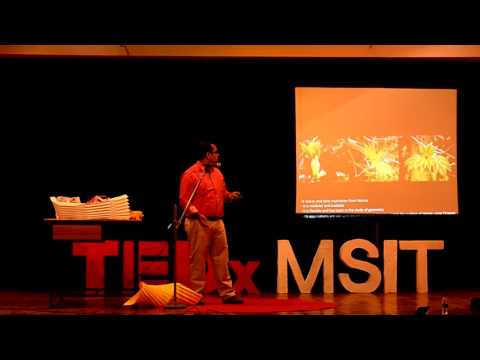
nature origami is biomimicry a beautiful
example here in cold climate countries
leave stone growth they are full-sized
because the dart system just doesn’t
have the kind of energy to grow in the
way that a hot humid climate plant would
give to the leaf so what happens is that
you fold the entire leaf put it inside a
bird and when spring comes a chemical
signal reaches the leaf and the SAP
starts pumping into the veins and the
veins are exactly where the holes are so
let me show you something which is
another kind of magic you have a form
like this you say okay it is a cylinder
this looks from nature as well it’s
partly dimensional and then what you do
is you start putting a little bit of
pressure on it it forms or to row it
then it forms a taste then you flatten
it it is magic and it is so common you
can google magic ball on YouTube and you
will get a tutorial how to make this
and what I call this is degrees of
freedom so you need forms they need
flexibility they need a formula many
things and you can resort to sama trees
like this and they’ll give you the
opportunity to do many things with one
theme and then start looking at nature
all around you look into a cabbage cut
it look inside it look at the next
mountain chain when you visit the hills
in Google Earth look at the coastlines
of countries and if you tear into a
microscope and look at the protein
sequence all folding it’s all folding
it’s all sequential folding it’s all
and then look at dynamic origami this is
dynamic origami bird’s wings are dynamic
origami it’s folding folding in a very
strict geometric sequence and that’s
origami once you learn it from nature
you start seeing things around you you
start teaching and beyond the material
of paper we start looking at plastics we
start looking at metal yes you can fold
metal you start looking at ceramics at
and then you start looking at skin and
that’s where my talk is heading because
have an architect so you can of course
create nice things other things which
are beautiful things they don’t have
purpose as it were but they do give life
to species around you I have to do it
you can do it with all the materials are
talked about and of course you can quit
with paper as well you can animate
and now I come to the crux of my talk
which is that what you get out of
origami you can create lighting you can
create furniture ceramics tableware
packaging product design product design
is upcoming fantastic field in India
look at what you terentyev origami when
you’re seeing product design think about
a planter that is small when the plant
is small and that can expand and keep
more earth as the plant grows you can do
that with more exotic forms you can have
the CD that goes in your CD tray you can
take it out and it becomes you can fold
it it becomes a mouse
you just need to put a little optical
reader into your start and it is a
functioning Mouse so you don’t have to
carry a separate Mouse with you you can
mean a foldable chassis of a car by
using an origami concept these are some
examples of students who are
experimenting with origami in fact all
over the world there are hundreds of
examples like this if you start looking
for them now
I come to the gist of my talk which is
just to forests and there’s a bigger
joint and a wonderful experiment by
more mundane things were status you need
hundreds of structural things in this
deck is you need one sheet of metal you
and then you look at examples of
architecture and you look at structural
performance or making at large spans
an aqueduct in Bishop’s Court in
Paternoster square then voted into a
beautiful sculpture so it functions as a
went for the basement but it’s also a
sculpture and time into space a facade
which protects you from the glare of the
but the political definitely more
three-dimensional of men flexibility
offer more geometrical shapes that could
adjust the movement of the Sun the
solution was inspired by another
these computer-controlled
three-dimensional triangular screens
respond directly to the sun’s movement
unfolding like an umbrella when the
sunlight hits them that’s what makes
these buildings greener solar rays can
heat the outside surface of windows up
to 90 degrees Celsius nearly 200 degrees
Fahrenheit by shielding the glass from
the Sun the screens on reducing solar
gain reducing glare living in more
diffused natural light into the building
saving energy by requiring less
artificial lighting
and what if instead of protecting
buildings from sun he wanted to harness
more of the solar energy traditional
photovoltaic cells would not work
because they are stationary or it’s
expensive to move them around as the Sun
moves what about the 3d damaged cells
maybe they become curved in form dinner
and experiments are already on way so
that your solar panel is always facing
the Sun so you maximize the use of the
photovoltaic and from an efficiency of
20% bring it up to 70% 80% and all using
origami cubicle scientists our
University
so you have limited space in the space
traffic that’s going up biological
canals and it all right away without it
inside the shuttlecraft
I think all its glory 100 meters 150
and now let’s come back to things which
tsunamis and you need disaster relief
they quickly you need shelters you need
housing and you to connect this with
massive speed and you need thousands of
these modules to come up regarding again
of our solution these modules up put
them in a truck you just need to create
a brick base unravel them and they give
you shed so another then in which oil
ami
is magic almost magical and what is all
this leading me to talk about that
origami is almost like a mood
biologists come to it for reference
astrophysicists come to reference
computer scientists engineers architects
designers my dream is that there should
be in the new future in our country an
Institute of making where all these
people can come and think about ideas it
is an origami University it can give to
all these disciplines it is a field
which is meditative with spiritual you
meditate when you fold that’s what I am
not doing when I am fully but at the
same time it words the key to many of
problem many problems and many
challenges in many disciplines so think
think art about origami and give it a
chance in your life [Applause]