
today it’s a real honor to be here
really arrived in India but I’ve been
doing the American diplomat thing for
about for about ten years I’ve served or
worked in almost every continent on the
planet except for Antarctica and been to
a lot of countries I’ve never been as
excited about being in the country at a
certain moment in time as I am being
here in India so much happening here so
much promise so many young people are
really the main reasons that not on the
India I think the rest of the world is
really excited so if I can today I want
to want us to use our imaginations and I
want us to use our imaginations to think
about what India might look like in 2050
before we get started I want to say that
in the United States the late Robert
Kennedy was the brother’s President John
Kennedy both were assassinated
Robert Kennedy said once that said that
some people see the world and they say
why he said some people see the world as
it could be and ask why not that’s an
incredibly powerful statement that has
been passed down from generation to
generation
of Americans in and we like to ask why
not why not create a better world why
not create a better future for whomever
and I think what I want to do today is
ask why not with you about a track so
let’s go 35 years in the future let’s go
to 2050 here we are in 2050
here’s India in the audience today we
have a future Nobel laureate in science
the future Prime Minister is with us
today
India and 2050 is the largest country in
the world its population is 1.7 million
people billion people partly on is the
youngest population in the world by far
its economy has quintupled
over the last 35 years it is now 12 a 12
trillion dollar economy poverty has all
but been eradicated in India and not
only in India than in many of the
countries in South Asia today is October
21st 2015 today a team of Indian and
American astronauts after a two-year
journey through space are landing on
Mars to establish the first human colony
to research the Red Planet
a few months ago India who has long been
a permanent member of the United Nations
Security Council led an international
relief effort in the city of Mumbai
South Africa which was hit by a
devastating earthquake India’s actions
and its commitment to disaster relief
saved tens of thousands of lives India
2050 is the world’s leading producer and
the world’s leading green energy country
in fact India is so dynamic in its
lean in its green energy culture that it
actually exports its green energy
technology solar wind biomass etc to
countries like Saudi Arabia and Qatar
who ran out of oil about ten years ago
good luck so how did you get that how
did you your generation who are leading
India 2050 how did you get to there how
did how did you make India so great and
resume its really as rightful place as
one of the leaders of the world well it
started back in 2015 because everybody
remember 2015 2015
India is leading the world’s major
economies and economic growth and this
is really critical at a time when it
would have been easy for you to stop and
say how we’re good we’re growing at a
fast pace we’re growing faster than
China things are pretty good you did you
said we can do better and you made some
very key decisions that paid off in the
long run you did things like invest
massive amounts of money multi-year
projects in thousands of miles of roads
new ports new railways more airports
invested in public transportation
infrastructure you started to move away
from fossil fuels and to green energy
along with the rest of the world you you
engaged in a level of Internet
connectivity for the rural environments
the likes of which the world has never
seen and in by the year 2025
almost every Indian event how literature
up or at daily access to the Internet
and all of that empowered
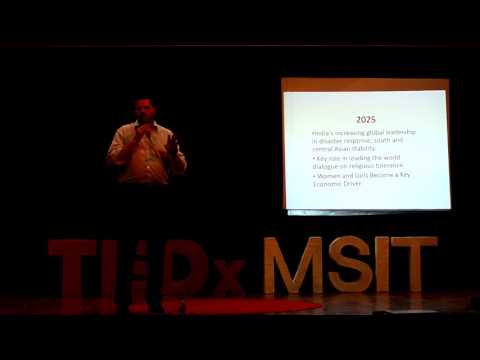
so let’s keep going in 2025 those
investments that you made the decade
prior are really starting to pay off
India’s becoming a global leader in
disaster response the military which is
steadily grown and strength and capacity
is now responding to disasters not only
India’s Navy helped secure three rite of
passage through the Indian Ocean to the
India’s centuries of religious tolerance
and and the peaceful coexistence of many
religions has allowed it to assume a
leadership role in the violent extremism
sector and India’s leadership has helped
tamp down many of the problems that
plagued the late the early 21st century
women and girls are now a bigger part of
the economy than ever
adding multiple percentage points to the
so by 2035 India’s space program is
reaching new heights the legacy of
President Abdul Kalam in his rocket
technology has been expanded greatly
India is now the world’s leading
commercial satellite launch launch site
not only in Bangalore but at other sites
around the country India is pioneered a
new way to remove space debris the
thousands and thousands of pieces of
space debris that can take out a
satellite and cripple our communications
or our ability to navigate the world
looks to India for a low-cost high-tech
way to access space about 10 years ago
India assumed its chair on the United
Nations Security Council and its
leadership the UN has been welcomed by
India’s investment in its communications
infrastructure that you did 20 years ago
has not only benefited the country
economically but it has created four
separate silicon valley’s in India
places where capital education and
innovation all come into play so when
people talk about Silicon Valley they’re
talking not only about Menlo Park in
California they’re talking about
Bangalore Chandigarh Jaipur and
Hyderabad
as places where the most innovative
poverty is been largely eradicated in
India and much of South Asia and India
is the world’s leading renewable energy
explored as we said the fossil fuel
producing countries have run out or are
running out of fossil fuels and India’s
investment in green technology decades
ago are paying huge dividends not only
for the planet but 14-years economy as
so let’s come back to present day we’re
back to 2015 is any of what we’ve been
talking about possible or is this just
another naive America standing up here
with great ideas thinking oh you know we
can we can make a better world I can
tell you on a personal level a big part
of my job I feel that sometimes is being
lectured to by people from other
countries sometimes the criticism is
fair oftentimes it’s fine I spent a lot
of time hearing about the things that
the United States has done wrong what we
could be doing better what we should
have done what would what they would
like us to do but one thing that I never
refute is when people say you Americans
are naive it’s not the way it works and
I always say I’m guilty I’m guilty
because I’m not to miss it
and I think that a lot of video is
optimistic too I think a lot of a lot of
you are asking yourself why not why not
this is the key thing we really want
this but do we want this India that we
talked about in 2050 the concept of a
win-win scenario is something that we
hold near and dear to our heart some
people look at negotiations or look at
international relations in zero to some
terms meaning somebody has to win and
somebody has to lose we reject that
thinking and I encourage you to reject
that too there are ways that India can
win Malaysia can win Sri Lanka can win
and yes even Pakistan could win at the
same time I wasn’t going to go to
Pakistan I went to them – they were
there are ways that you can do that and
everybody can win and we believe deeply
let’s take a look at your hand we’ve had
some pretty serious disagreements with
Japan in our history World War two
maybe chief among them Japan is has been
for many years one of our spawn is now
but we found a way to move past our
differences and find a way that we both
can win who here has been to the United
States ok you go through the streets of
the United States you are more likely to
see a Toyota or Honda car being driven
than you are General Motors or a Ford
that’s reality
that’s a win-win for us we weren’t
making their cars and the Japanese
taught us that we need to make better
cars and American consumers started
buying it because the ones that the
United States were making weren’t that
good that’s one example another example
is the Indian IT industry and we all
know about the power the prowess of the
Indian IT sector but what is that mostly
benefit does it mostly benefit one side
the United States benefits from it
because we get the mind share we get the
brain power that exists here
they’re being Delhi or Jaipur or
Bangalore or any of the other great IT
sites and India benefits obviously from
some of the you know the most high-tech
high-paying jobs that are available for
the country that’s a win-win so when we
say that we want that future for India
we really need and and I hope that you
take that as a sincere as a sincere
gesture we talked all the time about our
shared values you know the world’s
oldest democracy the United States the
world’s largest democracy India the
adherence to the rule of law the deed
defense of civil liberties the freedom
of expression the freedom of religion
all of these things find us and find us
as tightly as they bind any two nations
in the world and the connections are
getting stronger and stronger every year
last year for the first time we crossed
a million US visas issued out of Mission
India as a whole that’s amazing they’ve
never done that in a year before and
more and more Americans are traveling to
India that I think certainly Prime
Minister Modi and his his travels has
really helped raise the profile of the
video but I can say that having just
arrived in India four months ago we are
seized by India the United States people
want to know what’s going on here they
want to be part of what’s happening here
and they feel so optimistic for the
trajectory that India’s own and we’re
doing everything we can to help it to
cooperate from a United States
standpoint we believe that India and the
United States could quite possibly be
the greatest force for global good the
world has ever known there are some more
question
the value of a democracy there are some
who are questioning the value of
representative government they say it’s
too messy it’s too hard it’s easier just
to have some some strong man in charge
and let their brunt of it I’m not going
to mention any country’s but I think we
all who were talking we reject that and
we look to India to help us defend those
ideals those ideals that we all felt so
dear guest democracy is messy it’s
always messy and it always will be
but Winston Churchill once said that
democracy is worst form of government
ever conceived by man except for every
other one that we try so I encourage you
to hold on to that I guess my passing my
parting thoughts per year would be that
that India that we described 2050 India
that is a 12 trillion dollar economy is
the largest country in the world in
terms of population is a global leader
in so many ways the India that’s
eradicated poverty throughout only its
own population but all of South Asia
that’s the India that we want for you
and that is your India you are that it I
thank you very much [Applause]