
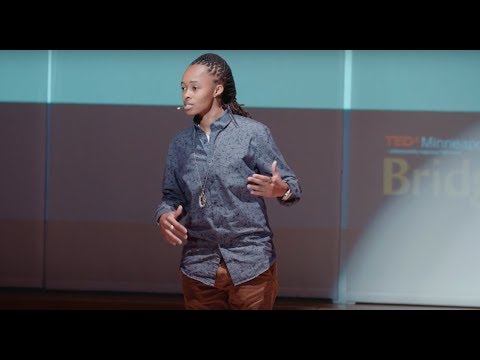
before I was born
there was movement paddle is pushing
pent up people through oceans of pain
that explains my fear of water when I
was born there was movement still lines
paths roads circles and tracks check it
I have my first perm in elementary
school went from coarse curly black hair
to straight thin then what are you gonna
do with this do after that I did braids
weaves ponytails extensions this faux
hawk mohawk duck tail design on the side
type thing now I have locks but before
all of that I also wore tracks then
there was high school st. Paul’s central
big grey fire floor and a basement
building kind of looks like a prison
kind of ran like one to the fifth floor
was for the academic acronyms like AP
and IB the fourth floor was for the
quest learners second to the best grade
point average earners the third while
the third was whatever the second was
passed in the first was us the theater
class how we were placed in this system
tracks pause my name is Tish Jones and
I’ve been called here to represent
ancestors whose blood sifted through the
palms of my little brother’s hands as he
plays in the sand and they bless him
forefathers who existed before my
forefathers and raised men to raise men
hence the Sun and the raisin and then a
generation of beautiful black women born
and bred to believe that beauty belongs
to everyone but them so they die and
they fry and they try to fit in in many
ways allowing trains to leave tracks on
their thighs because the tracks attached
to the root of her naps was hanging to
the middle of her back reduce
self-respect and she is alright with
that they call her a runner making laps
on laps known as a track star she is on
someone else’s track then there’s the
little boy whose father was sent away
yesterday yes he’s having a bad day so
he answered the test questions in the
wrong way he’s frustrated in the hallway
fighting to keep his tears to himself
and she walks by smart skinny makes
failing a test seem hard if you don’t
believe me people a report card anyway
she and he were cool they went to the
same school hung in the same crew did
things that two best friends would
normally do until after taking that test
when she he got labeled
advanced and he got labeled a fool
dropped out of school did what he felt
he had to
became a star mathematician a genius in
the kitchen studied how different greens
and whites would help with his addition
a financial adviser for women pimpin and
flipping now my man fights his tears
inside of a prison right next to pops
pause forget it just play track black
boy or football or basketball or just
ball black boy rob steal fail get money
kick girls and go to jail you do the
same black girl read Cosmo people vibe
and vixen try all your life to find a
place that you fit into you see I
represent broken history’s missing text
from textbooks kinesthetic learners that
don’t test good products of society 24
hours of good clean sobriety of language
that I play with because mine was taken
in a country that shuns me and I have so
much stake in it a people who are a
direct result of an action taken and the
people who fear those people so they’ve
created laws to evade and contain them
inside of lines paths roads circles and
tracks my name is Tish Jones and I have
been called here to represent the
missing piece thank you for listening so
I’m sure you caught my name so but for
the sake of repetition its Tish Jones
and the poem that you just heard is
called tracks we’ll talk more about the
poem briefly but for right now I want to
tell you a little bit more about me I am
a poet
[Applause]
so I’ve always been a poet I primarily
practice spoken word poetry which we
define at true art speaks as poetry that
is written with the intent to be
performed
I don’t do this work because I like to
be the center of attention although I do
like to be the center of attention I do
it’s true but it’s because spoken word
is so dynamic the writing process is
deeply deeply deeply introspective
critical and informative it allows the
writer to learn more about themselves to
play and imagine while simultaneously
giving us a safe space to question
critique and challenge the world around
us through a creative process the
performance aspect of it just allows me
or at the performer to connect with
folks we may have never otherwise
encountered yeah it is a powerful
practice of meaning making knowledge and
coming to know oneself Paulo Freire a
great educator author of pedagogy of the
oppressed once said that there was no
such thing as a neutral educational
process he said that education either
functions as a tool to integrate the
younger generation into the present
logic of the education system and bring
about conformity to it or it becomes a
practice of freedom the means by which
men and women deal with creatively and
critically their reality and discover
the tools necessary to reimagine and
transform their world spoken word then
is a practice of freedom and tonight
good people we are here to talk about
freedom
yell with that but before we do we have
to break the rules really quick we have
to do something about the fourth wall
the fourth wall is a theater term that
refers to this imaginary line between
the performer and the audience meaning I
need to hear from you my style is to
hip-hop to talk at you all night so
we’re gonna do this thing hip-hop style
call them response very true to TEDx but
also I need to know that you’re rockin
with me in the contemporary sense of
performance poetry we have folks snap
their fingers when things resonate with
them so if you hear anything at any
point tonight and you’re like I feel it
just snap your fingers so I know that
we’re good good good sounds like rain I
love it cool so let’s go back to the
poem really quick tracks was one of my
first practices at freedom it was
written just shy of 21 new to college
queer black woman from the historic
Rondo neighborhood which is in Saint
Paul yeah a historically black
neighborhood that suffered from like
many other black indigenous and POC
communities throughout the United States
it suffered from targeted systemic
institutionalized racism yeah this is
important to my process because when I
was writing this poem I had literally
just hit my stride yeah I mean like I
just got into being a poet so I was
thinking about these things
I was thinking deeply about the ways
that my history and those different sort
of intersecting identities would affect
my life my future my social circumstance
the process of writing the poem help me
dig into that a bit deeper let me
explain tracks has three core sections
the first is about identity right it
opens with a nod to my aunt’s
lineage as a descendant of enslaved
Africans in North America it then moves
into a discussion of my struggle with
beauty standards highlighting different
hairstyles that I wore through my
teenage years pause I heard some of
y’all laugh at that part of the thing
thing which is cool that’s actually
really good
you’re laughing lets me know that spoken
word is working you can relate to what I
was saying I’m sure some of y’all have
had some updos and haircuts and like
different dye jobs that you try to tuck
in the back of the photo album hoping
that they never resurface again I
thought so I’m gonna call anybody out I
know some people fine I’ll call you out
but what that says to me is that spoken
word is effective it essentially can
build a bridge across an assumed see of
difference so when I talk about braids
weaves ponytails extensions this boho
mohawk ducktail design on the side type
thing it allows you to dig back into
your catalogue of you know hairstyles
that we never want to mention again and
it affords us an opportunity to connect
with one another yeah me the performer
you the listener and more specifically
in the context of my liberation and the
liberation of my people other black
women who may resonate with this
struggle to attain the unattainable west
eccentric idea and standard of beauty
there is a freedom in that connection a
freedom from isolation a freedom from
thinking you’re the only one that’s
dealt with it you’re the only one that’s
thinking about it there’s also a freedom
and letting go of the notion that you
can’t connect with someone that doesn’t
look like you a freedom to connect yeah
cool so uh the same of the
home talks about the outward facing
theme I should say is the school to
Prison Pipeline
but the real juice is highlighting the
absent narrative yeah what you hear in
that poem is the students perspective
about their high school experience from
the voice of the student the fifth forms
for the academic acronyms like AP and IB
the 4th floor was for the quest learners
second to the best grade point average
earners the third well the third was
whatever the second was passed and the
first was us the theater class how we
were placed in this system tracks this
is nothing short of a social political
analysis of the education system a vivid
depiction of an area high school
perpetuating social class hierarchies
yeah
the thing that makes this so exciting
for me is that it comes from the voice
of the student there’s this thing that
happens with marginalized communities
where we don’t often get to tell our
stories ourselves we’re studied like Lab
Rats jay-z once said you want to know
what I call the projects of projects
because it’s a project an experiment
we’re in it merely as objects students
scholars reporters researchers
missionaries they come into our
communities and tell us about us what
this poem does what spoken-word does is
it allows us to provide a first-person
narrative to talk about the authentic
experience that we live yeah
furthermore it pushes back against an
age-old practice of omission and erasure
we get to keep and write our history the
people’s version are y’all with me type
so the third and most important section
to me is the section about purpose all
poems have a purpose
they illuminate the poet’s purpose maybe
even the narrator’s purpose but there’s
always a piece about purpose
I represent broken history’s missing
text from textbooks kinesthetic learners
that don’t test good products of society
24 hours of good cleaning sobriety of
languages that I play with because mine
was taken in a country that shuns me and
I have so much stake in it of people who
are direct result of an accident taken
and a people who fear those people so
they’ve created laws to evade and
contain them spoken word is a radical
tool in our collective liberation it
makes way for the voiceless to reclaim
language to reclaim words to reshape the
world now the approach and the
methodology may be different from poet
to poet for Shore but one thing you can
count on with the spoken word poem is
that we are going to come through with
our history be a personal collective
whatever we’re gonna talk about our
identity yeah and we’re gonna be
creative that’s one thing that’s
consistent and across the board with a
spoken word poem when a poet gets on
stage they are sharing themselves their
history their lineage their hopes their
dreams their fears and their wildest
dreams for the future yeah they are a
bridge beckoning connection we all have
been inducted into this idea of
difference for so long spoken word is
challenging us to let go of this
practice of other and really see one
another to build tribe that’s my mission
my mission is to build tribe so this
isn’t a call to you all to pick up a pen
and write a poem or a book that’s my job
but it is a call to open your hearts to
support the arts to go to a show to
practice freedom through deep listening
and recognize the significance of
bearing witness to another’s story and
carrying that truth with you every day
for the rest of your life to paraphrase
Lila Watson my liberation is intricately
connected to yours and yours to mine and
it is time to get free thank you
[Applause]
you
Please follow and like us: