
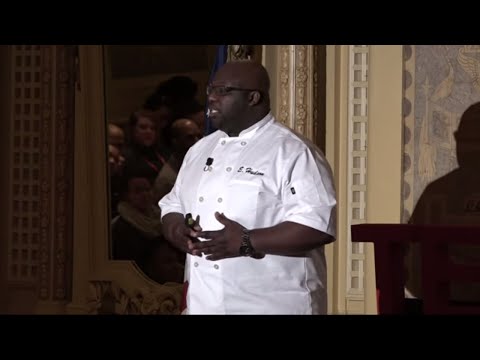
to a couple of you who thought I was
here to pour you water or serve you
lunch I’m not here to serve you food I’m
also back backstage behind the banquet
room the catering manager let me use a
cart here and one of the workers was
like what are you doing back here
I’m like oh I’m getting one of the carts
she said well that’s not how the cloth
goes on top let me help you I’m like
okay thank you so I want apologize to
growing up we had this thing in school
called show-and-tell where we had to
bring something in school that
represents who we are and show the
school how cool it is and everyone’s
like oh wow that’s nice you have your
lucky hat or your favorite pin or
something you got from a trip so I
thought at home I’m like oh man it’s my
week to go for show-and-tell fifth grade
what am I gonna do for my peers what can
I bring in class that represents Who I
am so I asked my mom and my dad I said
hey can I um can I cook for my class mom
dad and said sure so I packed my mom’s
frying pan spatula mayonnaise ketchup
steak Holmes cheese salt and pepper and
my dad drove me to the school and I
dropped and he dropped me off and had
all this cooking equipment in my class
until this day a good friend of mine
burnt Evans who was an elementary
teacher he reminds me like man in fifth
grade you made cheesesteaks in a Friday
they was banging – I was like wow yeah I
did do that I forgot 34 now yeah so um
I’m standing out to say Who I am today
working in food and education as a
culinary arts teacher I found that
there’s a strong connection between food
and education I always didn’t look at it
like
that because when I went to college
majored in hospitality and tourism
management my bowl was – you know what I
want to work on a cruise ship I want to
cook for people when they served them
that’s why that’s what I want to do when
I got to college teaching fell in my lap
and I started working with students and
I’m teaching them culinary and
hospitality and I see that they’re
struggling they’re struggling with not
just cooking because they all have their
their top chefs at home their mom and
dad who taught them how to cook and they
come to my class like wow that’s not how
my mom and dad taught me but look this
is how I’m going to teach you and
listening to me not them you don’t cover
food halfway with foil and put it in the
fridge that’s not right we don’t do that
that’s not safe we often tell our
students to think outside the box think
outside the box which is very important
to understand the concepts of different
things and how they connect into to
further your thought but we before we do
that we need to show them and reiterate
how why it’s important to think inside
the box there are so many common things
such as how many teaspoons equal a
tablespoon how many tablespoons equal a
cup how many cups arena playing how many
pints are in the court quarts in a
gallon those things you know about
what’s inside the box before you can
think about outside the box furthering
conversions and tripling and doubling
recipes and cutting recipes in half it’s
a lot I know right fermentation food and
science first of all fermentation is a
chemical process that takes place when
it turns a substance into energy when
you’re eating a yeast roll you’re
actually taking part in a science lesson
how did that yeast roll get that size
how did it get fluffy and big we all
have bread at home I’m sure that’s
science right there I had a student who
came to me in class she said Mr Hudson
looking like my cookies on the tray all
heard the whole tray was all you saw was
a brown mass like what’s what’s going on
let me see what’s going on she said
didn’t they’re all stuck together Mr
Hudson I said hey what did you put all
the ingredients in the pan and the bowl
yeah I did
no you didn’t you’re missing something
you didn’t use baking powder there’s not
going to rise without baking powder this
is the leavening agent this causes
things to rise so before you mix the
butter and the brown
the flour and baking powder must become
best friends first to try to use that as
an analogy metaphor they happen marries
together so the flour knows that hey
there’s someone here so help me rise
when I’m in the oven gotta use that next
time you understand me yeah you got you
got to be creative if not they’re gonna
fall asleep in class and most of them
just want to eat all the time and it’s
not about you that’s I don’t look if
you’re here to eat you’re missing the
whole lesson imagine going into a
classroom of students and everyone’s
coming at 8 o’clock in the morning and
they’re halfway sleeping tired
I’m like hey guys we’re on a field trip
let’s go get your coats on yes we’re on
a field trip
we’re get regular bus we’re gonna go to
a different country and on a different
ingredient no like oh we’re not going
anywhere
say hey traveling starts in your mind
first food is social studies think about
it
my mom is the gingersnaps all the time
when I was a kid gingersnaps she’d take
some cheese out the fridge and put a
bajillion ginger ginger snaps and
chewing on them and munch them like man
I love ginger status old school being
older now I worked with ginger all the
time now tell my Sooners like look
ginger wasn’t always in the US it came
from different country Southeast Asia
parts of India it was cultivated from
there originated there now it’s all
throughout the world
cooking is geography there’s social
studies there’s so many opportunities
that we can use food and education as
far as read teaching not just read
teaching and most importantly learning
before you can reach something you have
to learn it and usually when you read
teach it that creates a reinforcement
reteaching and throughout the summer
lots of students like they lots of
students they forget things that they
learn throughout the school year so it’s
very important that we we teach and we
would call them to relearn things and
reinforce things throughout the school
year think about food
so how this looked some props here
absent this is soup okay so there’s no
sleep in here but as you see so think
about think about food you can see food
you can smell it you can hear it cooking
you can touch it and feel it you can
taste it like all these all these this
food uses all your senses what better
way to connect and using food and
education food language arts so I know
y’all hungry right now for lunch right
so here’s the menu
today’s lunch menu ran some fries
chicken lasagna or spaghetti but none
I’m not puttin but peach salad excuse me
and we’re gonna have some flour
tortillas language arts vocabulary Houma
phones words that sound alike but are
spelled differently there they’re those
things happen every day and especially
on food and recipes and cooking you have
students have a spelling test and these
culinary words are foreign to them the
foreign because they’ve never heard them
before and they’re getting to my
culinary class they’re like wow that’s
how you spell spaghetti yeah
the G is silent sorry lasagna the G is
banana all these words that they’d never
seen before
it’s it’s an introduction to a new
vocabulary takes them from here to here
and it connects them so man you know
what when I get up in the morning I’m
gonna go to culinary class and mr.
Hudson’s gonna show me some new things
because we’re connecting we’re
connecting messages all about education
as possible through connections whether
connect our kids to that seat in the
morning it’s just not about plus and
minuses but what’s the content behind it
food and education rules the world food
and math had a young man in class he’s a
junior I say hey
we need to double that recipe for those
cookies we’ve gotten more orders recipe
calls for one and a half cups of brown
sugar
he took a measuring cup he said what’s
what’s 1 and 1/2 he’s just holding his
hand I said don’t you double the recipe
you needs more brown sugar double ooh
one and a half cups I said tell me what
it is young man he struggled it’s a
double recipe one and a half cups your
mother actually go to the grocery store
you and your cousin should give you $3
and says had you guys put this evenly
between you two how much money can each
of you spend
he said dollar and 25 cents I said look
everybody going to classroom right now
look at the white board I drew some
pizza slices I drew some hamburgers and
cut them in half it was my goal as a
teacher to show him how food connected
to math it’s everyday it’s in this
cookie right here has a diameter radius
which leads to a circumference I was
thinking last night as I was sleeping
how many kids go to McDonald’s again
french fries what if they got a small
fry and medium fry a large fry had to
count all the fries and then
differentiate the difference between the
amounts of french fries proportion and
then use that to calculate the price and
see if the price range fits the order
just food for thought
I didn’t write that I’ll just never
snows good right we’re behind we’re
behind
we’re behind is a country on each States
of America we ranked according to the
performance of the program for enter
national studies assessment will rank
24th and reading out of 72 countries and
we’re ranked 40th and math out of 72
countries so every every opportunity
that we get to to teach our kids
something and to reinforce something
let’s take that serious 2014 I decided
how can I help not people just inside
the classroom but outside the classroom
with this food and education idea and
it’s thing they’ve been around for a
long time Home Economics
– piccola Home Economics and culinary
February is actually in United States
it’s the its national Career and
Technical expiration month so let’s get
a round of applause for all teachers who
teach a CTE class for all the hard work
and dedication I decided I was going to
go around and Delaware which is a state
on the East Coast right below
Philadelphia I was told to say that
y’all laughter sir I decided to go
around and go to churches daycare
centers after-school programs in people
homes summer programs and do this thing
called spatular which is showing a young
man or a young woman or a group of them
how cooking and academics relates
together in 60 minute session and we
will cook taste it analyze it then ask
questions like how why what what took
place with vocabulary words are
associated was their swing small dice
and mincing how can you do something
differently what if we use brown sugar
it would have used white sugar but if we
didn’t use flour what would happen and
the 2014
I was notified by the National
Restaurant Association that I was going
to be the educator of excellence for
Delaware they flew me out to Chicago I
got to go on a food tour and taste
different teas and spices and all kinds
of craziness I’m a little kid from just
from the trailer park and Concord
Delaware Seaford I’m here in Chicago
what other national award winners from
every state and we’re talking about
problems that we have in our classroom
it was a great opportunity in a very
appreciative of that
speaking of opportunity you have the
opportunity each and every day before
you eat or before you drink something to
share with the younger person how that
connects the education our earlier
speaker Michael Phillip was talking
about broken chairs ideal were broken
recipes and from that we have to teach
our students every day and learn and
move forward thank you so much for your
time [Applause]