
[Music]
music and history have been tied
together in the entire history of
mankind the music has always represented
the socio-cultural development of man
the life of man and the development of
music has always been hand-in-hand and
has helped each other in its progress
music has developed and has helped in
the cognitive development of man in the
spiritual inspiration and creative
expression back home in India music is
considered as a form of ganderville Vida
and musicians have been hailed as
gondolas a kind of heavenly beings and
no wonder many of the gods and goddesses
of the Hindu tradition are embodied
performing a instrument god Krishna
plays the flute Shiva please the dummer
ooh Nandi placed them read angam and
Saraswati plays the sax with Davina Wise
has been the first instrument that man
discovered that he could sing he could
produce a note and after that was the
hunter’s bow when he first heard the
twang of the bow while he was hunting he
said hey this is a nice stone and he
used the bow for more one more than one
purpose which was hunting he created a
music instrument using that then he made
a two string instrument dothe re the 1
string instrument was a diary then he
tied three strings and made three
tantrika
this were all predominantly strummed
instruments and then he changed the
number of strings and got more notes and
then one fine day
he put in a small wooden piece or
sometimes a metal piece which later
began to be called as a threat he
discovered two notes he started making
changes using the frets he had four
frets seventh fret instrument then
twelve fretted instrument a krogger will
me Lavina v raga may Lavina so what does
this term veena one ent Davina anything
that can be played was called the winner
our first references to this term is in
the sama Veda when you see sculptures
and this from the samaveda period
holding you know sculptures having an
instrument that looks like a veena and
to the recitation of sama Veda as the
police were chanting it their wives were
playing this instrument called Arden
berry which was also a strummed
instrument to the accompaniment of the
beautiful sama Veda soon all over India
this instrument became so popular and
took many shapes sizes different
structures with different sound
qualities we had the rudraveena we had
chitravina vichitravirya and Saraswathi
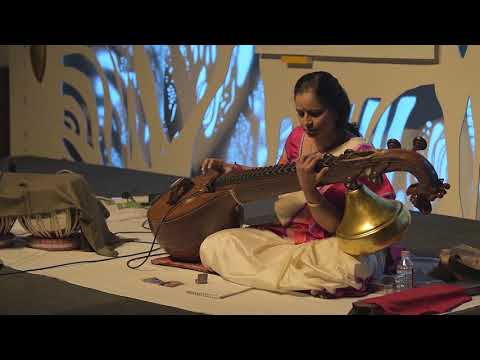
bina Saraswathi veena as you see today
has taken its shape structure and sound
for the last 350 400 years to this shape
there was a place a complete region
called tanjo it’s not the city that we
know a standout now a whole region
called tanjo where initially cholas were
ruling they were taken over by some of
the rulers and finally the Nayak’s came
so I’m tracing history and the
development of music side-by-side so you
can trace this intertwining of
development in India so when the Nayak’s
came over there was a huge outbursts and
it became a melting
point of culture art literature and
poetry so during the reign of King
raghunatha Iook there was this amazing
minister called Govinda deeksha and his
wife I’m sure of go in the digital had
done a TEDx talk those many years ago
it’s routine totally amazing because he
was a man with amazing ideas and he
created a revolution in art and culture
during his time so he was the person who
actually designed the veena with 24
frets for the first time that rests on a
ledge made out of honey bees vats with
two main resonators both hollow with the
veena designed in a shape of a human
body with the head something like a
spinal cord and the lower portion now
there are 24 vertebrates in our spinal
cord and the veena has exactly 24 frets
he designed the seven stringed
instrument that is four main strings and
the three strings on the side and during
the time of raghunathan Iook
instrumental music gained a lot of
popularity and there were so many
amalgamations of musicians
instrumentalists during this time 24
also because 12 notes and two octaves
and the veena itself you can play three
octaves on this instrument there’s a lot
of mystical satirical and spiritual
significance that is attached to this
instrument it is considered to be the
queen among all instruments which is why
the goddess of learning Saraswathi is
personified little veena and what is the
esoteric significance
24:00 Akshar –is in the Gayatri mantra
the sacred hymn which is why there are
24 frets the four main strings symbolize
the four Vedas Rig Veda sama Veda
Ayurveda another way Nevada the three
strings on the side symbolize each a
Shakti which is desire jnana Shakti
which is knowledge Kriya Shakti which is
action now playing this instrument you
activate the nerve endings the tip of
the fingers of both these hands and
nerve endings are acupressure points so
when you literally pull the strings you
activate the pituitary gland and you
activate a certain positive energy which
is why even playing the veena is
considered to be a beautiful type of
Kundalini Yoga so this is the mystical
background that is attached to this
instrument before we go further I think
you should listen to the instrument the
sound and we can go further into the
story of the veena
[Music]
you
[Music]
Oh
[Music]
that is the sound of the veena that
Lagoon ethnic created he didn’t create
this instrument he created something 400
years ago and talking about the
development of music during the
development of other things in India
King raghunatha tonight’s Minister go in
the dictators son Benkei Tamaki was an
amazing scientist mathematician so with
the help of the 24 frets he came about
and he invented a theorem 72 melakarta
vargas 72 parent scales that gave birth
to several generales several children
Gragas now the 72 melakarta raga the
system that is introduced to Indian
classical music made Indian classical
music one of the most systematic one of
the most theoretically sound one of the
most scientific and grammar rich
traditions of India so every raga there
is there’s actually a small formula
called Akata Piatti Sankhya you use this
formula you can find out any raga that’s
a whole different subject by itself
coming back to the structure of this
veena why do we have a dragon head here
so legend goes that at one point in time
deep into the forests when a group of
sages we’re performing a sacrifice there
was a dragon demon that appeared and
gave them as much trouble as possible
and prevented them
doing the sacrifice so these sages pray
to Lord Brahma the Creator and ask him
to do something to destroy this dragon
demon so he delegated this task to his
wife goddess Saraswathi and she went
into the forests hid herself and played
magically melodious music from the veena
hiding herself somewhere inside this
dragon heard this music and was so
intoxicated by its magical sounds that
it really it went mad and it was
searching for the origin of the sound so
much so that this dragon started doing a
penance beseeching the grace of God to
know the source of this music Sun
Goddess Saraswati appeared and he said I
surrender all I want to do is to be in a
place where I can listen to this music
all the time
no wonder Saraswathi replaced the
peacock on her veena with a dragon so
when all of us play we better play the
right notes otherwise the dragon might
come alive and for the wood that’s used
jackfruit tree used to grow a lot in
Thanjavur district so they used
jackfruit tree wood to make many
instruments Brittingham veena and other
things in the olden times they used to
be huge temples with jackfruit trees and
the temple bell would be tied onto the
stack through tree so five times a day
the temple rituals would go on and the
bell would be rung at a time for at
least 10 to 15 minutes the temple bell
would ring the huge bells and the
resonance of that Bell will get on to
the wood of the staff root tree
so after a period of seven or eight
years I’m sure the resonance of that
Bell would have really soaked into that
mode so that tree would be cut and a
music instrument Avena or
would be meeting soon the demand for the
instruments increased and they started
having jackfruit tree plantations and we
no longer had the temple Bell kind of
seasoned wood so we just had jackfruit
tree venus and then we also started
using the demand for veena increased so
much that we started making venus with
drumstick wood with red cedar wood and
other types of wood like that veena has
played in many social locations it’s
such a part of the life in India it’s
considered to be one of the most
auspicious instruments harbinger of good
luck good health and good everything so
you could have been our concerts in a
wedding in an auditorium as an
inauguration of something you could have
it in temple festivals and there is also
a custom that when a woman is pregnant
in the eighth month they usually
organize Avena concept because the
vibrations from the veena is said to
have a direct impact on the child in the
bubble so this instrument is as old as
the Vedas and as new as tomorrow it has
been growing so much adapting itself to
the modern times with the advent of
electronic and electrical development in
India we not kept up so we had contact
mics we had electric my microphones we
had sound cards we had di boxes we had
laptop sound the sound was amplified so
you could hear it from being a chamber
player instrument it made its journey
into the stadiums and today I personally
have traveled worldwide to the remote
parts of the world carrying the
Saraswathi veena and the melody along
with it today they also make digital
Mina’s electronic Mina’s there is a
latest digital veena where if you just
put
midi mixer if i play just on the veena
you can hear it as a flute you can hear
it as a sitar as some other instrument
so this instrument is growing its
popularity is growing and they’re using
it in films popular music in jazz
concerts rock concerts in all types of
genres veena is used I’m sure after this
you’ll go back read a little more here
little more about Saraswathi Meena the
national instrument of India
[Applause]
Please follow and like us: