
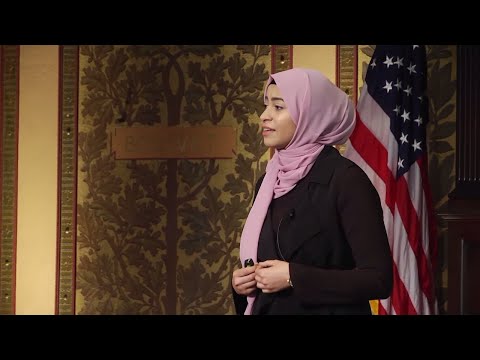
last March I was right here in Gaston
Hall attending the ownit summit after
the end of the first panel I decided I
wanted to go outside and call my mom to
talk to her about all the super awesome
feminist woman who were doing the kind
of thing I wanted to be doing 10 20 30
years from now woman who were actively
working to create a space for themselves
and for future woman like myself I was
so excited to talk to her until I heard
her voice I knew that tone of voice mama
what’s wrong nothing’s wrong habibti I
love my things wrong mama you’re crying
what’s wrong I’m just I’m just sad about
things back home don’t worry about me
though nothing’s wrong I’m just I’m okay
focus on your studies you’re a senior
everything is gonna be okay
I knew not to take my mom’s words at
face value
I knew that tone of voice that would it
was the tone of voice that comes from
the gut-wrenching pain of losing a loved
one I decided to call my little sister
Fatma
I spoke to mama I heard her voice who
was it who died this time it was
Mohammad who let Hani our maternal
cousin this was the third cousin we lose
in the span of three months I can’t even
keep count how many family members we’ve
lost over the past two years I was born
in Benghazi Libya most of my family
lived there until they were displaced in
2014 because of a civil war that no one
wanted starting October 15th 2015
we’ve been continuously losing family
members and loved ones to a civil war
that no one wanted I still feel the pain
of each loss still feel it right here
but more than the pain I feel guilt you
see there’s a survivor’s guilt that
comes during times of war and I feel it
exponentially how is it my family are
trying to live escaping the horrors of
war while I’m at Georgetown what did I
do to deserve this level of privilege to
make things worse I didn’t have the
language to speak about this type of
guilt to my friends which only isolated
anymore
I felt guilty for the smiles at a crack
joke I felt guilty for the stress of
midterms because my cousin’s didn’t
hadn’t even gone to school for the past
couple of years and I couldn’t talk to
this about my I couldn’t talk about this
to my friends because we’ve been taught
to value problem-solving overactive
empathy so every time I would talk to
talk to someone about this they try to
come up with some solution which was
never really a solution only isolating
me more
I still remember one specific instance
of this I was talking to one of my best
friends whom I loved dearly
about this and she said maybe I should
consider learning to forgive she started
reading doesn’t lead to two quotes to me
which only infuriated me more how dare
you how dare you ask me to forgive when
my cousins were taken away from their
mothers how dare you ask me to forgive
when my family home was burned to a
crisp how dare you ask me to forgive
when I still hear the crack in my aunt’s
voice every time her son’s name is
mentioned
she took a moment and then responded but
how will you heal how will your country
heal you see by that point I’d perfected
the art of I’m fine every time someone
would ask me about this don’t worry
about me I’m fine don’t worry
and the little smile to look to assure
all my friends that everything was ok
and that they didn’t need to feel guilty
for not being around me all the time
after all the losses I’m fine well good
know about it but every time I did that
raging forest fires of anger started
inside of me which left no space for
healing was it even possible to heal
after this much loss I started looking
for ways of healing that didn’t require
forgiveness forgiveness requires someone
ask for forgiveness forgiveness requires
some form of moral justification or
explanation of these people’s actions
and I couldn’t bring myself to do so
while talking about this to one of my
professors
she mentioned a group called the Y ihr
the Youth Initiative for human rights in
the former Yugoslavia there a group of
young activists who create art
installations like this one across the
different cities in the former
Yugoslavia this art installation was in
Pristina and Kosovo it has inscribe all
inscribed the names of 1819 missing
persons since the last war in Kosovo and
in front of the wall
they put a chair to remind people all
these names for all these names there is
still a chair in someone’s living in
someone’s dining table their families
are still waiting for them to come home
for dinner what was controversial about
this piece of art though was that the
names of the victims were not just those
from Kosovo there were crow
and Bosniaks and serbs the pain
transcended the borders that were
created by the war that reminded me of a
scene that i had seen at a libyan Aza a
libyan Aza is a social occasion after
someone dies all family friends and
loved ones come to give condolences to
the family of the person who had died I
was at one Aza when I saw a scene that
no amount of words can describe to
mothers whose sons had fought on
opposite sides of the war hugging each
other and crying
each whale barely drop in the ocean of
their grief I was so surprised by the
scene I asked my cousins about it and
they said this wasn’t a rare sight they
said these mothers understand each other
in a way no politician ever will both
mothers wake up every morning for a
brief second everything’s okay until
they remember and when they remember
it’s like a wave hitting them in the
face again and again and again every
moment reminding them of the moment they
found out that their son was no longer
alive these mothers when they see each
other they don’t see politics they see
the pain they practice empathy these
mothers understand each other in a way
no politician ever will or else why
would they keep sending our sons to
fight each other
in trying to understand this I’d have
the only thing I know how to do when I’m
overwhelmed by emotion I wrote a spoken
word poet Sarah Kay the poet says spoken
word poetry is poetry that demands to be
heard or witnessed one of my professor
is an undergrad taught me that spoken
word poetry is three minutes of me on a
stage uninterrupted so I can interrupt
the status quo to me spoken word poetry
is feelings that refuse to sit on paper
or a screen they want to scream and they
use my vocal cords as a tool to do so
and so I wrote this poem
we have a proverb in my country chief
and man magische vallei en but the curse
come to my money and not my children but
the curse has taken both the curse has
turned my home into a graveyard full of
names of people and once recognized
filled with the stench of death almost
distracting me from the smoky gray of
all the tombstones with father daughter
son beloved beloved beloved that word
brings about the shrieks of all the
mothers after losing their sons that
word brings about the grief of knowing
that my brother isn’t coming home my
brother isn’t gonna tell me I’m safe my
brother my beloved mode then reach the
Palestinian poet says I kill her and I
lie in the same grave in war this war
has turned my city into a graveyard and
in the graveyard there is no winner for
the killer in the killed lie in the same
grave
this poem was a culmination of two years
of emotions this poem was the beginning
of my healing process it taught me that
in the graveyard there are no winners in
the graveyard there’s only pain and pain
pain knows no ideology no nation or
ethnicity or religion pain affects us
all and reflecting about this poem and
everything that I’ve been through in the
past couple years I noticed something I
noticed that people try to put a
hierarchy on pain we try to say
my pain is tougher than theirs my pain
it’s harder but in the process of doing
so we don’t realize that we’re isolating
them from empathizing with us and we’re
stopping ourselves from emphasizing with
them we try to tie a moral character to
pain and in the process we don’t
acknowledge the pain of those that we
disagree with empathy on the other hand
empathy allows us to see the pain of
those that we disagree with to go a step
further
empathy allows us to see the humanity of
those that hurt us I believe empathy can
be learned specifically empathy can be
learned through art and I’m not talking
about the really expensive art that no
one really understand that goes from one
millionaires house to another
millionaires house I’m talking about the
art that disrupts the daily I’m talking
about the art that disrupts the news
bites
that we’ve become descent desensitized
to I’m talking about the roses of
Sarajevo campaign which was done in a
way to draw a red rose in every place
that someone was killed in Sarajevo in
1995 I’m talking about bear story which
tells the story of Leopard I see those
in Chile in the span of nine minutes I’m
even talking about Hamilton which has
led us all to reconsider how we view our
history and how we interact with our
society today art is a powerful
disrupter my personal medium of art is
poetry for the past two years I’ve been
performing poetry to diverse audiences
and it never ceases to amaze me how a
poem so personal to me can deeply affect
someone who was born and raised in
Venezuela or Colombia or Yemen or Syria
or even in the safety of the United
States and I think that’s because poetry
spoken word poetry is vulnerable when I
perform a poem it’s three minutes of me
on a stage sharing my heart to a group
of people I’ve never met before but it’s
that vulnerability that allows them to
approach me after the end of the poem
and say felt that you see I have this
kind of similar experience because of
this in this often opening up a
discussion that wouldn’t have happened
otherwise
poetry uses my tongue as a paintbrush to
accentuate the colors of my words in a
performance that’s the portrait in the
end
and that portrait opens up a key to
finding empathy now while there are
still raging forest fires inside of me
from all the pain and all the loss I can
confidently say that there slowly but
surely calming down from the rain
brought by by empathy empathy is the key
to healing a divided society both
personally and societally an art is the
key to that empathy
[Applause]
Please follow and like us: