
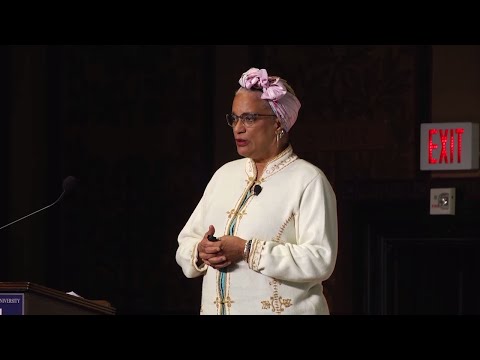
greetings everyone thank you so much for
coming I am feeling so much better about
2060 following Pedro and our mod my
millennial status is well in short I’d
like to greet all of you and thank you
for being here today my family friends
fellow talk presenters what a wonderful
day to be here in the here and in the
now we are graced and blessed by small
blessings and very tender mercies my
story starts simply enough I was born I
was I was born on April 10th 1954 at
12:45 p.m. on a Saturday afternoon in
New Orleans Louisiana very famous City
if any of you don’t know where this
place is see me in the breakout session
I’ll tell you all about it
you’re warmly welcomed and invited in
the West African tradition of naming
children on the day and the week that
they were born and the order of their
birth I’m called Mele Amma how I came to
have this name as a different story for
another day but please feel free to call
me Mele um firstborn daughter on
Saturday suits me well
um a few weeks after I was born May 1954
the US Supreme Court handed down a
decision that would come to be known as
the Brown versus Board of Education
decision this decision by the Supreme
Court effectively struck down all of the
Jim Crow laws and bad legislation and
laws of the person of the Plessy versus
Ferguson decision of 1896 which ushered
in many many years of terrorism murder
and disenfranchisement in the name and
guise of self-proclaimed white supremacy
it was a very very difficult time I
forgot everything I’m not gonna lie I
did so I’m gonna take my glasses off so
my mother was holding me in her arms
when she heard of this decision and she
held me a newly minted mom held her
newborn baby me very close because she
knew in that moment that my worldview
would be so much different from hers my
mother said a prayer for me and all the
babies like me things would be different
today I am a rising first-year student
at Georgetown University
I joined familial traditions of many
people all over the world who send their
eligible children to be educated at
universities colleges and institutions
from which they themselves matriculated
and upon completion of their education
pledge their finances their physical
support their moral support and their
dedication to these universities
oftentimes through many many generations
I went to to legacy schools and went
through legacy schools in New Orleans
Louisiana my great-grand aunt was the
principal of McDonough number six which
was the school I attended in elementary
school so this is me at the convocation
a few weeks ago two months ago when I
first arrived here and I was very very
honored to be asked by the university to
accept the College banner at this year’s
convocation it was an honor
it remains an honor it’s very important
to me and very important to all of us
and to the extended Georgetown
descendants Association so getting back
to my legacy schools my aunt my great
aunt was the principal at McDonough
number six which was the elementary
school that I attended I was fortunate
enough to be able to go to a
neighborhood school three blocks from
home I walked to school my mom my
parents we walked it was very safe
it was very secure I thrived and did
really well
in my little school clothes in my
neighborhood we were very very busy
learning to read to write being
creatively stimulated and we have recess
was very important going out to the
playground teacher ringing the bell
we were also children who grew up with
President Kennedy’s physical fitness
program it was the Cold War everybody
maybe was going to go to the Olympics
one day and beat the Russians while we
were in school we also had civil defense
drills which sort of went along with
your physical education because the
civil defense drill strategy that was
you as quickly as you can you go under
your desk now I have to say that I was
never quite comfortable with the under
table strategy of avoiding nuclear
annihilation how is how okay so that
wasn’t so good for me but I managed we
made it through across town for me
however there was a little girl in New
Orleans who lived a very very different
first grade year than mine her name was
Ruby Bridges and she was escorted every
day into school Ruby was the score
escorted every day into school by United
States federal marshals because she was
the first little girl to integrate a
white
school I went to a segregated black
school a Negro school Ruby walked the
gauntlet every day going to class past
angry white women who hurled epithets
daily at a small brown girl while they
kept their children their precious
progeny close to their sides out of
school and they planned the next boat
plane car ride out of the city if they
were going to be forced to have their
precious children go to school with me
us going to school and learning together
what kind of people do that hurl
epithets at a small girl because she’s
going to school with your child
six years later I think I got to go back
six years later after having this
wonderful bucolic school year six years
of school for myself members of my class
through the laws that were coming into
being at the time I had to go to
integrate a school in my neighborhood it
had always been a white school and we
had always gone to McDonough number six
which was a black school and I did not
want to go to that school that summer
was an intense summer of indoctrination
education more strenuous discipline by
my by my parents as they taught me and
made sure that I became aware of
negative words and ugly slurs and
horrible things that people will say to
one another
I didn’t understand it at the time it
was difficult it was hard I wanted to go
outside and play with my friends and go
on vacation like we always did and have
this wonderful summer and the fall go to
school with my friends instead I
realized now all of these years later
that my parents were preparing me to be
a young soldier and very hostile
territory and hostile territory it was
teachers classmates neighbors on the
walk home from school the walk to school
even the neighbor’s dogs there
like us dog person it wasn’t easy but we
survived we made it
hostile difficult unsure we made it
through
it’s very important there was no valid
reason that I could see or that I could
hear that these families and these
children and these mothers didn’t want
to go to school with me
my mother’s child simply because they
were white and I was not
I’m never gonna be white and that’s okay
what kind of people do that everybody I
knew and everybody that I wanted to know
loved me both of my parents were the
respective babies in their families now
when you are born and you are the baby’s
baby you got a sweet deal there was not
a home or a table or a family member or
door that I was not welcomed into and my
family would send me out from New
Orleans to the north to the east to the
west there were relatives all over
America and they all wanted me it was a
good deal and I thrived and I grew and I
was always going somewhere but the most
important person in my life was my
grandmother
Geneva Ruby Taylor lawless Smith
Big Momma big grandma mother my heart I
spent much time with her and most of it
was in the best friend pocket of our
relationship she told me tales of and
stories of my family my great
grandparents my greater grandparents my
greatest grandparents all the way back
to Maryland to this place
Mary Ellen Queen and Abraham Mahoney
born here in Washington DC isn’t that
amazing
so today telling a story telling this
story this is not my story this is her
story and if there were any one thing
that I could do today it would be to
change places with my grandmother so
that she could be here and she could see
all of you but that’s not the case so I
proudly stand here today in front of all
of you telling our American story which
has its roots and its foundation here in
Maryland in 1715 my ancestor of record
arrived here in Maryland as a free woman
in the company of Thomas Larkin who’s
then indentured her into servitude Queen
Mary served out the terms of her service
servitude and when that was over she was
then enslaved by the Jesuits of
garland or their agents working on their
behalf that meant for Queen Mary and for
her family that all of her generations
would be kept enslaved her grandchildren
her children her great-grandchildren
what kind of people craft laws in the
17th century of a colony that forever
consigned the children born from the
bodies of African women to be slaves in
perpetuity for all of their lives
because that was the law and so my
grandmother’s children were all kept
enslaved until 1794 when her
grandchildren and some of her
great-grandchildren use the courts and
sued the Jesuits or their agents in the
court of Maryland for their freedom
there are many notable names that are
associated with these suits
Edward queen won his freedom and 1794
very successfully and today there are
free Queens all over the world in 1810
Priscilla Queen and her baby sued in the
courts and their case was denied there
are no records a Priscilla Queen from
this 1810 case except for her attorney
of record
who later wrote a poem that we used
today very prominently because you see
my family was here in the light of the
Rockets red glare and perhaps one day
Priscilla and baby walked off with the
British
Francis Scott Key the attorney of record
for Priscilla Queen and her child we
know nothing of Priscilla and what
happened to her but we do have records
of her kids and her kin her good friends
her family are named in a bill of sale
brokered in 1834 by the jesuits of
Maryland and Henry Johnson and dr. Jesse
Beatty in Louisiana this bill of sale
comprises a listing of the largest
recorded human trafficking incident in
the United States of America people
often say well they’re slaves today and
they are there are that doesn’t say much
about the people who were enslaved but
it says a lot about the people who ends
leave I don’t think we’ve learned as
much as we should in 200 years
today these documents as I said comprise
the largest single list of people sold
by an institution in America I’m sure
they’re more and we are certainly very
happy that Georgetown has bought this to
the forefront the sale ensured that I am
here today as a legacy student I’ve been
asked over the course of the past couple
of months how is it that I at the very
very tender age of 63
remember 2016 is looking better 2060 is
looking so much better how I at the
tender age of 63 came to be a student
here at Georgetown University my answer
is always the same a hundred eighty
years ago
the Jesuits sold my family they did and
they also sold many other families
family groups but that sale was for the
greater good because today we have this
venerable institution that we call
Georgetown University Georgetown has
produced many many individuals
presidents pawns and policy makers we
could have a Bill Clinton and we can
have a Steve banner this is an esteemed
institution
the united states has benefited greatly
from the sale of these 272 people and
what was private history at this
university has moved into public
American history it belongs to all of us
now and there’s no walking away from it
we have to have difficult conversations
about how the great institutions of
America came to be the sale of 272
people who were my family were the
foundational funds used to secure the
wealth and education the educational
wealth of this university and of course
all of this was done for the greater
good it just wasn’t there greater good
there greater good would come later in
the bosom of Jesus and with me standing
here talking to you today
[Applause]
Please follow and like us: