
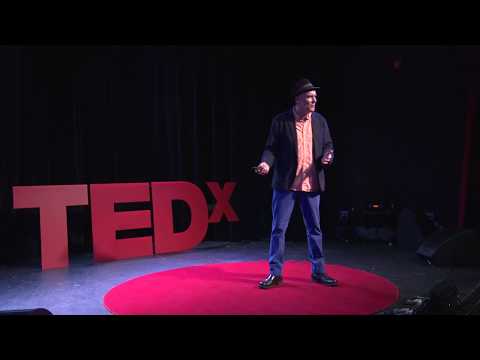
I’m a lucky man I’m also a professional
musician which is arguably another way
of saying
music has taken me around the world it’s
introduced me to some of my best friends
and even my wife it supported me for the
years that I’ve been working at all I’m
deeply grateful for that so 18 years
into my music career things were looking
good I had a new CD out it was my 10th
album I had a full calendar and I had
lots and lots and lots of hair and
that’s when I quit I got this email from
no friend of mine in England who had
just finished a master’s degree in peace
and conflict resolution that was fully
funded by Rotary International as a
rotary peace fellow and it snapped my
head around sideways I thought I’ve got
to go do that now
it was almost a mystical reaction that I
had in college conflict mediation had
really been my focus but in the years
since then as a musician it had been
squeezed a bit to the side when I got
that email it was clear that it was time
for me to put peace work back in the
middle of my life so I talked to my wife
about it amazing woman that she is she
said yeah okay go for that and then I
applied for that same fellowship it’s
internationally competitive and I had no
reason to believe I would get it but I
went ahead and announced a farewell tour
and told people that I was leaving music
at least for a time to focus on peace
work so my wife and my 10 week old baby
our 10 week old baby and I moved to
Australia to study at the University of
Queensland when I did in fact against
the odds get the fellowship I think
Mason might have been the youngest
applicant for a passport that year he
was just a few days old and since then
I’ve been pretty heavily engaged in
peace work both in the US and in other
places around the world and I don’t need
to tell you that there’s no shortage of
peace work to do right we have plenty of
conflict and we know that we’re living
in a particularly divisive time right
now in the US but it can seem a little
bit overwhelming I mean what does peace
work look like for us as individuals how
do we find our way into that
work here’s the irony I stepped away
from music to do peace work and in my
studies and in my work I keep coming up
against the fact that music provides us
really quite a powerful tool in peace
not just as an actual tool to to shift
conflict dynamics and build bridges
across divides but as a metaphor a lens
we can look through to help understand
what piece work is and what it isn’t let
me give you a couple of examples I think
most of us agree that in order to be a
good song a song has to be creative
excellence in music isn’t just about
adhering closely to rules there has to
be a spark of originality you may be
surprised to hear me say that the same
is true of piece work because we kind of
expect piece work to come naturally to
know what to do right and it doesn’t we
know from grade school science class
what does come naturally most of the
time when we’re faced with aggression
fight and flight the theologian and
nonviolent scholar Walter wink said that
our best options however are usually
neither of those usually there’s a third
option he what he called a third way
that can be a little bit more innovative
and maybe get us a little bit farther
down the road I want to tell you about
my favorite example of that it happened
in 2007 in Knoxville Tennessee
there was a clan and neo-nazi rally in
Knoxville just over the mountain from
where we are now and the counter
protesters came out in numbers and some
of them came out with brilliant
creativity they came dressed in full
clown regalia and the Ku Klux Klan’s met
the Ku Klux Klan that day when the Klan
began to chant white power the clowns
listened very closely like they couldn’t
quite understand what they were saying
and then they joined right in
enthusiastically because they figured
out that this was a rally for white
flour they had brought bags of white
flour and they threw flour in the air
and they had a whole lot of fun and
people started laughing at the Klan
rally and ignoring the Klan so they work
that gag for a few minutes and then they
said wait I don’t think that’s what it
was at all I don’t think this is
Valley for white flour I think it’s a
rally for white flowers and they started
handing out flowers to everybody and
people were smiling and then they said
no that wasn’t it again another clown
said oh I think we heard them wrong I
don’t think it was white flowers I think
it was tight showers and held up a camp
shower and they all crowded beneath it
and then they said no no that wasn’t it
at all this is actually a rally for
white power and they threw toilet paper
in the air and then they said no no no
that wasn’t it at all this is a rally
for wife power and we can get behind
that they pulled on their wedding
dresses and joined in chanting wife
power wife power the upshot was that the
Klan left an hour and a half early they
had the Town Square reserved for four
hours but they left after two and a half
because they had no idea how to deal
with this right I mean they know about
animosity they kind of thrive on that
they know about your fear and they like
that part too but when they were
upstaged by humor and fun they had no
idea how to respond so the best peace
and justice work like the best music is
inspired and planned for and skilled and
extremely creative there has to be a
little bit of conflict in music for it
to work as soon as a melody goes in a
direction we don’t expect to – or a
rhyme surprises us there’s a little bit
of tension in that song right a little
bit of conflict and that helps it makes
us lean in it makes the song work better
if it doesn’t go anywhere
if it’s just one note repeating well you
know the word monotonous that’s a
synonym for boring but literally it
means monotone us right it’s one note
repeating that’s not music that’s a
garbage truck backing up but
surprisingly perhaps I want to make the
argument that there’s a good and healthy
place for conflict within peace work as
well and we often understand peace work
as an effort to quell conflict to
eliminate conflict but that’s not
actually how it looks to me I had the
extraordinary opportunity a few years
ago to spend some time with John Lewis
the civil rights hero and US congressman
and we were talking about ways
we think piecework is generally
misunderstood in our culture and he told
me some amazing stories and one of the
things he said that I’ll never forget he
said dr. King used to say to me and just
with the preamble to that sentence all
the hairs of my arm stood up he said dr.
King used to say to me sometimes you
have to turn the world upside down in
order to set it right
conflict is often necessary on the way
to justice and we can’t help but notice
then we when we look at the lives of our
greatest peacemakers the folks we revere
worldwide though most of them were
deeply committed to non-violence it
seems like everywhere they went people
ended up bloody so are we wrong to call
them peacemakers I don’t think so I
think we need to nuanced our
understanding of what peace means to me
peacemaking is not an effort to
eliminate conflict peacemaking is the
art of approaching conflict in ways that
are constructive rather than destructive
but notice that the verb in that
sentence is approaching so that little
infant we saw in the passport photo he’s
now eight and he’s learning to play
violin you might notice that I lost my
hair but he found it we endorsed some
squeaky notes in the afternoons in my
house and I don’t mind that’s the sound
of learning and it’s pretty exciting to
me to watch him work so hard and really
make progress and the thing that I say
to him all the time is buddy if you want
to be really good at a musical
instrument the main thing you need is a
willingness to be bad at it long enough
that’s what practice is we work out
those skills when it doesn’t matter so
that later when it does matter they come
naturally again we may not necessarily
see peacemaking through quite the same
lens but it would be appropriate to try
that lens on John Lewis who we saw a
moment ago he and his compatriots
practiced for an entire year every
Wednesday night before they ever staged
their first lunch counter sit in they
screamed at each other they literally
dragged each other across the room by
the
hair they studied non-violence so that
their bodies and their minds would be
ready when they got there this is how we
do the work we show up and we do it
badly and we notice and we make notes
and we study and we improve our skills
in a word we practiced audiences the
concerts often feel like their role is
pretty passive I’ve found that the
output is happening on the stage and
their role is just to receive anybody
who has spent much time on stage will
tell you that that’s the furthest thing
from the truth a good live performer is
constantly tuned in to what they’re
getting back from the audience and while
they’re listening to the audience
they’re listening to their own
instrument to make sure that it’s in
tune and they’re listening to the other
folks in the band to make sure they’re
in the groove and they’re listening to
the moment to see if it needs them to
step forward or step back obviously
listening is a huge piece of conflict
resolution as well it is pretty much
impossible for someone to work on the
nuts and bolts of a conflict if they
don’t feel heard and when they do feel
heard and understood not necessarily
agreed with but really truly heard it’s
extraordinary how new possibilities for
ways forward together can emerge yet
when we come up against conflict it
seems to me that our most common
questions are what can I say to make
this better what can I do to fix it
Miles Davis said it’s not the notes you
play it’s the notes you don’t play and I
wonder if that might be the best place
for us to start in conflict what you can
say maybe is a little less what you can
do is listen
there’s this extraordinary moment that’s
happened of handful of times in my life
when I’ve been at a concert and a song
ends and fades into silence and it’s
been so moving and so haunting that
nobody claps now we have a
well-established social convention that
at the end of a good song we’re all
supposed to clap right what I want to
know is this how do 2,000 people in a
room together make the decision not to
clap without discussing it in a moment
like that it’s as though we’ve all
melted into one aggregate personality of
course there are some people who hear
that story and say yeah okay that was a
lovely feeling but it wasn’t real I mean
it was a nice vacation from reality and
tomorrow morning you’ve got to wake up
and go back to the cruel competitive
world and deal with that what if it’s
the other way around
what if the sense of connection actually
is the part that’s true and the sense of
disconnectedness of loneliness of
isolation that a lot of us walk around
with a lot of the time what if that part
is the illusion now when we bring that
sense of connectedness to conflict work
everything changes they shift from being
a conflict between us and them to being
a conflict between different parts of us
and that means people are harder to
dismiss it means that we can find it a
little easier to muster some empathy it
can change everything every once in a
while somebody asked me how long did it
take you to learn to play the guitar of
course the only sensible answer to that
question is I don’t know yet right I
hope to be playing my whole life and I
hope to be learning that entire time
piece work is a little bit like that
there isn’t an end point that we’re
going for it’s about the stretching on
the way I have this old bumper sticker
that says peace is possible on an old
guitar case and I have to be honest that
over the years I’ve become a little less
comfortable with that statement I’m not
sure I believe it’s true if peace is a
static state where we’ve worked
all our conflict and everybody’s relaxed
I’m not at all sure that’s true I’m not
even sure it’s a good idea but that’s
not bad news that’s a reframing think
about this when we look at a tree
we don’t say wow what a failure it
spends its entire life trying to touch
the Sun no luck right it wouldn’t be
good for the tree to touch the Sun it’s
not its job it’s job is to reach and
then reaching it becomes a healthier
tree and it also helps the world around
us it kind of makes me want to bust out
my sharpie and fix my old bumper sticker
and add a word because the question
isn’t is peace possible the question is
is more peace possible can we do any
better than we’re doing right now I
think we can and I think it’s worth the
effort as I explored my own capacity to
have an impact in the world I feel like
I’ve learned some things about
everybody’s capacity to have an impact
in the world and here’s the main shift
that’s happened for me I stopped
believing that heroes matter much I
started believing that it’s movements
that changed the world that means all of
us doing a little bit each bringing our
own parts moving in the same direction
that’s what a movement is and that’s
good news for those of us who want to
have a positive impact because it means
that we all actually do have the
capacity to change the world now granted
you start dropping the phrase change the
world in company without irony people
are going to do some eye rolling because
it sounds naive but the fact is it’s not
naive to think you can change the world
the problem is we’re sloppy with our
semantics we use the phrases change the
world and fix the world and save the
world like they are interchangeable and
they are not they don’t mean the same
thing if you think you can fix the world
I’m sorry to say that is naive if you
think you can save the world that might
not be your gig but if you think you can
change the world you’re just paying
attention
the truth is you can’t be in the world
and not change it everything you do
changes the world whether you like it or
not so the question for each of us is
which changes we’re gonna make and how
we go about getting started what’s
bugging you right now what do you see
when you look around you that doesn’t
feel right where are the people who care
about what you care about go and show up
and spend some time with them listen and
learn from them and then offer your
gifts pick something you can actually
achieve and then do it together and then
pick the next thing and do that too that
really is how the world changes so there
are lots of synonyms for peace and I’ve
become more enamored with some of them
over the years and a little less
attracted to others this one I think is
my favorite harmony beats unity looking
at peace work through the lens of a
musician you can’t help but notice that
unity is when we’re all singing the same
note together harmony is when we’re
singing different notes and they create
beauty together through that diversity
true beauty loves diversity it’s part of
it so I can’t think of a better way to
leave you all today than with just a
little bit of harmony
[Music]
these be your usual these be your bum
these be your bum
[Music]
[Applause]
Please follow and like us: