
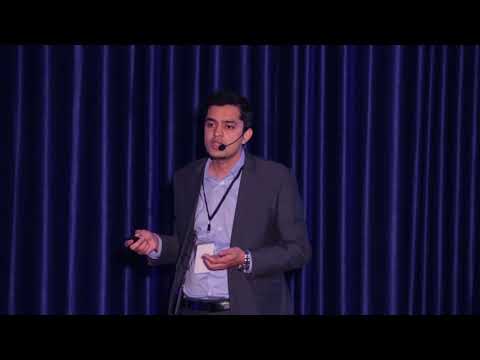
I’m here to talk about something really
simple and I’ll start by talking about
trust because something profound is
happening in the world of technology
that may have the solutions to India’s
biggest problems and we’ll start with a
few simple questions for all of you
please raise your hands if you’ve ever
been on an airplane okay very well if
you knew that the pet that the pilot is
flying the airplane didn’t know how to
fly
would you still take that flight fair
enough
how many of you look for reviews when
buying something online it’s really
greatly ok would you be ok with sending
money online to a stranger please raise
your hands I think the point is made
trust is something that we seek when we
interact and transact with one another
but trust is also about a lot more Trust
is the grease that allows our economic
and political machines to function for
instance we trust our democratic
institutions to hold a free and fair
election
it’s what enabled the previous Indian
general election to be the biggest
Democratic exercise in human history we
trust our lawmakers and our judiciary to
uphold the rule of law then there are
other institutions such as banks and
corporations that we rely on for a
multitude of things so suffice it to say
then we depend on institutions for our
most basic needs our rights our
education our health our physical safety
our prosperity and future are completely
placed in the hands of our institutions
suffice it to say also then that the
cause for a lot of problems that we face
in India today should be attributed to
institutions a multitude of factors have
compromised our institutions and
undermined our trust in them what are
those causes I think we can debate all
we want but there is one rampant disease
that I think all of us agree contributes
to this more than anything else I’m
speaking of course about corruption
India in the transparency international
index ranks 79
that’s an abysmal eat low number and
just to give you some context the lower
the number the most the more corrupt the
country is in a recent World Economic
Forum’s survey 50% of young Indians said
that corruption contributes most to
India’s problems the upside though is
that we are willing to do what it takes
to fight with corruption and this was
evident when in November of previous
year our prime minister give us a
pleasant surprise and said that 14
trillion rupees would be be monetized we
didn’t go riding in the streets like we
do when India once the World Cup what we
did we became together as a country and
supported the intention behind that move
so that’s the good thing even if you
don’t believe the statistics behind our
corruption I think it’s evident to all
of us that the social and political
landscape has been dominated by moral
outrage over corruption so we’re really
angry about corruption and we’re dealing
willing to do what it takes to eliminate
it so why is it corruption still so
dominant and what no new innovative ways
can we find to deal with it a popular
opinion has been that technology holds
the solutions to corruption this is
because we feel that through the use of
technology we can eliminate middlemen
and since the human element is to blame
for corruption technology may bring
about some change some ones
that the average person today has more
power in their hands than the US
President did two decades ago that’s
right all of you in an Information sense
you have more power than the US
president that about two decades ago and
it is this immense power that fuels the
opinion the technology can bring about
change but even with the massive impact
that technology has had on our lives and
the way we’ve come to depend on it for a
variety of things there’s been a
fundamental missing element of
internet-based technologies you see the
technology of Internet has evolved over
the previous three decades or so and it
involved in layers with each layer new
functionality was introduced we found
new ways of using the Internet and also
what each layer the Internet became more
secure however one element was missing
that is the layer of trust now the
causes for that are the way we have
structured our society for centuries
we’ve held on to this idea that
institutions such as governments banks
and corporations are centralized what
centralized means is that the authority
and power is in the hands of a few why
is that a problem
well if power is concentrated in a few
hands and there is lack of transparency
the system can be cheated and
manipulated to serve the interest of
those who are in power where we went
wrong when developing technologies and
solutions to interact in our economic
and political systems was that we
mirrored our technologies to match the
structure our structure still dominates
where power rests in the hand of whoever
controls the technology our legal
identities ownership of assets
government records these are all highly
centralized
so when you think of centralized power
on one hand and lack of transparency or
the other it isn’t difficult to see why
technology hasn’t been able to solve
corruption but what if that could change
what if there was a technology that
could give us that missing trust layer
of the Internet
what if there was a technology by using
which organizations and institutions
could be mayor transparent secure and
efficient that technology now exists and
is called the blockchain some of you may
heard of it some of you may have an
blockchain not the most grandiose
sounding word is it well neither is the
technology behind blockchain but what
I’m hoping for you to do today is not
get behind the intricacies of blockchain
but understand how it’s different from
the existing structure and what we can
do with it blockchain evolved during the
2008 financial crash it was invented by
a guy or group we don’t know because the
identity is anonymous called Satoshi
Nakamoto blockchain at its core is just
a record of transactions transactions
can be anything of value it could be
money it could be assets it could be
legal documents or even votes so the
next question that obviously comes to
mind is how is that different record
system record-keeping systems have been
existing since civilizations well the
difference is blockchain is a
decentralized and distributed online
database that anyone with an
interconnection internet connection can
be part of
a traditional database which is
controlled by let’s say a government or
a company the blockchain isn’t owned by
anyone who owns it then all of you
millions and millions of users who are
part of the network on the blockchain
and all of you can help run the
blockchain and heyou own the information
transactions made on a blockchain aren’t
stored in one single source but across a
network of millions of computers users
who are part of the network use their
own computers to store bundles of
information these bundles can be
referred to as blocks what each block
basically is is a collection of
transactions that were made in a
specified time frame so to take one
popular blockchain as an example which
is the Bitcoin blockchain every block
contains the transactions that happened
in the previous ten minutes in addition
to this each block that was created has
a timestamp and a link to the previous
block of information and all of these
blocks are secured by the highest form
of cryptography so that’s what it is
that’s what the blockchain is it’s
secure it’s transparent and it’s
decentralized and basically any
government function or economic function
that is based on the blockchain would
follow these characteristics so if you
think about how this can be used for the
Indian story think now of government
spending and budgets being based on the
blockchain every single public rupee
that is spent would be open to scrutiny
all of us here would be able to look at
how much money was spent what it was
spent on and when it was spent and all
these records cannot be manipulated
because their time stamp and secured by
cryptography corruption isn’t the only
aspect that blockchain can address
there’s about 2.5 billion people here in
the
who don’t have bank accounts when you
consider the implications on India if
you take the number of Indian citizens
who don’t have bank accounts it would be
the eighth largest country in the world
because these people don’t have bank
accounts they are unable to participate
in the global economy
they don’t have bank accounts they
cannot avail financial services they
cannot get loans simple cell phone apps
are now being used to give these people
economic identities so they can be part
of the global economy so we just saw
that blockchain can also be a catalyst
for Financial Inclusion but it doesn’t
stop there much has been spoken about
the ease of doing business in India
there’s these things called smart
contracts which are based on the
blockchain technology individual
businesses can transact and carry out
business functions without the
involvement for over third party another
area is land registration which is
archaic and inefficient and rife with
corruption if we could base our land
registration and real estate on the
blockchain it would be a big boost to
the economy and would also give property
owners confidence around the ownership
blockchain can impact democracy itself
how many of you here vote can you please
raise your hands are all of you certain
that the vote that you casted went to
the person that you intended it to
is there any way for you to find out
well blockchain can do that for us
because a voting system based on the
blockchain would be able to give you
exactly who you voted for when you voted
and those records cannot be manipulated
by any government agency simply put the
blockchain can transform the way we
understand governance but with any other
revolutionary technology the issue is
with the rate of adoption as well as the
resistance to change blockchain the way
it’s designed is fighting again
very old standing structures of power
and that’s where all of us coming we
need to establish a world to study how
this technology could impact all of our
lives we as Indians have been born into
a country where the institutions were
created for us we didn’t have to fight
for them then we should take it upon us
to look for new ways where we could
establish trust back into our
institutions thank you
[Applause]
Please follow and like us: