
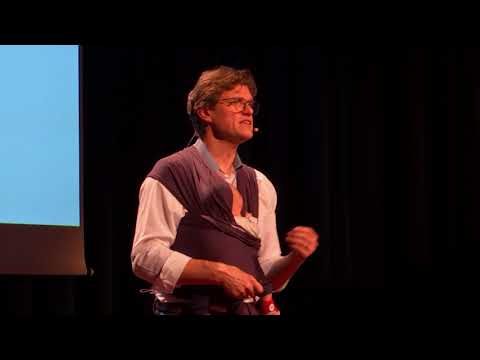
this is my little boy Louie he’s six
weeks old this is very first tedxtalk
and i’m wondering i think like whole
parents what is he thinking what is he
feeling maybe a little bit more because
I’m a neurologist and a consciousness
researcher and that question really
fascinates me what can we say about
little Louie’s consciousness it’s
actually a very difficult question that
historically was the field of religion
and philosophy so we would look back at
the old Christian scholars they would
consider that consciousness would
suddenly appear right at the moment of
conception as you can see here and his
wonderful painting the moment the spirit
the soul enters the human body another
quite popular view actually all the way
up to the Middle Ages was the ancient
Greek philosophers view Aristotle who
proposed that after conception the
menstrual blood somehow organized itself
into a human being and that would be
conscious exactly 45 days after
conception that is 45 days for boys for
girls for some obscure reason he thought
it would take much longer actually twice
as long so that would be 90 days as a
scientist I propose we now leave
religion philosophy aside and try to
confront our thoughts with actual
observations so here we leave the Dark
Ages coming to the Enlightenment
Leonardo da Vinci was the first to
actually make up servation these
wonderful drawings of the human fetus
you can see here in the uterus but still
it was very limited to say meaningful
thing
about anything going on in defeatist
mind and even now with all these
wonderful technologies ultrasound
permits us to see how the baby grows
inside the womb but still what can we
say about the mind well we’re fortunate
at the University of liège to be part
of this European Network were with
colleagues at the University of Tubingen
they have a wonderful machine and you
see my wife and essa and it’s quite
strange possesses position where her
belly is inside this detector of
magnetic waves because when a new fetus
has a change in electrical brain
activity this creates very small changes
in magnetic fields him they can actually
capture that and then see how the brain
reacts to sounds and the results are
here Louie’s brain showed clear
reactions to different sounds actually
he could pick up when it was a new sound
you see here this red arrow showing the
wave of brain activity that was observed
when he said eh this is new he might
even be the first human fetus to show
that there could be some working memory
going on already during pregnancy and
this was done in the third term so I
think this is wonderful and really also
has major ethical and clinical
consequences because when we see here
the first picture of little Louie and
there’s no sound and you can imagine he
was crying and I remember when the nurse
was taking a little blood sample and he
cried and she said well you know don’t
cry I know it doesn’t hurt you I was
thinking well do you what can we say
about pain perception in newborns well
historically not so
when I was at university and of the
atheist in textbooks it was written
babies newborns are unconscious they’re
just a bunch of reflexes they can’t feel
pain so even surgery was performed
without giving painkillers that luckily
has changed and now scientific studies
have clearly shown that babies newborns
can have emotions can have pain and so
we treat them as should be but still
many questions remain I mean look at
these wonderful eyes maybe a bit
subjective here but to me it’s really a
challenge to know what’s going on behind
in that beautiful brain that beautiful
mind and again scientific studies now
offer us a glimpse of what it might be
to see as a newborn
this is an app you can actually download
for free and you see here what little
Louie might have seen just after birth I
don’t know if you can guess what son
here let me help you a bit and you see
that vision of course in the brain of a
newborn that’s an immature brain it’s
learning progressively to make sense of
the world initially will be very blurry
and then progressively emerges this
perception adding color and all the
richness of our wonderful visual worlds
now again thanks to a European network
called the human brain project where
it’s all about understanding
consciousness and actually trying to
model consciousness and computers now
the brain is in the computer the mind
isn’t just the software program but I
think it’s wonderful with all the
different colleagues throughout Europe
to try and understand the emergence of
the mind and how of course at my
university in yesh we mainly study
adults but again thanks to
collaboration with our friends in Israel
we have now tools to monitor what’s
going on you see these two electrodes on
littlewey who again was a guinea pig and
we can see how that little brain changes
depending how it interacts with the
environment you see the colors you see
time evolving every minute in the
beginning was like cool all blue colors
low activity then something happens you
see the upper row is what we think his
stress level becomes all red very active
then you see is being breastfed and
enjoying things and we can try to read
that out in these brain electrical
recordings and you can actually see this
on your smartphone so that the image
there is just a screen capture of my
smartphone permitting to try and bridge
into his wonderful mind and wonderful it
truly is because you should know that
right now he has a number of brain cells
neurons similar to yours and mine
billions of them but it’s really
intriguing is that he’s making a lot of
new connections these cells are bridging
to other cells really very very fast we
think it’s about 4,000 new connections
each and every second at his age and
this is just the beginning because he
will continue up to a million nearly a
million new brain connections every
second and that I think is just
wonderful and a challenge for us to
understand the developing human mind
where maybe the historical error was to
consider consciousness as all or nothing
it doesn’t suddenly start it’s not black
or white but rather 50 shades of grey it
progressively emerges and then again we
can’t reduce the complexity of
consciousness to just one dimension one
thing
it has many many aspects maybe we could
compare it to a growing diamond
with more and more aspects to it that
reflect all the colors of the rainbow
and the challenge for a scientist is to
truly understand and explain the wonder
of it all thank
[Applause]
Please follow and like us: