
so imagine living in the country that’s
made up over thousand small islands with
the average ground level is 1.2 meters
above sea level and the tallest mountain
you can conquer is a mere 2.4 meters
high I’m talking about the Maldives the
lowest and the flattest country in the
world now when I think about the
Maldives I picture myself lying down on
one of its beautiful tropical beaches
sipping away an icy cold mojito while
watching the waves roll in unfortunately
due to predicted sea level rise the
Maldives
along with his beautiful beaches will be
completely underwater by the year 2100
and just to clarify that is worth in the
century without land the country cannot
survive the Maldives is located around
600 kilometers southwest of Sri Lanka
and its archipelagos dispersed over 750
kilometers the Dravidians of India and
Sri Lanka will first arrived to the
islands over 2,500 years ago and they
were soon followed by the merchants of
East Africa and Arabia who came to the
Maldives for trade now when you look
closer at one of its head holes you will
notice that they’re made up of many
small islands varying from 1.4 to 2800
square kilometers and these islands also
have very specific functions to name a
few there are islands solely for
landfill fuel zippers and even prison
islands highlighted in red is the
capital of the Maldives Mali
it is home to a hundred and thirty
thousand people all squeezed into this
two square kilometre area you can just
see how vulnerable this places so can
anything be done to save the four
hundred thousand people of the Maldives
the Australian Immigration Department
have predicted that they will have to
take in the people of the Maldives as
global warming refugees if no other
solution has been discovered if the
Maldives moves the Maldives is lost
along with this 2500 year old rich
culture so when a country faces a threat
so total and so radical maybe the best
solution is one that is equally radical
my perspective is to relocate the people
of the Maldives and the associated
culture onto obsolete semi submersible
oil rigs I believe as humans we’re
responsible for our earth I believe its
architects we have the capability to
make a difference a difference that
maybe just maybe can even preserve an
entire culture so as part of my master
of architecture thesis program I was
very interested to explore the idea of
reusing an existing technology such as
an oil rig and responding it to the
current and projected crisis of the
Maldives and how does one to imbibe agin
to embark on this mammoth task I’m going
to take you through a brief step-by-step
process of my attempt to demonstrate how
the people of the Maldives and the
culture can be moved on to the
parameters of a semi-submersible oil rig
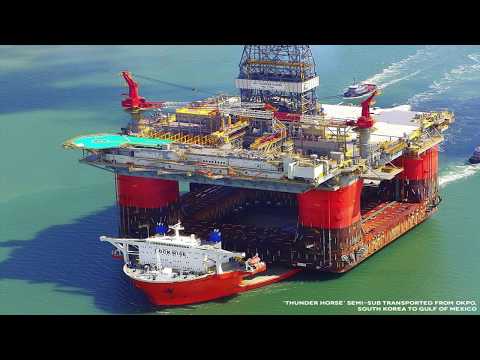
semisubmersibles also known as semi subs
are the most stable of the seven
offshore rigs they float in depths of 30
to 2,000 meters and they also
transportable like this guy here
thunderhorse the largest semi
submersible in the world was recently
transported all the way to the Gulf of
Mexico from the coast of Korea
but just like the rotten milk on your
fridge oil rigs also have an expiry date
this expiry date relates to the oil
drilling operation used but I believe
the superstructure is still has their
potential to be recycled and to be given
a new life Transocean was recently on
his end of life voyage to the shipyards
in Turkey from the coast of Norway and
this is what was left of it not a pretty
sight
so rather than destroying these oil rigs
into scrap metal
why not recycle them it would be like
buying an old car from a car dealer a
new car smell but an old car bargain so
as part of my research are based on this
prototype which is 16 meters high but 80
meters long and the platform level is
around 9,000 square meters now once you
lift this platform level up there’s
existing structure which holds all the
mechanical equipment required for oil
drilling operations to take place but
since we’re not drilling for oil here
this equipments not required there is
also a drilling void which allows all
the pipes to be deployed deep into the
sea rock in search of oil and this posed
an immediate opportunity to use this
void as vertical circulation hub in the
nuke and the newer oil rig which I’ll
come to a bit further on there there are
water desalination plants electricity
generators and black water treatment
facilities all onboard but I wanted to
take it a step further and propose
cleaner ways to harness energy such as
solar wind and even maybe energy
harnessed from the ocean currents so now
that the parameters of the oil rig have
been established the next challenge was
trying to figure out how to get the
people of the Maldives and their culture
to fit with the parameters of this oil
rig as a starting point I looked at
Molly and examined all the key functions
and ratios that exist within it and
these ratios were then placed onto the
oil rig in ER it’s rare
form but then I thought to myself was
this a best way to go about it in order
for people to be more familiar with
their new surroundings I look closer at
a suburb in Mali called ma fauna and the
three-dimensional spaces that were
explored here really highlighted what
people are used to so then the oil rig
was then inspired by these spaces an
attempt to convey a feeling of home into
the new environment ma Phyu literally
translates to where the village path
meets the ocean as you can see there are
many visual and physical connections
direct directed towards the sea this
organic layer was initially placed
directly onto the oil rig and then after
many iterations and further development
it turned out to be the public realm of
the new Maldivian rig where it also had
visual connections to the sea and a
strong link to the mosque since Islam is
a main practice of religion in the
maldives the central void has now been
converted into the vertical circulation
core allowing people to be transported
to the different levels but more
importantly down to the ocean with a
port as appropriately placed so one
arrives to the rig by boat gets to the
port and finds an elevator to his or
hers desired level market life is a very
integral part of the Maldivian way hence
white forms a heart of the oil rig
locals prefer fresh fruit and vegetables
to be delivered from all over the
archipelago on a daily basis fisheries
is a second largest industry in the
maldives having fish market located on
the edge of the rig allows the daily
catchment to be transported directly
into the fish market like so and at the
same time remanence can be washed back
into the ocean efficiently so now we get
to the housing levels
as we noticed earlier in Mali we saw
that the buildings were mainly made out
of concrete construction and this is
maybe due to time and cost pressures
this means that the Maldives has
succumbed to modernity coconut timber
which was once an integral traditional
building material in the Maldives has
been reintroduced back into the oil dirt
to form a connection to the Maldivian
past and at the same time it works well
because of its lightweight nature so a
couple more levels of housing and we get
to 225 houses which can hold up to a
thousand 50 people also noticed earlier
we saw that there were particular
islands in the Maltese which have a
specific function right
I believe that idea can also be adapted
here we redesign these rigs for a
specific use this could be livestock
rigs vegetation oil rigs education ones
and even maybe prison oil rigs I believe
this is required for a more holistic
floating community and coming to think
about it
oil rig hopping doesn’t sound too
different from island hopping
so we require 400 rigs to house the
entire population of the Maldives there
are currently 370 waiting to be
demolished with 160 in use with newer
and larger ones being built each year so
this suggests that there are more than
enough to start refurbishing and start
deploying to the shores of the Maldives
to provide a smoother transition into
this end of the century this project
might seem like a long shot to many of
you so too did the personal computer
generation ago and the television a
generation before that we’re just over
80 years left before the possible
disappearance of the Maldives there’s
still time to come up with failsafe
solutions to keep the Maldivian
geographical position on this earth and
the Maldives isn’t the only country to
face this problem but many low-lying
Pacific
all nations also require immediate
attention so today I’m here technology
that I amongst millions of others are
born into a throwaway world we’re part
of a society and a generation that is
highly influenced by consumerism and
overproduction of short-lived items so I
would like to challenge the architects
and designers of this generation to be
bold to question the implementation and
production of new material and to find
fuses between existing technologies with
neglected resources resources by which
today’s standards has been consigned to
oblivion thank you
Please follow and like us: