
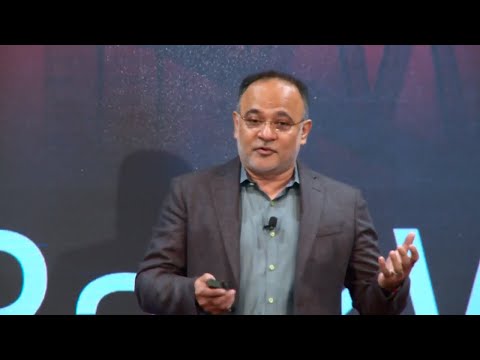
my name is Irfan isa do remember the
name because we’re gonna come back to
that in a bit
and today I’m gonna talk to you about
artificial intelligence and a little bit
of an understanding of the past the
present and perhaps the future of
artificial intelligence I’m interested
in building technologies that are
actually building intelligent machines
so you ask you know of course what is an
intelligent machine what an intelligent
machine is a machine or a system that is
capable of extracting information from
the environment sensing something
understanding it and then doing
something in relation to it reacting to
it so for example your computer system
recognizes who you are and allows you
access it could be for example a system
on your bank that detects fraud and
prevents access to somebody else to
prevent you from getting to that kind of
stuff
it could even be things like your Fitbit
that recognizes if you’re falling asleep
or not you know those types of different
types of things where sensing leading to
an action with an understanding in
between that’s what AI does and of
course many people like me have been
building systems like this for about 30
years so what I’d like to do today is
take you through a journey that I
started as a student did the present day
about how we’ve been building these
systems this is less about me much more
about actually telling you how things
have evolved over time okay so one of
the things we are interested in of
course building these systems that would
actually be aware of what we’re doing
and respond to us so 30 years or so back
iPhone computers very exciting okay
because they could do a lot in terms of
computation I could actually get a
computer to simulate physical phenomena
things like breaking putting something
like if I was to put something like this
on my hands you all know from physics
that if I put it on some other type of
thing it’s gonna fall right simulation
basic lever and stuff that you learn in
physics now how do you build that kind
of stuff into a computer that’s what I
was doing as an engineering student of
course it started figuring out very
quickly that you know you are very good
I just showed you this and almost all of
you were gonna speak aware that is gonna
fall many things if I was to throw it
you pretty much know that I’ll catch it
because it came down certain you know
physics to go
so of course the first thing we thought
about was how do we build these kinds of
physics in so many early systems and
even and actually something like 1980s
there were pictorial representations
just taking a picture of something and
asking oh is this gonna fall through or
it’s gonna stay remain stable just
understanding the physics of these types
of things if you showed it something
like it’s about to fall it would trigger
it predict when it’s gonna fall so
simulation was an important part of
these kinds of things so as an
engineering person I knew how to do this
but all of a sudden I ran into these
people who were doing artificial
intelligence and computer vision
computer vision was an ability to create
a system that can see you know pretty
much like what we do with our eyes now I
showed this kind of stuff and we did of
course show these systems and pictures
to computers and you wanted the
computers to kind of predict what’s
gonna happen is it gonna fall or not and
that kind of stuff was very interesting
and of course that got me more
interested we could also do things like
take pictures on a conveyor belt at you
know a delivery facility and figure out
oh this is a big box or this is a small
one and what are the sizes of these
things how to distribute them kinds of
stuff we take for granted these days
another thing that actually I witnessed
a video of anybody late 1980s was a
system a car with a camera in front that
could detect other cars lanes and drive
itself and avoid collisions the kind of
stuff again we see a lot of this was
something I saw as a student in the
1980s timeframe late this got me
interested in a whole lot of this stuff
of course I was a naive young kid not
knowing anything about any of this kind
of stuff just wanting to do things but
this was the era where AI was actually
coming big artificial intelligence and
technologies like that were getting
really popular of course I was lucky
enough to work with some of the best
people in there and the first thing I
did for my PhD thesis was develop a
system that would recognize human
expressions so now I’ve imagined a
camera looking at you you make an
expression and it says hey you’re happy
you’re sad you know Kings like that of
course now to do this I have to go
beyond building a physical simulation
system I have to understand human
communications especially things like
our visible aspects of how I gesture how
I make expressions and stuff a complete
different ballgame and
have to build that in to build a system
like this you know how people make
expression so of course a system that
when I make an expression it mimics me
like a you know toy problem or some sort
that’s what we did again you know it was
very exciting I learned a lot about
human communication and in fact joke I
have is many a time I would sit there
start looking at people forget what
they’re saying just look at the
nonverbal cues of how they make gestures
and expressions
my wife would smack me reboot me and I
would get back to normal you know that’s
what helped so you know that was
something which we did so that’s we’re
going from physical simulation we build
things like you know understanding how
humans communicate build the system on
that kind of stuff
graduated came to Georgia Tech and one
of the bigger question said okay now
let’s scale this up let’s do something
bigger trying to track whole bodies in a
home situation so one of the things I
started talking about was this whole
concept of computer seeing people
intelligent and aware environments so
what we did is we built actually a full
home on the Georgia Tech campus the name
of this room was the ovair home and in
this one be basically instrumented with
a whole lot of sensors that would
actually understand what’s going on and
react to different types of things
happening in the space again an exciting
project we work on it we did and again
it wasn’t just me it was a huge number
of faculty at Georgia Tech and students
who worked on this kind of stuff the
other thing is we also now want it to
not just do research but train the next
generation of researchers to do this
it’s great place Georgia Tech to do that
kind of stuff a couple of interesting
things means we developed a lot of
things we had a robot moving around in
there are trying to you know find
interesting objects to cheat it all the
objects were very nice colored and stuff
like that because it was hard to find
all of them at that time I developed
this to many people I had a very
well-known politician from Georgia come
visit the lab I showed him this kind of
stuff and he looks at me and he says oh
finally you have technology that can
bring me beer
yeah okay we’re in a beverage company
today anyways so but a different kind of
beverage another person I was talking to
a banker insurance person said oh you’re
talking about long-term research because
we’re talking about this home that would
watch over our kids and adults and
everything in health care situations
this person looked at me and says you’re
talking about long-term research 53rd 15
years 30 years you know there’s only one
instrument in this country where we
think about that kind of a long-term
thinking it’s called a home mortgage
that was eye-opening again this was of
course before the subprime collapse so
maybe even not me no more so you know
those kinds of things have kind of been
happening and we’ve been building these
types of technologies since and this
taught me a little bit about it’s not
just about the technology it’s what
people perceive from this technology and
how that becomes a normal part of our
lives I mean the face example I told you
right now you can take out your phone
after you take your selfie you can turn
on or RIT or Facebook and you know
snapchat it tracks your face remember
all of the kids that you’ve seen doing
the barf games and stuff like that it’s
actually doing the kind of stuff I did
for my PhD thesis now on this device
right so similarly this recognizes my
face and everything else like that the
computing technology has changed a lot
right I can walk around and take a
picture of this and it would recognize
where I am it would actually take the
name Centennial TEDx transcribe it right
you can actually be walking in China
pointed to a sign it will translate that
for you these are the kinds of things
that are now available the other thing
which has happened is this thing has
gotten smaller right the technology the
compute power of this thing is actually
more than what actually took us to the
moon all right so these are the kinds of
stuff that we have there’s something
called the Moore’s law which has been
predicting that every two years the
compute power will double we’re about at
the plateau of it nowadays faculty like
me are sitting and thinking about what
next thinking about these kinds of
things are coming in but you know these
technologies are interesting based
recognition works but also they make
mistakes so of course remember we can
predict things like physics we can also
predict the
like words every time you’re typing
things on your phone it’s predicting the
next world
it’s typing it in of course it does
interesting things remember my name
Irfan I usually get messages calling
organ urban but my friends who actually
met me the first time and after de
Mestral healed would they spell my name
if ran i f ra n because it’s easier to
type RI f then ir so computers make
mistakes people make mistakes they can
be both trained to do these types of
things and improve upon that kind of
stuff that’s that kind of stuff we’re
thinking about so now fast-forward to
the kinds of things we want to move
there so in my lab we do a lot of
different types of things we build
technologies that observe surgeons and
trains them as they do different
complicated procedures we can watch
athletes perform different types of
physical activities learn from their
behaviors and tell them more about how
to improve their things but also help do
things like gait recognition for people
with walking disabilities we can
actually recognize what people are
eating behaviors and stuff like that
guide them in different types of things
improving their health systems we can
actually analyze dynamic scenes like the
ones that cars have to figure out where
the obstacles are so we can avoid them
we can do a lot of these types of
dynamic scenarios we can analyze them
because one thing we do now is give the
computers robots systems eyes one of the
things that was different was computers
are deaf dumb and blind sitting in the
corner of the room that has changed now
because the research community I belong
to has been spending a lot of time
convincing and creating technologies do
this nowadays you all speak to your
phones in the home there’s a small
device that also listens to you
if you want to talk to it and you can
actually order things fast right you can
also do things like have a security
system that’s aware of a whole lot of
things kinds of things that are now
available and actually what makes it
interesting is some of them are actually
$1.99 the phone is still about a
thousand bucks but other technologies
are $1.99 so these types of things are
actually becoming prevalent in our
society so at Georgia Tech one of the
things in the growth of their starts of
taking the engineering
there was now we have created a huge
Center for machine learning at Georgia
Tech and the intention of these types of
things is to now bring together create a
home for preeminent scholars in the area
of machine learning in AI and also train
the next generation I’ve been because I
was not fast to move back volunteer to
lead the center right now it’s an
exciting time because we’re making some
amazing things happen the thing that’s
unique about this new level of machine
learning and AI from the 1980s when we
started this is it’s a much
cross-disciplinary area a Georgia Tech
we actually have faculty and students
from computing engineering and Sciences
well that’s no surprise but we also have
them from humanities Social Sciences we
also have them from biomedical
engineering types of things and we also
have them from public policy business
and design because the city is going to
look different with this kind of
technology right the home is going to
look different more importantly public
policy has to adapt to what’s gonna
happen with technology the kinds we’re
talking about so working with public
policy is important so our goal really
is to start kind of building this new
ecosystem that can get ready for
thinking about these types of things and
build new technologies now a couple of
other things to think about am I going
to predict the future today and tell you
when you can actually have an autonomous
driving car in your neighborhood well
not today
sorry it’s going to happen in some time
or the other and it’s going to be
actually something it’s not going to be
instantaneous you know you’re not gonna
wake up one day and technology is gonna
be there it’s gonna slowly develop and
that’s the kind of stuff that is
important to think about in technology
is that it’s already around us we’re
using it if I was to take your cell
phones away today fine you will miss a
couple of selfies you will actually get
upset at me right if I take away for
those of you are nuts about exercising
you will get upset at me if I take over
your health disparaging devices and you
know you heard from Medtronic there is a
device that actually monitors your heart
it’s inside you that’s an advanced
computer similarly you know homes help
you know whom temperature monitoring is
all being done with computers and as
much as you’d like to believe it or not
even those cars that are not driving
themselves have a lot of
leaders inside them yet there’s a lot of
technology around you and in 1980s when
you started to hate calling a phone and
leaving a message on an answering
machine because you did not want to talk
to a computer or a machine now you
prefer to leave messages right so things
have changed so one of the things we
always talk about is you know how we can
understand what’s going on with these
types of things and I will just end with
one quotes that I actually believe in
and this is called Amara’s law which
basically says that we tend to
overestimate the effect of technology in
the short run and underestimated the
effect of technology on the long run so
we’ve forgotten OCR the ability to
recognize text speech recognition that
have been developed for the last thirty
years are part of our lives right now we
are stressed about the fact that
somebody’s gonna build Terminator right
well I want to build commander data I
mean a friendly person that will help us
with our lives so that’s the kind of
stuff now yes to some extent I will
admit people like me are kids in a candy
store it’s much better metaphor than a
bull in a china shop but we’re building
this technology we’d love to engage with
people who actually use this technology
join us help us evaluate these types of
technologies and let’s get them out
there so you can actually benefit from
them thank you
you
Please follow and like us: