
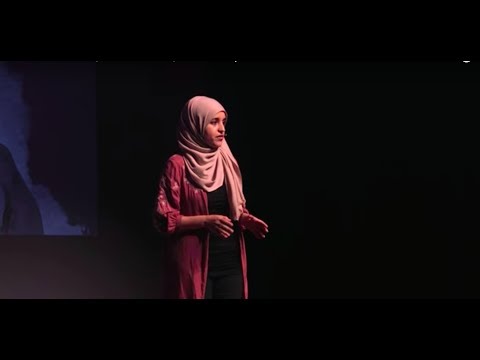
woman of color oppressed conservative
not free but free enough to stand here
on stage not educated close-minded
because of this thing on my head these
are just some of the words that usually
pop up when people see women who look
like me sometimes because of the color
of my skin in this case a headscarf I’m
wearing or maybe even my accents English
is my fourth language by the way and it
singers I don’t even blame them because
we’re all biased the important thing is
that we acknowledge this fact but what
if I told you that we can change the way
we look at each other that we can change
the way we look at people who are
different first of all let me tell you
who I really am
my name is Yasmine sed I’m 25 years old
as I said before I’m I was born in
Belgium I’m a granddaughter of Moroccan
Mine Workers
I work as a marketing and communication
officer at the University College here
in Antwerp and the founder of Amina the
founder and director of flex and our
rise I write for the daily newspaper the
more ham so it’s perfectly possible that
you have seen me on your screen that you
read my opinion pieces in a newspaper or
that you already have heard me on the
radio so not to I only know how it feels
like to be a member of a minority group
or a member of our society I also do
know how it feels like to be
misrepresented by the media and at the
same time to be a part of that media
while constantly being reduced to the
way I look and what I believe in and
even though our society is so diverse
there are still so many people who have
never the opportunity or never took
their chances to meet someone who thinks
and looks differently I’m often the only
person at events as a speaker or a guest
who is a woman of color Muslim or even
just a woman and believe me it’s not
because I’m the only one who speaks her
mind are the only one who is passionate
about making a difference in our society
I’m not and if you think about it it is
actually pretty sad because
if you see at how diverse our cities are
for example here in Antwerp alone there
are more than 170 different
nationalities which makes the city as
diverse as New York but still it’s
sometimes just feels like we’re all
living next to each other instead of
with each other and that’s why media and
general are so important for a society
there are not only an important source
of information about social changes in
different communities they’re also an
interesting way of interacting with
different kinds of people in our society
that’s why media should reflect the same
diversity that’s seen in our society if
even I don’t see people who look like me
and different spaces where I’m invited
how do you think other minorities to
feel and just to be clear when I use the
word minority or diversity I’m not only
talking about people of color or
religious minorities such as Muslims or
Jews I’m also talking about women in
general people with disabilities and
members of the LGBTQ community because
they are mostly forgotten so let me tell
you this personal story I have one year
ago in September 2016 I wrote my first
opinion piece for the daily newspaper
the Markham
it was a pretty good start because it
was shared so many times it even
resulted in an invite for a live TV
program next to the world’s best major
bats OMERS and and I remember how I felt
when the taxi driver drove me to the
studio and Brussels how did I get here
and I was hearing my mother’s voice
telling me why do you always get
yourself into trouble anyways just
imagine a 20 year old something student
was going to have this conversation on
live TV for the first time and she was
going to explain about how hate against
minorities leads to irrational decisions
in our society and in politics and the
thing is I didn’t feel insecure about
what I was going to sell but I was
insecure about the consequences after
how much hate will I receive and how
many people will be blinded by the way I
look and not listen to what I had to
tell and will my positive selves be able
to handle all this negativity
anyways I survived except for the death
threats I received and the hateful
tweets where I’m standing here so it’s
all okay and I also did receive so many
positive comments from journalist
politicians even my professors were
sending me emails to support me and it
also received many messages from people
who I didn’t know people who were so in
shock for seeing someone being
articulated on TV someone who looks like
me someone who is being fluent in Dutch
and I still believe that they meant well
but I didn’t feel like a compliment
of course I’m fluent in Dutch I was born
here I even know so many people who
weren’t even born here in Belgium and
are fluent in Dutch it’s not a big deal
it’s not an accomplishment so it didn’t
feel like a compliment but what it did
mean is the fact that there was
something shifting in their minds that
they were changing the way they were
thinking about certain minorities and it
does also mean how rare diversity on our
screens actually is especially here in
Flanders and that’s not all because a
couple of weeks later I officially
started as a columnist for the daily
newspaper and I remember how my
colleague asked me this one strange
question
he got me slightly irritated by the way
and um he asked me he said yes mean how
does it feel to be the first headscarf
wearing Muslim woman rising for a
newspaper here in Belgium and Flanders
and I was like who cares is it what’s in
my head that should matter instead of
what’s on my head and you can still find
the interview online because my answer
was except exactly two words who cares
and yeah I was kind of naive to be
honest because I didn’t realize how
important that question actually was
because being the first means changing
the narrative it means making a
difference without even knowing it and
even though I didn’t see it as an
accomplishment it was a huge step
forward for a media industry because
being the first also means opening doors
for more others to come and
unfortunately we all know that the first
step is always the hardest and that’s
exactly what I experienced you’re during
months of writing for DeMorgan it was so
hard to be constantly reduced to the way
I look and not to the message I was
trying to spread and that also made me
realize if no one on your screen our
imprints looks like you how will you be
able to believe that you can get there
too
that you can have the same goals and
same ambitions more importantly how
would others know that a woman of color
can also talk about the world of
startups instead of always being invited
to talk about her race or gender and how
its others know that a Muslim woman with
or without a headscarf can be financial
experts too instead of constantly being
reduced to the way they look like and
their beliefs it’s so important to have
diversity in the movie industry
especially in superhero movies that’s
why the Black Panther and Wonder Woman
are such a huge deal and there is also
science behind it because research has
already proven the importance of
representation and diversity in the
media and entertainment industry and the
thing is if you want to battle all these
stereotypes if you really want to make a
change and end misrepresentation of
minorities in our society then we start
then we have to start by accepting the
facts that diversity in media is
powerful because diversity in media
means normalizing all of us it means
making us feel comfortable with all our
differences because what is seen on our
screens I was read in Prince has felt in
our society
we absorb all the information we see
every read and it has incredible
influence on how we live our lives and
how we interact with each other more
diversity media benefits all of us and
if we’re really that honest about making
a difference about ending
misrepresentation and doing something
about the lack of representation of
minorities in media then how about we
start now thank you
[Applause]
Please follow and like us: