
had this deep desire of being a stronger
they’ve tried different ways if you look
at different civilizations they have one
thing in common all civilizations if you
look in the path Greek Egyptian Romans
Persians Chinese Indians they have
heroes in their histories and they
repeatedly talked about that talked
about these heroes so it looks like it
that was actual history even the modern
TV shows in the movies if you look at
the Holyrood there there are a lot of
these super super humans these are the
Superman Batman Sandman Spider Man what
they have what they all have in common
is they are stronger than regular people
mentally or physically so my story
starts from 2011 at the University of
Louisville I wasn’t there but Susan
Harkema team they had one person one
individual who had a spinal cord injury
spinal cord completely severed he
couldn’t move lower extremities at all
after receiving the intervention
intervention he could start moving his
legs voluntarily so paralyzed completely
then intervention now voluntary movement
he can’t walk but he has this movement
he can stand up pretty big deal then
2014 the same story continues at may
2014 same teams as three more people to
the same study now we have four people
who had spinal cord injury spinal cord
severed paralyzed now after intervention
which I will talk about what kind of
intervention they start being able to
move their legs which was significant in
that time because before this time we
thought CNS injuries is end a time so
this intervention was this little small
lead and the back of a spinal cord small
stimulator sending impulses electrical
impulses this was something new the
technique has been used for pain and
different purposes but not for motor
movement
the small stimulator after an minimally
invasive surgery could be implanted on
the back of a spinal cord which can over
time generate different different kind
of simulations which can cause
improvement in motor function so this
gave us this idea is it possible to do
it on more patients maybe if there are
20 people they might even improve more
or it can’t be made maybe it’s not even
possible on other people because for pop
for 4 people is not enough to decide and
generalized for the entire society so we
thought about an alternative method
which doesn’t need a surgery
transcutaneous stimulation came to the
game so there was a method in the called
chance cutaneous spinal cord stimulation
small patch small electrodes put on the
same area but over the skin and the
patients were located on their side and
their leg are kind of hanging from the
ceiling so they could freely move their
legs we asked them to move their legs
without stimulation at the beginning of
course no movements because we chose the
spinal cord injured patients who
couldn’t move their legs after applying
the stimulation over time and practicing
over time same people could generate a
lot of movement and this this was kind
of a new thing for us will I’ll explain
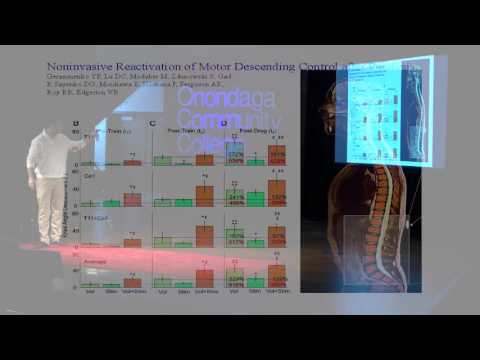
why the same paper was published in
Journal of neuro trauma at 2015 and if
you look at the improvement pre-training
it’s almost no movement and
post-training we have that change and
that’s the angle of a joint which which
which is the actual functionality of
other muscle so the patients were moving
improving 200 minimum 900 percent
maximum in the force not 100% in a force
so that was that was something happened
over for five weeks we didn’t continue
this study because what you decide just
give it time limits we can’t say the
study will continue forever and as the
time limit was four weeks
so we were thinking is the lower
extremity the only organ in the body can
improve in this fashion
maybe heart can improve to upper
extremity hands we don’t know so one
step backwards and we change a topic we
changed our proximity in the new study
we implanted cervical spinal cord again
below the level of injury
now our patients they were paralyzed in
upper and lower extremity cervical
spinal cord innervating upper extremity
you see all those small implants and we
started having the patients we’re
starting asking them to do the handgrip
so this is this is what we are we are
measuring now the grip force that device
different Springs and we measure the
force the patients would come here 12
weeks first week they just practice
practice practice so if they can improve
on their own they will show in the poom
at the beginning of the study and then
they go into the surgery the small
surgery small leader starts the
stimulation and you see the improvement
in weekly we have kind of almost
doubling the force of these patients in
this study we have minimum of one eighty
three percent one hundred eighty three
percent and maximum three hundred fifty
percent improvement now we were thinking
about what’s the mechanism can be
applied is on everything else the
mechanism which we are thinking right
now the hypotheses which not proved yet
but that’s an interesting hypothesis is
not what everyone thinks
everyone thinks first time when you’re
looking at these results okay they are
regaining function so first thing you
would do you’re comparing these patients
to their own prior to this study or they
own prior to the injury when you’re
there can be or comparing them is like
okay he can generate 40 Newton’s with
the hand he used to be able to do 400
not quite there yet but what we are
thinking this is not free enabling of
the same things not regaining the same
function this is a new function in the
spinal cord there are a lot of paths
days in entire CNS which are standing
there doing nothing but now with the
stimulation we are teaching the spinal
cord to learn to reactivate the same
pathways to do something new so that’s
the hypothesis this is something new we
are giving to the patients who are
paralyzed at the moment this can apply
on anyone that’s gonna fire any of us in
the room
our CNS in general has a lot of neurons
they’re just standing there watching
each other and that’s the reality how we
can teach them can we even teach them we
never knew we can teach them but now we
learn that this is a new method of
teaching the central nervous system was
the old method we know we all can learn
by looking by watching by listening by
touching we never knew there’s a there’s
something other than our own perception
and this is this when the stimulation
comes to the game it can it can go more
forward just imagine that the
possibilities okay now where we are
that’s where we are we don’t know where
we are going if we don’t know if the
same method that we are trying to apply
on every single organ in the body is
going to happen in the future we have
hypotheses we have goals not quite there
yet okay but I always try to look at it
like this the CNS system the central
nervous system we are not using even 5%
of it and we all know we are species
which needs to survive on earth or outer
space or anywhere and maybe this 5% of
the brain is not enough maybe you found
a new way to improve even more to help
each other even more so I hope for the
for the studies for these kinds of
studies as well others of course to to
improve in the future and give us
something new and I wish you the best thank you