
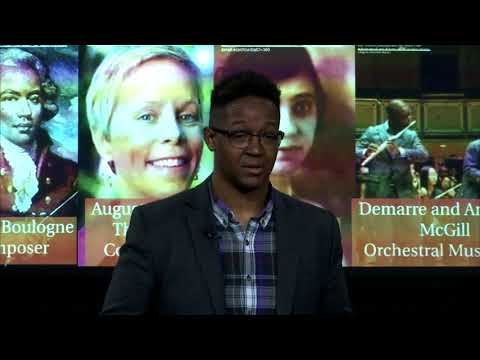
so we’re gonna talk about classical
music I thought what better way to start
them with a little bit of listening so
I’m going to play two pieces for you
both written in the Classical period now
listen very closely here’s the first
[Music]
all right now here’s the second
[Music]
great so both of these beautiful violin
concerto were composed in the 18th
century by classical music composers one
was written by Wolfgang Amadeus Mozart
who is one of the most iconic classical
composers in the history of the world
the other was written by this man Joseph
Boulogne Chevalier the st. George
now Joseph bulan was born about ten
years before Mozart in Guadeloupe to a
black slave and her white master he was
a conductor composer and violinist
during his lifetime he was appointed by
the King of France to be the conductor
of the prestigious Paris Opera however
he was unfortunately never able to take
that post because the members of the
orchestra refused to be conducted by a
mulatto man today approximately
two-thirds of his works are lost
and his work is seldom performed as many
young people I spent a lot of my life
trying to find a sense of belonging in
the world and in my field as a musician
myself I spent a lot of time performing
and practicing and meeting with conduct
conductors and professors that don’t
look like me about the music of
composers that don’t look like me either
in my everyday endeavors performing and
having class and my other things outside
of school
I’m often the only black person in the
room many times I find myself being the
only person of color at all as you can
see in this picture you can spot me on
the third row this was taken last
quarter
now I don’t say these things to complain
that’s simply the state of things as
they are now on the other hand I’ve
spent a lot of time in high school and
college asking myself questions like am
i black enough
does anyone that looks like me care
about the same things that I do should I
be spending my life pursuing something
that’s more historically associated with
black culture how could I not ask myself
these things when people in in my high
schools and in college have called me an
Oreo because they thought that I was
black on the outside yet somehow my
interest made me white on the inside I
don’t get it either I felt that I was
spending my life pursuing an art that
simply wasn’t meant for me however since
this time I’ve come a long way to
realize that the contributions of
minorities and and women in the arts
have been going on since the 18th
century and and before now this brought
me to a very common place where
minorities often occupy seeing that
people of their background have been
doing amazing things in the field and
contributing to our society yet they
asked themselves questions like why
didn’t I know about this why didn’t I
learn about this in school the work of
people of color has been marginalized as
a side note if it’s mentioned at all in
my 14 years of classical music study I
have played three pieces by black
composers one of which was by myself
this is a real problem and I think that
needs to be addressed when I first
started getting interested in diversity
inclusion in classical music I did what
anyone else would do and started doing a
lot of research I talked to my mentors
colleagues professors went online did
Google searches and because I was
looking for what work was already being
done in the field and to my surprise I
actually found that there are a lot of
initiatives that are trying to address
this issue of diversity in classical
music upon finding all of these
different organizations that are out
there I thought to myself how is it that
I can’t name five black composers after
going to some of the finest classical
music institutions in the country in the
University of North Carolina School of
the Arts
Indiana University Jacobs School of
Music in Northwestern University
something clearly was not working it’s
very interesting when in moving forward
with this I thought to myself not only
are they are the problems within these
schools the problems are in the
professional scene as well if you look
at the orchestras around the country
four percent of performers in the top 25
orchestras are black or Latino combined
zero percent statistically speaking of
pieces performed were by any composer of
color at all zero percent now I’m not
saying that there were zero pieces
performed by these major orchestras
however the fact that the number is less
than 0.5% of all the pieces is startling
within itself and if you look at the
conservatories around the world in the
country you’ll see that the faculty
students and administration simply do
not represent the diverse world in which
we live
now I could give you single-digit
statistics all day to explain how much
this is an issue some of them might be
two digits because there’s a decimal
place but I think from here we need to
move forward I had a conversation with
Aaron Dworkin who is the Dean of the
University of Michigan School of Music
Theatre and dance and one of the most
amazing advocates for diversity and
inclusion in the performing arts and he
told me something very interesting that
has stuck with me ever since
he said that in dealing with these
issues of diversity many times it’s not
difficult to address to address them
they simply require that you think about
them at all for example at the
University of Michigan they’ve started
recently an international chamber music
competition called the M prize
now the M prize is amazing in a lot of
different ways it has some of the
largest cash prizes I’ve ever seen there
are there is phenomenal and media
coverage for all the ensembles that
participate and the ensembles get to
collaborate with each other and it’s
simply amazing however the most
important thing to me about the Emprise
competition is that if you look at the
panel of judges and the board members
you’ll find an extreme amount of
diversity there are female musicians
representatives black musicians Asian
musicians Latino musicians now in doing
this he did not have to sacrifice
artistic excellence for the sake for the
sake of diversity in fact the Emprise
competition is now one of the most
prestigious in the entire world he
simply had to think about it at all here
at Northwestern we are also making a few
changes in speaking with a lot of my
friends in the beena School of Music and
colleagues I started a petition among
students to show our administration that
this is a serious issue that is a
concern of the students now we’re not
asking that anyone reinvent the wheel
we’re not asking that anyone throw away
what we already have we’re simply asking
that the contributions of all people are
considered in our music theory music
history and oral skills curriculums now
these are not difficult issues to
address as Dorkin said some concrete
things that we can do are simply adding
sample materials by diverse composers by
female composers into our everyday class
classroom activities another thing that
we could do is simply by when we are
introducing a major work play a piece
that has been recorded by a diverse
musician this will allow the students to
have a much more wide-ranging education
and I think that this is a model that’s
that’s conservatories all around the
world can follow very easily now I know
that there is definitely no quick fix
for this issue however there are a few
succinct things that I think are very
important when we’re starting
initiatives to combat diversity and
inclusion firstly I think that all of
these initiatives need to be thought of
as top-down what I mean by that is that
the nation’s best music schools the
nation’s best orchestras wind ensembles
chamber ensembles and soloists need to
take it upon themselves and realize that
they are the trendsetters in this field
what they do other people will follow
who they Commission for new works other
people will Commission second we need to
ensure that our initiatives are
inherently inclusive and not more
divisive many times there will be a
black or Latino only orchestra that only
plays the music of black or Latino
musician of composers and there are also
lots of initiatives where there are
musicians that go into inner-city
schools and they perform classical music
for the students there and this is great
however what they don’t realize is that
these children are seeing people that
don’t look like them coming into their
school playing music of people that they
can’t relate to they need to be hearing
about people like Joseph boulogne
because I can tell you from personal
experience that learning about the
contributions of people like you at such
a high level it’s so empowering and
gives you the confidence to know that
your form of expression can also be
appreciated third within our each of our
minority groups we must value the people
that have come before us and teach our
children that they can truly do whatever
they put their mind to when I was a boy
I learned about people like Jackie
Robinson Harriet Tubman George
Washington Carver because they were
people that I could look up to that have
made major contributions to the world
and are also black however I hope that
the next generation can also learn about
people like Sanford Allen who was the
first black musician to ever enter the
New York Philharmonic or people like
Florence price who was the first black
woman to have a piece performed by a
major orchestra in the Chicago Symphony
finding out about people like this is
what’s truly going to create diversity
in the field that we love so much now I
realize that today I’ve focused a lot on
black musicians and that’s simply
because that’s my experience
however in dealing with the petition
I’ve realized that so many other of my
colleagues feel the exact same way there
are so many people that feel like the
work of people of their background has
been marginalized and pushed
aside it’s time that we realized that
the oppression of one of us is truly the
oppression of us all we must fight for
ourselves but we must also fight for our
neighbors it’s time that we truly bring
the contributions of minorities and
women into the Canon of classical music
now I’d like to close today just by
performing a short little excerpt of a
piece by William Grant still with one of
my good friends in the School of Music
and fellow musician Karen Zane thank you
Please follow and like us: