
[Music]
I’m an award-winning artist that is if
you count kindergarten drawing contests
and I think we should I remember that
competition amongst the other
five-year-olds to be pretty intense but
I did it I won in fact I still remember
the drawing so I made this tree and I
put a little bird on one of the branches
and had musical notes floating in the
air perfect naturescene
really groundbreaking stuff seriously
though everyone loved the drawing and
but more importantly and this is the
more important part of course I still
remember the feeling I remember the
feeling of getting the blue ribbon so I
grew up in a small town in western North
Dakota and I was born with spina bifida
so I was somewhat of a knock had
somewhat of an awkward childhood I know
that’s hard to imagine given that very
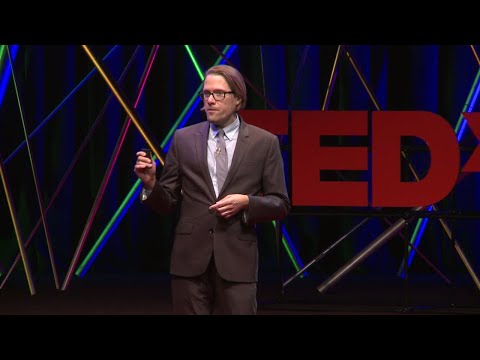
assertive looking young man there but I
knew I was good at drawing drawing
became therapeutic for me and it also
gave me confidence so much so that I
decided to dedicate my life to art but
17 years ago I became a receptionist at
an art museum in Fargo and fast forward
to today and I’m now the director and
CEO of that very Museum which continues
to introduce me to the impact that arts
organizations can have on individuals
and communities I think art museums
today are primarily known for having
things we have challenging modern art we
have intricate sculptures we have
beautiful paintings of flowers rare
artifacts but what can art museums
really do for us and that’s what I’d
like to talk about more today the late
Stephen while for many years the deputy
director of the Hirshhorn Museum of the
Smithsonian once wrote that art museums
in the 21st century will go from being
about something to being for somebody I
think what he predicted was basically
our current century purpose lies more in
what we do than in what we
have and I take that a step further I
think that arts organizations and
museums are not only for people I think
we can actually be human centered
problem solvers so I would like to
remove from your mind the arts as this
very beautiful decorative flower for the
sake of this talk replace it with this
one of the handiest tools in your
toolbox now in the US and likely in many
places around the world I think people
are more and more existing in binary
silos I think people are identifying as
black or white or urban or rural or
liberal or conservative all of this I
believe leads to a decrease in empathy
and cultural understanding according to
recent study in fact people identify as
white have a Friendship Circle that is
over 90 percent white and people who
identify as black have a similar
statistic that can be applied to them as
well this is the u.s. today
as exemplified by Chicago and st. Louis
with each dot representing a person of a
different racial identity according to
the narrow and somewhat antiquated
categories of the US Census but I still
think there’s some interesting things to
glean from these these graphics there
are very few integrated neighborhoods in
the u.s. much less integrated cities or
towns I’d like to talk about empathy for
a minute broadly speaking empathy is the
ability to genuinely relate to someone
else’s thoughts experiences actions and
feelings when you carefully experience a
good work of art whether it’s a painting
or film or theater or dance you are
often asked to make a human connection
to the person or the people who created
it to try and understand their
inspiration try and understand their
intentions and their actions and their
thoughts and feelings by doing this if
you’re able to make these connections
through artwork you are practicing
empathy so it’s no surprise that studies
are beginning to find a direct
relationship
the two now what happens when there’s a
decrease in empathy one of the things
that happens is an increase in the
objectification of people in Ferguson
Missouri for example we now know that
police officers have a long history of
targeting people of color to devastating
effect
conversely seeing police as an
oppressive system does not reflect the
humanity the officers and stripped them
of the dignity of the many that serve
their communities with honor and this
damaged relationship is not a Ferguson
only problem interestingly enough part
of the solution may actually lie at the
Perez Art Museum Miami where a program
exists called art detectives which
connects middle-school students with
police officers and art educators and
provides them with a meaningful shared
experience in the schools and at the
museum but why do this through art as
one of the program managers says because
art is truth-seeking prompted by this
program one of the participants who’s
now in middle school shared a story when
she was 8 years old and she was riding
in the backseat with her mother her
mother was driving obviously she was
pulled over by the police
seemingly routine traffic stop the
police then actually pulled a gun on her
mother and she felt herself threatened
as well this experience made her very I
think reasonably so afraid of police
officers and now she’s in this program
and they’re having this shared
experience as equals and so she sees the
humanity of the officers and vice versa
the police officers are having a shared
experience with community members that
they are to protect and to serve
I believe that programs like this can be
a part of community police training
pretty cool stuff
the ability of art museums to help solve
problems does not end at the ones that
are human-made we’ve been talking about
chronic illness today again art museums
like ours here and others around the
country are actively developing programs
reinforced by science that shows that
the environment that a person is in has
a positive impact on their ability to
cope or their recovery which makes
perfect sense of course but museums have
been late to the game in this but
there’s now emerging programs around the
country and one of them is at the
Honolulu Museum of Art where a very
important PTSD program exists called
warrior eyes on art the goals of the
program are threefold it is to help the
whole if it’s to use art and positivity
to heal it’s to get the soldiers used to
civilian life and it’s to give them the
tools necessary to cope with the trauma
that they’ve experienced so many many
soldiers experience a dramatic shift
throughout this program which i think is
pretty great and I want to talk about
this painting for a minute I believe
this to be a pretty important painting
you might think as an art museum
director it’s it’s about the product but
for me I think this is important because
of the creative process so at the
beginning of one of the sessions the
soldier who made this painting painted a
disembodied head and on the bottom he
added some fire and on the top of
storm-clouds basically the essence of
turmoil was being described throughout
the creative process it changed
throughout the day prompted by the
instructor with a very simple question
how can we make this painting more
hopeful so we thought about it and he
eventually he added the crown and then
some simple brushstrokes added some
raised hands essentially going from
despair to optimism as he created which
i think is pretty great
now we saw Chicago and st. Louis here’s
North Dakota pretty there are dots in
there I swear
along with its therapeutic therapeutic
abilities art is an effective connector
of people it connects people to one
another and it connects individuals to
themselves it is also a central element
to elevating regional economies
however our binary existence reveals an
arts access gap where people with more
resources who often live in cities too
often have more access to the arts than
people who live in rural communities or
rural parts of the world and underserved
neighborhoods I think we can do better I
think we can build more inclusive more
creative more empathetic more vibrant
more entrepreneurial communities that
will lead us into the future and I think
we can do it through the Arts recently
thanks to support from members and
donors our museums in fargo-moorhead
have taken the bold step to make our
galleries general admission free doing
our part as a region and helping close
this arts access print gap I could go on
from here but you get I think the idea I
can leave you with one thing I hope it
is this the arts are not a luxury but
instead are useful and they exist for
everyone they’re also exactly what the
world needs more of right now
[Applause]
[Music]
you
Please follow and like us: