
I started my lab two years ago at the
Neuroscience Institute at NYU and what a
fantastic voyage it has been these last
two years and these are the shining
stars who light up our lab and where did
this journey begin
I grew up in Calcutta India and this is
the house I grew up in eight by one by
one Loudoun Street it’s etched in my
memory for life and every time I go back
there
these memories come streaming in
memories of my father reading his
morning paper on the verandah my father
who’d once done the first kidney
transplant in Calcutta and now has a
hard time remembering what he ate for
breakfast memories of our first kiss on
that verandah and the nurse later our
wedding celebrations there and more
recently memories of our son Ari’s rice
eating ceremony re
he is almost 2 and it’s fascinating to
see him learn at the speed of light he’s
making all these associations between
people places objects events you know
he’s forming his episodic memories and
that’s what I’m interested in as a
neuroscientist I want to know how these
episodic memories are formed from our
sensory experiences as we navigate this
world were exposed to all these sensory
stimuli would we see what we hear what
we smell what we taste what we touch has
to be combined in time and space into
one coherent memory and so deep-seated
as this memory it can also almost last
us a lifetime right and these are
coherent memories because
even the hint of that sensory experience
can conjure instantaneous recall and so
powerful is that memory it can help us
change our behavior adapt our future
actions based on the situation
so we asked other neuroscientists why
are they in the brain business because
I’m interested in my own brain this is
probably the most exciting thing to know
about ourselves
fascinating I started out in philosophy
and psychology and I realized that
neuroscience really rests at this
interesting juncture potentially
everything is at least a little bit
related to neuroscience the lens in
which we understand the world like why
we feel what we feel like to do what we
do how memories change current
experiences and future actions in order
to find treatments for such diseases
Alzheimer’s
personality brain filters differently
the same upcoming input interprets it
differently oh we do not cystic organ
wants to extend insanity I think the
stigma that exists against mental health
are there because because they believe
this is what makes us fundamentally the
neuro system have a subject of natural
laws and I would like to understand this
well one day because it’s the most
important organ the brain is one of the
most complicated things that were made
by evolution and bold dreams that’s what
we have but you know only 10% of those
students and postdocs who dedicate
almost more than a decade to studying
neuroscience will make their way into
the faculty level in academia academia
an environment that promotes freedom of
thought promotes collaboration it pushes
us to take risks challenge existing
paradigms and passionate as they may be
not all our dreams will be supported we
rely on your taxpayer funding to support
our research and we’d like to solve
problems the diseases of the mind but
we’re very far from it it troubles me
even as a neuroscientist I can’t help
alleviate the suffering of my daddy’s
dementia symptoms I can’t explain to my
mom who’s given up her dreams who’s his
primary caregiver
why is he
these memory losses a brilliant
professor and physician that we know you
know if I bring in figures of
Alzheimer’s disease they’re very grave
and I know Nasreen has a personal
connection with Alzheimer’s here five
million people in the US suffer from
Alzheimer’s today now that’s only going
to increase the 13 million in 2050
700,000 people died last year of
Alzheimer’s and it’s going to cost us
more than half a trillion dollars to
support the health care of these
patients so the National Institutes of
Health brought up this goal that by 2025
maybe we can dream of curing or
preventing understanding Alzheimer’s we
need to raise 300 million dollars for it
what happens in Alzheimer’s neurons die
we lose our memories neurons are the
building blocks of the brain they
connect with each other to form circles
[Music]
so he just said wow bother he’s fast
asleep over there at the back and there
are two kinds of neurons primarily in
the brain although they’re actually
hundreds of kinds with two very
important kinds and they talk to each
other through electrical signals and
chemical signals so you can think of
neurons that cause excitation as being
like the go signal they’ll allow
information to propagate forward then
you also need a stop signal and these
are the inhibitory neurons and they’ll
block excitation from falling through an
excitation and inhibition coexist in
harmony creating a balance they create
an order in the brain right imagine if
you didn’t have any stop signals utter
chaos
crash crash crash
crash so we did an experiment in the lab
we imaged brain activity when an
ambition was intact you can see the
order the symmetry the synchrony of the
neurons firing back and forth then we
said what happens if we take away
inhibition let’s block inhibition with a
drug and that’s what starts happening
look at the other chaos and can you
imagine that is what happens when a
patient of epilepsy suffers a seizure
and you can only imagine what happens to
the memories that are stored in that
region of the brain see you know when I
was a kid and I used to go to school I
say walk to school I was pretty you know
we lived pretty close to my school and
then the mornings I would take this
particular route I walked down rat
Loudon Street because there was this
really nice bakery and that the whiff of
baked goods
it was enticing I’d pick up a treat on
my way burn the way back I would take on
slightly longer route to catch a glimpse
of the fountains in winter park kick off
you know this is just an example of how
my behavior was being shaped by
motivation and sometimes they’d also be
shaped by punishment so we asked how do
we study this right
and how does space-time context merge
together as one experience and shape our
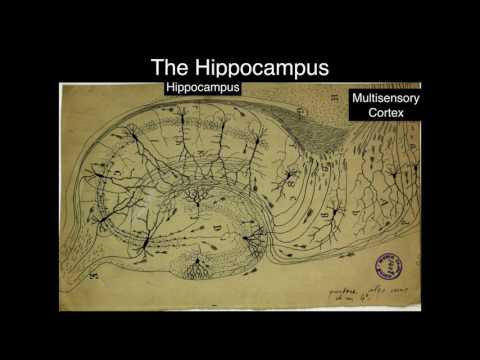
memories so there is this area of the
brain the hippocampus
it looks like the seahorse and that’s
why it’s called the hippocampus and
creak so if you look at it I’ll trace it
out it looks like this right like a
seahorse and it receives all these
sensory inputs from the multi sensory
cortex next to it takes that processes
it stores it at MIT as memories that’s
my rendition of the hippocampus here and
other than the seahorse and enchantix
sea creature is also the jellyfish that
neuroscience owes a lot to
the jellyfish helped us see inside the
brain so we can take fluorescent
proteins from the jellyfish I put it in
the brains of mammals and then see
neurons light up and we were able to use
this to trace the connections between
this multi sensory cortex and
hippocampus you can see in green those
processes in neurons talking from the
multi sensory cortex to the hippocampus
you can even put different colors and
different neurons and you can record
from them talk to them with electrical
recordings and this helped us map a new
circuit this was a new circuit which
made the multi sensory cortex inhibit
the hippocampus and we asked can it
filter information this way so we
decided to image the activity of those
inputs from the multi sensory cortex to
the hippocampus during rewards remember
the width of baked goods so here we
imaged when water rewards were given and
you can see every time the water is
given those neurons light up in red
you’ll see the neurons pop up do you see
it
not when race running not when there’s
looking out of turn only when the water
or what comes also happens when so we
asked what happens when we silence the
circuit massive having a really
unpleasant experience word sensing
danger a fire a fire truck in action
what would be your response run run as
fast as you can but put that fire truck
in a very different context for example
Ari’s fire truck in the woods
it shouldn’t conjure the same emotions
right your brain would output two very
different outputs for these two images
right it’s a picture
Empire State Building I took on my way
home and c4 it’s a partial view but you
can still see that it’s the Empire State
Building this is one I took from the
Washington Square so far away almost
hidden is the Empire State Building
these are two different images but your
brain is telling you it’s the same thing
let’s complete the pattern let’s
generalize it and call it only Empire
State Building
it’s a pattern separation pattern
completion well so in neuroscience nerd
zones what happens is if you have input
so let’s look at that input pattern
that’s not a crossword puzzle that’s the
input pattern for say the Empire State
Building and that’s the neuron output so
neurons have a fire when you see the
Empire State Building you see the other
angle from Washington Square and you see
the input pattern is different but
there’s still some similarity right
there are two of those neurons are
exactly the same so the brain will say
I’m going to produce the same output now
let’s think of fire truck and action
producing this output and toy fire truck
very different input so it should render
a very
an output we silenced that circuit and
this context and aversive context and a
safe context produced the behavior that
would be only for this fear context so
they over generalized their fear they
couldn’t discriminate between aversive
or safe environments that’s exactly what
happens in PTSD a loud pop in New York
is not the same as a loud bang in Iraq
but in patients of PTSD it conjures the
same emotional response the same
physical and emotional suffering dr.
Duval in the fantastic void the
science-fiction movie said all the sun’s
that light the corridors of the universe
shine dim before the blazing of a single
thought and the next few years in the
past celeb we are dreaming of imaging
activity of the brain to see the blazing
of a single thought
[Applause]
Please follow and like us: