
[Music]
you
[Music]
everyone from down to earth will go up
into space anyway we’re talking about
what I’m doing
first of all I’m a businessman I make
furniture as a hobby they do astronomy
I’ve been interested in astronomy since
I was a little kid but got serious in
1986 during the last apparition of
Halley’s Comet and you know after that I
developed for astrophotography and
service imaging planets in 2003 now
imaging planets is basically fighting
the atmosphere you know one problem we
have when we image outer space is that
does this thing for the atmosphere that
interferes what we’re doing it basically
distorts the image now there are three
ways to fight it well of course the
first way is to remove the atmosphere
which is out of the question please
we’ll all die but the other way is
getting out of the atmosphere sending
sending probes like the Hubble Space
Telescope the second is adaptive optics
which is a technology which was
developed by an organization called the
National Security Agency of the United
States of America now what this
technology does is the initially did it
not for astronomy but for their spy
satellites now this technology was
distinctly classified and given to
astronomers and we use it to sharpen
stars to fight the atmosphere
unfortunately these two technologies are
way beyond the budgets of ordinary
people
except for governments so what we are
doing is basically what you call lucky
imaging now lucky imaging is basically
using a video camera and taking a video
of an object or in our case a planet and
we have software’s that basically sort
out the good in the bad frames and
basically those
sharpened image now the camera that were
using when I started I was using a
webcam for the Philips – you can
currently I use the camera from a
company called qhy and it’s a seamless
camera now one thing about imaging
planets when I started imaging you know
people doubted what I was doing because
they look at this guy from Philippines
where’s that you know I was you know
dealing with people from Japan the
United States and Europe but you know
when you’re imaging pilots the most
important thing is the stable atmosphere
and that’s what we have here in Cebu
now to get good images you have to be
number one close to the equator because
planets are higher planets move on a
path in the sky of the ecliptic
in layman’s term it’s called the zodiac
now these planets and the Sun moved
through the 13 zodiac constellations
Brackley 13 a 12th and the 13th is of
yukos so those of you who are doing
horoscopes say you’ve not because there
are no no there’s not others it’s not
well constellations but 13 and in fact
it’s wrong by one month because the
example right now it’s supposed to be in
Gemini but it actually is in darkness so
it’s one month late the horoscopes that
we are today narrate you know we have a
very stable atmosphere not only because
we’re close to the equator but because
we are close to the sea the sea the
laminar air or the devil air flow which
is wind from the seat stabilizes the
atmosphere now in my case I got my five
minutes of fame when they discover the
second Red Spot on Jupiter this is a red
who will be this is a storm
white initially wine this is the storm
over here and this is the great red spot
now the reason why this became a big
thing was because the other red spot is
this big thing over here the great red
spot then the great red spot was
basically first observed in the 17th
century so we took about almost about
four hundred years for the next major
red spot to appear or by doing sorry
five hundred years and and by the way
this telescope that I used to discover
actually it’s a Sbarro telescope from a
friend from Japan and the last year when
I went to Japan I basically it was quite
emotional because after ten years I was
back you know reunited with this
telescope
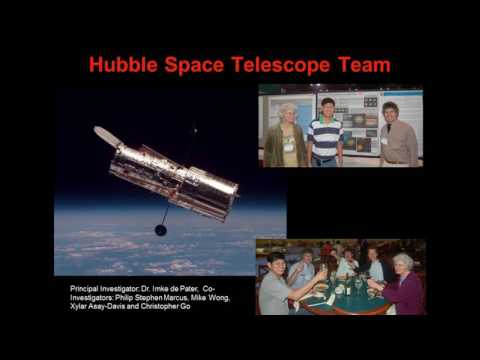
I used the discover the red spot now
what is this one thing one perks about
having a discovery was I was invited to
use the Hubble Space Telescope along
with some astronomers like dr. Inca the
father Phil Marcus my Kuo and silver as
I Davis this is our Berkeley group based
in UC Berkeley and basically we use the
Hubble Space Telescope to make the first
throw some of the new Red Spot and this
is the red spot over here using the
Hubble Space Telescope and using this is
a different filter to show this storm
this storm is actually very huge it is
an anticyclone you can see it over here
it’s about the size of the earth and you
know how powerful this is about 500
kilometers per hour so it is basically
the second biggest storm or the second
biggest anticyclone in the solar system
right now what are you saying that
I’ve been doing was that this image of
Saturn over here I was involved with
this this is the Hubble Space Telescope
image of the transit of Saturn this
happened in 2009 when I was playing with
the software I discovered on this day on
February 24 2009 that 4 moons would
cross the face of soccer this is
actually very rare occurrence so I
called my friend Mike Warren who’s my
partner in Berkeley too you know
he has contacts with a Space Telescope
Science Institute whether we could use
the Hubble Space Telescope then I got an
email from him saying that he was doing
some OGT with the Space Telescope
Science Institute and we got three
orbits from Hubble so this image of
Hubble became one of the top 100 image
of the Hubble Space Telescope now my
second five minute of Fame occurred in
June 3 2010 now this is the first ever
impact detection here on earth when an
impact on Jupiter you can see here this
is the you can see the flash here and
over here you can also see the flash
over here this is a Super Bowl line
basically a small asteroid the size of
about 20 meters structure bitter but it
was about one Megaton so it’s like a
hydrogen bomb exploding on Jupiter and
one thing interesting was that after
that discovery between me and Anthony
Wesley in Australia we we were able to
get our Space Telescope the Gemini in
North which is in Mauna Kea and Very
Large Telescope in Las Campanas in Chile
and we were able to do follow-up surveys
with this with the impact unfortunately
there were no remnants unlike the
previous major impacts like Schumacher
levy and the Bourbon packer the West’s
impact of 2009 where it had a impacts
car in this case this was we it was
concluded that this was the first ever
super polite detection and it became a
new science in in astronomy now another
thing that I was able to do during I
think 2011 there was a huge forum that
appeared in Saturn and we teamed up with
the Cassini Cassini spacecraft let’s
start Leo orbit on Saturn and we did the
support for Cassini and these are my
images of that storm you can see this is
a Cassini image the Cassini of worst
since Saturn it’s a satellite there and
one thing which really got us excited
was that we were able to publish a paper
in a very prestigious journal Nature and
this is probably exactly my second paper
in Nature where I co-authored this paper
and this we found out that this forum is
actually a huge thunderstorm and one
thing about this thunderstorm is that it
became the largest storm in the solar
system with wealth around the planet
it’s even bigger than the Great Red Spot
so if you think that the thunderstorm
freehub in cebu is big this is much
bigger and this thing lasted over six
months so when I wanna do it I think
people will become like them is Baja
so one understand that a new
collaboration is with the thighs a new
collaboration with the National
astronomical research institute of
Thailand now I’d like to talk a little
more about this because I was so
impressed with that ice
I wonder if you have built in Thailand
lately you’ll see the timeline is very
progressive now in fact one thing which
really impressed me with Thailand is how
much they push for scientific research
they have an organization this
organization is to promote astronomy not
just to you know have people who become
astronomers but to get people into the
sciences because one thing that you
should realize and this was published in
the Businessweek that Science and
Technology economy whenever you develop
new technology you create a new economy
and the thing is you cannot create a new
economy or new science without research
and basically you know Thailand is
something that we can emulate cylon was
able to reduce poverty from 18% to 1.4
percent of 2.4% in ten years so all I
can say is we’re not hopeless and one
thing which really broke my heart is
when I asked my friend which is an
assistant minister of of knowledge how
did he do it you know the answer was we
learn it from you
[Music]
we learned it from the Philippines so
those of you who are old enough we know
that you know the Philippines was one of
the top economies in the 60s 50s
I wasn’t born then but you know I think
you know you know you know that we were
the top economy in Asia during the 50s
and 60s and right now unfortunately
at the Murtaugh’s blazer to the bottom
now this is not a project that I’m
working right now
this is juno and this is a spacecraft
that’s currently on jupiter and I’m very
involved with this right now this
spacecraft arrived at Jupiter last year
on July 4 and we were able to do some
work for the spacecraft during that time
July 4 I was in Mount Wilson Observatory
in Los Angeles this is exploring
observatory in fact this is where
astrophysics was born we were asked by
the team in JPL to the u.s. Jupiter as
the spacecraft a port Jupiter of course
before that we had a conference with
NASA astronomers in observatory that
quote but there soon in these France
last year last May to basically brief us
on what tuna will be doing and basically
you know Juno were involved in this
thing the spacecraft and one thing about
the spacecraft either super-weird off
it’s a it’s a different orbit from
previous spacecraft it goes close to
Jupiter and this orbit is once every 64
days they were supposed to be 14 days
but we were not Eve and they were not
able to reduce the orbit through 14 days
because of a problem with the valve but
the dania rate this spacecraft has been
astounded us these are the images of
juno cabinets you know we’ve never seen
images like this before this is the
highest resolution image of Jupiter ever
but one thing interesting about this
spacecraft is that it allows us to
basically allows the public to get
involved with the spacecraft
anyway I’m going to end my talk with a
short video discussing about what how
you can get involved
which you know this is a documentary
from Discovery
Discovery Channel thinking
[Applause]
Please follow and like us: