
[Music]
[Applause]
I’d like you to close your eyes can you
imagine that when you open them again
that everything around you is unfamiliar
and new ponder that for a moment now you
can open them
[Music]
[Music]
what an extraordinary world we live in
but how well do we really know it I’m an
artist working and sound and imagery
that’s me on the right I’m on a mission
to experience the world around me very
differently what you’ve just seen are
excerpts from that over the last nine
years for my quest as a composer and
musician I’m aware that we don’t tend to
analyze music when we listen to it
particularly instrumental music we allow
it to just flow into us but what about
visual information that seems to be
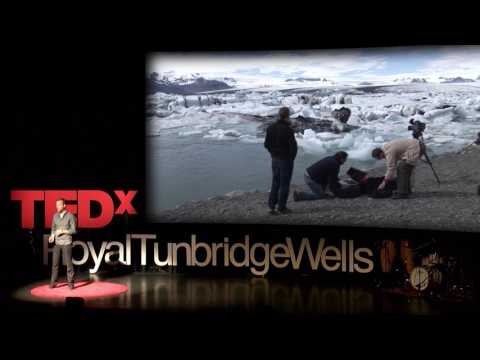
different my story starts here in
Iceland in 1999 I was on holiday but I
was also filming and collecting sounds
I’m always up to something
like recording geothermal crackling
under the surface of the earth
I loved the landscape of Iceland the
forms the patterns and the quality of
light and the volatility I wondered why
some environments affected me more than
others and why I liked some more than
others what was it about them how was I
experiencing them differently flying out
of Iceland the extraordinary landscape
from the air really captivated me and it
lit a spark for something here’s me was
my older brother Johnny he was born very
premature brain-damaged at birth and has
cerebral palsy his language is limited
but his experience of the world is very
visual with great attention to what I
might see is minor details what could I
learn from him I became a father to
fredericka in the year 2000 my wonderful
little teacher showed me a lot about how
a pre verbal child was experienced in
the world around her and I wondered how
the development of language might affect
that to be lose something when we start
to speak and name things could we
experience with no analysis how would
that be do we know what is real or
imagined beauties and the eye of the
beholder but what does that mean if we
don’t actually know what we’re looking
at these images are minut but they could
be really huge looking at the world as a
child was a beautifully simple idea but
I had no idea how to do it
Iceland was calling me I had a dream or
an obsession to film from the sky
madness or inspiration I don’t really
know but I had no money to do it so I
reached my house and hired a helicopter
and a gyro-stabilized camera
call me an obsessive I didn’t think I
get a second chance at this so I
accessed the best technology I could
find to try out an idea to experience
the world around me differently
Iceland’s an amazing country and I had a
wonderful experience there I tried to
look through the lens with curiosity and
openness without analyzing remember when
you opened your eyes at the beginning of
this did you have a slightly different
perspective here’s me in the middle of
the world’s third-largest glacier they
said nothing to do with the film shoot I
just wanted to be left there for a
little while
everywhere I looked miles around in
every direction it was white
thankfully they picked me up again on
this film shoot I really wanted to slow
down my world as well and I worked for
the first time with vision researchers
phantoms flow motion cameras slow motion
gives us the opportunity to see subtle
changes that happen and constantly
change in environments in this language
dominated world I was trying to make a
film that shared its secrets without
words I called it the air hold still on
my breath it was about experiencing
beauty through abstraction and ambiguity
but no context or analysis like a piece
of music novelty can give a massive
release of the neurotransmitter of a
dopamine into the reward systems in the
brain could look in the new at the world
make me feel happier I’d started
something I couldn’t stop I took the
finished film to the Cannes Film
Festival to see what might happen there
I met David Lynch’s producer who
encouraged me to turn it into a feature
film that’s the kind of guy I can’t
ignore this was getting bigger I needed
some help
I was now in the world of nonverbal
filmmaking so I sought out a real master
a hero of mine called godfrey reggio he
made the cutsy trilogy starting with
Koyaanisqatsi in 1982 the music was by
Philip Glass and had the support of
Francis Ford Coppola this was a film
without words leaving the meaning up to
the viewers Godfrey said it’s not for
the lack of love of the language that
these films have no words it language no
longer describes the world in which we
live language was limiting could I move
beyond it I teamed up with the producer
Rob Alexander from perfect motion and
things then really got organized the
project became breath and I got some
funding finally we could do more aspects
of the project we put together the
creative team and an academic team that
was drawn from six UK universities
including Oxford and Cambridge we were
mapping the human life experience
through the metaphor of landscape I was
Restless though I wanted to head north
again and shoot something really tricky
I was on a shoestring budget but somehow
I managed to convince one of the world’s
best camera manufacturers to support me
Ari I ended up in the Arctic Circle with
one of the best low-light cameras in the
world I loved having access to this kind
of gear but I had no idea how to use
this camera I was on my own in almost
constant darkness than minus 20 I heard
it out eventually I was there to film
the rora borealis but would it come out
could I capture it the stakes were high
this was think or swim oh I had six days
of that
and then thankfully it happened it came
out and it was amazing
here’s me shot on a 360-degree camera in
the middle of the night deep snow
filming these extraordinary displays or
the merry dancers as my or Cajun mother
calls it I was absolutely thrilled to be
out there filming this one of the
highlights of my life back home I
started to film other landscapes the
human body could I fly over the human
body like had done with a helicopter
over Iceland for that I needed the right
technology and this large green beast
here is called a Myro
it’s a motion control system and it’s
made by a company called Mark Roberts
motion control and they won an Oscar for
it and that’s an ultra close-up lens
called a borescope for this kind of
project I needed the right kind of
people as well the kind of person who
had been filming insects was David
Attenborough for decades Rob
Hollingworth was my guy he was on the
camera and he joined a great team on
breath of people helping me realize this
rather mad vision of mine I wondered how
close I could get before it was
unmanageable when you work in an extreme
close-up shots can be completely ruined
but any minor movements in the equipment
vibrations or breathing but not just
breathing lymphatic twitches in the body
things I couldn’t even see with a naked
eye even though I had the best equipment
and the best people the first day was a
total disaster well it was to me I was
demoralized I only had a few shots but I
was seeing new and amazing landscapes
right there in front of me we had
another go with some new technology and
a new approach Pablo Picasso said it’d
take him took him a lifetime to learn to
paint like a child I really understood
that now we filmed the very young
mapping the human journey to old age
maybe our bodies weren’t so familiar
after all I was entranced by the
ambiguity of body terrains and I started
seeing parallels to what I’d shot in
Iceland lots of intense observation and
comparison so here’s a closer for my eye
Iceland in Norway were inspirational but
what about the landscapes near in my
home as fascinated by what’s all around
me like a toddler crawling around in the
undergrowth I could find very different
worlds like the water droplets on this
leaf I loved getting lost in these
places time disappears I wondered how
much of the world around me I was really
aware of as fascinated by the symbiotic
relationship between life-forms I
started cultivating mold on fruit and
vege in my airing cupboard for some
reason my family had a problem with this
I could see a whole new world on a
decaying orange landscape of a distant
planet perhaps an abundance of life
could we live in balance like this with
nature could we develop a greater
awareness of the interconnectedness
between the diverse environments we
inhabit our survival relies on that
technology had transformed since my
first slow-motion exploits phantom
cameras could now slow down motion by
40,000 times an eye blink would take
over three minutes at this speed I
worked with the world’s top slow-motion
camera and did some experiments and blew
things up slowed them down and saw what
I didn’t normally see this is butane gas
and water this was about bypassing the
analytical brain and encouraging a sense
of mystery and unknowing to challenge
how we see our world
can be very misleading but how
misleading I set up a chemistry lab at
home I started filming in Petri dishes
to see the behavioral and visual
similarities between very different
environments on very different scales
macro within the micro distant planets
again I had a burning desire to return
to Iceland with phantoms top camera I
needed another bite of this it was
little money left in the budget but my
crazy idea somehow captured the
imagination of another cameraman
manufacturer Vision Research who made
the phantom and it happened here I was
again working with a camera worth well
over a hundred thousand pounds but I use
it I was reading the manual on the plane
on the way out I had to learn fast I was
filming the majesty of waterfalls and
the twisting forms of geothermal mud and
explosive geezers so where do I go next
well my exploration always continues I’m
always shooting something new and
learning I hope to draw all the strands
of the project together into a finished
film and interactive art installation to
bring the power of a nonverbal journey
to a curious audience like this one can
we listen to the earth it gives us so
much it’s not a resource but the source
of life can we live in harmony with the
spaces we inhabit and look with more
curiosity that this awe-inspiring world
or as William Blake said to see a world
in a grain of sand and a heaven in a
wild flower thank you
[Applause]
you
Please follow and like us: