
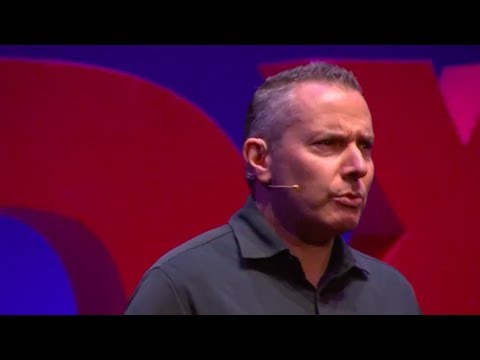
very much everyone I’m clearly here
under false pretences because I can’t be
both
and lo I’m actually Jonathan Anderson my
colleague Edwin Lowe who I’ve been
working with for 30 years is down below
that when we were first asked to give a
TED talk we had to think long and hard
about what we would talk about and also
about which of us would do it you know
instant TED talk you’ve gotta be on the
ball you’ve got to be serious
that would be snappy and we couldn’t
decide which of us was going to speak so
it wouldn’t came up with this great idea
he said to me one day
why don’t we employ an interactive time
dependent randomization algorithm and I
looked at him I said well what’s that he
said rock-paper-scissors and anyway
apparently I I don’t know whether I won
or lost actually but anyway I’m I’m up
here and just a couple of words before
we get going
I don’t know whether any of you know our
working men quite possibly not but we’re
we’re quite diverse artists
stylistically and I just wanted to
explain something about them because
it’s very relevant to what we’re going
to say later we have never been afraid
of reinventing ourselves stylistically
if it suits the material we always want
to find the maximum expression we can
for any project that we’re doing so we
are not afraid to look different from
subject to subject and the reason for
saying that is that we’re going to talk
about three projects and the three
projects we’re going to talk about look
very different one from the other and
the thing behind them all is that if you
look at the world differently if you
keep your senses sharp and alert you can
find magic absolutely anywhere and
wonderful things can result so the first
project we want to talk about is
chrysalis and this takes us back to 2004
we were very tired we’ve been working
too hard so we did what all sensible
people do in these situations we ran
away and we went to Amsterdam and we
locked the computer in the safe and we
locked the phone in the safe and all we
did for a few days was we walked and
talked discuss things read just thinking
about where we’ve got to with our with
our work and where we might go from here
and out of that something quite
extraordinary appeared one idea kind of
brings to the surface out of it all
we’ve done a project called the
abstraction which as you can see is a
series of well they look like folded
pieces of paper these are actually all
details from real buildings real
structures some public buildings some
private buildings and we created this
project as it’s being released
it was very very well received a lot of
modernist architecture involved all shot
on film black-and-white beautiful prints
that kind of thing we care a lot about
the printing incidentally if you’re
Beethoven and you write your ninth
symphony you really don’t want to go
playing it on the ukulele so anyway we
suddenly realized we could use these
negatives as building blocks as atoms to
create an entire new universe so you
could start off with a negative like
this and turn it into this and we used
CGI software architectural software and
manipulated these images and colorized
them and outputted them the saint-
incidentally also gave rise to this
which is probably a bit dark on the
screen it looks great on the monitor
down here I’m sorry about that
and if you look at it closely you can
perhaps make out that it derives from
the same original content and we threw
everything into this mathematics nature
Fibonacci number sequences music
composition Theory history of arts
literature and just everything went into
this a lot of Middle Eastern art
influenced because of the geometry
involved in creating these new images
and the interesting thing about these is
that they really don’t look like
photographs they feel very much in a
continuum with contemporary art of
modernist art but if you saw that you’d
never imagined that this was a
photograph so those few days in
Amsterdam were actually quite crucial to
us because what happened was we learnt
to think about the world in a different
way
and we came back from Amsterdam with our
perception altered now actually quite a
lot of people come back from Amsterdam
preventatively
however this was an idea based
perception alteration rather than from
any pharmaceutical experimentation so
that’s the first project we wanted to
talk about and what it happened was we
learned to look at the world differently
and we’d learned to look even at our own
work differently and we’d actually
discovered things in our own work that
we hadn’t necessarily known without
before the second is a project called
manga Dreams and I apologize this is
gonna sound a little bit like a
travelogue because we’re now in
Southeast Asia and it was the following
year 2005 and we were in shopping malls
because in Southeast Asia it’s very very
hot you’re on the equator and it’s very
humid and what happens when school ends
is that all the kids rush into the
shopping malls it’s lively its energetic
it’s really really exciting there’s a
real energy there but in 2005 it was
like a visual assault because suddenly
all the kids had really spiky hair or
hair flopping across their faces so they
can’t see where they’re going and I
looked at Edwin he looked to me and with
this is like being inside a Japanese
manga comic book or an anime movie it
felt like we were in a parallel world I
mean it was just such an extreme
experience visually to suddenly see this
all at once and the thing was it wasn’t
just these kids it was everyone we
suddenly realized that the young
businessman had little gestural elements
in their hair it was toned down but it
was the same thing so suddenly we
realized that manga is conquering the
world we went away and we thought about
this this is maybe the first time in a
hundred years that a visual art form is
influencing youth culture this much it’s
always been music jazz rock and roll the
Beatles punk psychedelia whatever it is
is new
driven and now for the first time a
visual art form is in the ascendancy in
this way the second thing that we
realized was that there’s an
extraordinary change in asian confidence
Asian kids that are not copying the West
anymore and actually Western kids are
copying Asian kids if you look at the
styling of Nicki Minaj or Lady Gaga One
Direction’s hairstyles from when they
first started all of this quite clearly
derives in a diluted form from Japanese
comic books and we thought well we need
to respond really really differently to
this and we were talking about it
further and we realized it also
represents contemporary dysmorphia
everyone having plastic surgery Seoul
incidentally is now the plastic surgery
capital of the world pretty much and you
can go to fashionable parts of Seoul and
you’ll find people boys and girls with
the most beautiful perfect faces you
will ever see in your life which is
going to be really interesting when they
have kids
and then we started thinking about
Facebook and Instagram and everyone is
always perfecting their pictures before
they put them up so everyone owns these
fabulous lives which are actually not
the lives they’re leading and we thought
we have to find a way of responding
outside the box to this what are we
going to do and we thought well what
first shocked us was that it felt like
we were in a parallel world maybe we
were maybe we actually are in some kind
of parallel universe where these
creatures exist so we we then knew what
we wanted to do and we went to shopping
malls in Asia and we found people on the
streets in London we said to them okay
we’ve got this great idea for an
experimental art project and we’d like
you to be a part of it and we can
promise you three things one this
project is going to be huge which means
we can’t afford to pay you and that’s
genuinely true we couldn’t have afforded
to pay them to if we use your images if
this project works you will end up in
books you will end up in museums and
that is a tiny slice of immortality and
three it’s going to be fun because life
is way too short for a bad day in a
photo studio so that was our basic
intention and we got makeup artists and
hairstylists and and clothes stylists
and the results again they don’t really
look like photographs these are all real
people but there’s this real tension
between reality and not reality you can
see it’s real but it can’t be real you
can see all the imperfections on the
skin you can see that you know imperfect
nail clippings the hairs on the skin
that the blood vessels under the skin
the creases everything you know it’s a
real person but somehow it’s almost
impossible to believe that this is a
real person
and so we created all these images it
was a long long process I mean the first
idea was 2004 2005 we actually finally
released the project in 2011 it was a
very slow incubation period and a lot of
the pictures we left blank like this
just with the studio behind it but for
some of them we created on the computer
afterwards we created tableaus and so
this again it’s challenging the idea of
what am I really looking at and what’s
the truth of what I’m looking at and
it’s something we do quite a lot in our
work that abstraction series we showed
you at the start that talks quite a lot
about you know it looks like folding
pieces of paper it doesn’t really look
like a building but they’re all real
buildings and then it challenges again
what you expect a photograph to be and
it’s quite interesting because that
tension between reality and fiction it’s
really not to do with what’s in the
image it’s to do with the baggage that
you’re bringing to the idea of the
photograph and there’s probably no other
visual art form that has quite that much
in the way of baggage attached to it and
the third thing it touches on is
something we use a lot in our work it’s
one of the reasons we were artists for
the Olympic Games is that it’s to do
with the heroic and the mythic and then
these are things we explore a great deal
in our work and one of the side effects
of that or one of the very nice
consequences of that is that although
you guys probably don’t know who we are
I pretty much guarantee you’ve all seen
our work because we were approached by
Lucasfilm and created images that were
used for Star Wars 7 including in the
poster so you actually all know some of
our work already and it was directly
because of this project that they came
to us so talking about mythic things
brings us to the third project which is
called voyages and any one of you who’s
been looking at our instant Instagram
account will know that we’ve been going
on endlessly about this because it’s on
on exhibition right now at the Science
Museum until the end
the month but this is a a very very
interesting and very new project anyone
remember the final scene from Raiders of
the Lost Ark where the Ark of the
Covenant it’s put in a crate and it’s
wheeled into this enormous storage area
well places like that actually do exist
the Science Museum in London shows less
than 5% of what it opens and it’s a big
museum as I’m sure some of you know and
so we happen for other reasons to find
ourselves in the science museum storage
facility and we came across a huge
collection of model boats and they’re
all in crates but the sights and the
ends of the crates are wrapped in opaque
plastic so you can actually look inside
and we were looking at these and there
was there was just something strange
really strange about this and we
couldn’t quite work out what it was
until Edwin did a snap on a small camera
and he just said Jonathan look at this I
kind of looked and I looked at him we
both looked and we both looked at each
other and we just went oh my god
because what had happened was the
plastic had completely redefined the
models all the obsessive detail that the
model makers loved to put into these
boats all of that was gone and instead
what had happened was all sense of scars
our size and scale had been completely
removed and so they look like real boats
and they look like real boats at sea and
they look like paintings of real boats
at sea so we went to the Science Museum
and the conversation went something like
this
dear science museum we would very much
like to photograph your model ships dear
Anderson and oh that’s great we’ll take
them all out of the crates
yeah Science Museum please don’t do that
if you do that we won’t photograph them
eventually after some negotiation we did
get to photograph them in the crates
exactly as they were you can’t really
blame them it’s a slightly ridiculous
idea photographing what about boats
through plastic doesn’t sound like the
best premise for an art project but
anyway what then happened we discovered
was while we were photographing there
was a series of panic phone calls to the
directors office asking if they should
stop us because we were doing all the
wrong things it’s an absurd idea but as
Einstein said if an idea isn’t absurd
there’s no hope for it so these images
are the result and while we were making
these images the strangest thing
happened because we weren’t just
thinking about paintings which obviously
we were thinking turn our eyes Vysotsky
Aschenbach all these people Rembrandt
people who drew ships in the sea and
zone but also authors like Hemingway and
Melville and Conrad CS Forester Horatio
Hornblower and all this stuff was going
through our heads cascading through a
music Benjamin Britten reveled if you
see all these stuff Greek mythology
odysseus tied to the mast listening to
the song of the sirens and actually all
these references that we were thinking
about became like a sirens song to us
trying to get us to set these boats for
you upon the sea so it’s an it’s an
unusual project and it’s got an unusual
kind of aesthetic to it the communist
question we’re asked by people who come
to the exhibition is but I thought you
guys were photographers and these are
paintings we say well they are
photographs but again just lose all that
baggage all that distinction between
different visual art forms because none
of it matters none of that technique
matters the only thing that matters is
what you do with it like da Vinci said
if you just draw from nature without
having a purpose you’re no different
from a mirror replicating any object
that’s put in front of it
and it’s been a wonderful voyage making
these in making these images and setting
these boats free and it really brings us
to what we want to say to you which is
you need to have confidence you need to
have confidence to really look because
all of these voyages all of these inner
journeys and passions and lives that
these boats had they were always there
just waiting for someone to set them
free and we were lucky enough to have
senses sharp enough to find them and
that’s true of science and it’s true of
art if you look at the world in a
different way if you see things
differently you can make a difference
it’s as true of Picasso as it is of
Isaac Newton Marcel Proust said that the
real voyage of discovery consists not of
seeking new landscapes but in having new
eyes and Yeats said that the world is
full of magic things patiently waiting
for our senses to grow sharper so our
message to you is be brave be confident
be brave enough to see the world
differently be alert with all your
senses and you will find magic you’ll
find it in the most unlikely places like
a storeroom
you’ll find it in shopping malls you’ll
find it just by chatting and then you
can go on these amazing voyages and
journeys and it’ll give the world
something special it’ll give you
something special as well oh and
sometimes don’t forget to lock your
computer in the safe thank you very much
you
Please follow and like us: