
so then I first came to the United
States to the state of Oklahoma in 2009
I looked outside my airplane window and
I wondered where are the Cowboys where
are the teepees to my surprise I didn’t
see any then I went to school at USA OH
in Chickasha a small rural community in
Central Oklahoma and one fine evening I
struck this friendly conversation with a
group of cowboys who asked me so Patel
you’re from India I bet you can see
elephants in the streets in India and I
was like yeah you sure can depends on
how much you’ve been drinking I didn’t
say that
but that brings me to the problem and
issue of stereotyping we all have
stereotypes I had stereotypes of
Oklahoma when I first came here
Oklahomans of stereotypes of me but we
can dispel these stereotypes using
anti-bias education we’ve all heard the
alarming statistic that only 34 percent
americans own a passport when i first
started teaching in the public schools
as a fourth-grade teacher i was appalled
to learn that only one of my 64th
graders had ever traveled outside the
United States and only 10 of them had
ever left the city of Oklahoma City
that’s when I realized that my job as an
educator was not simply to teach the
students academics and disciplines and
the subjects is required by the law but
my job was also to broaden their
horizons and bring the world to their
classrooms to their families into their
communities after my first year of
teaching fourth grade I embarked on a
tour of the state of Oklahoma where I
traveled to over 40 schools from the
Panhandle to southern Oklahoma rural and
urban teaching students about different
countries teaching students about
different cultures teaching them
different languages I’ve had the
incredible privilege of traveling to
over 30 countries and I speak six
languages so children were fascinated by
some of the stories and the lessons that
I taught them from Antarctica to Latin
America to South Asia and on this Jewish
some of the lessons that I taught
included the elephants at the classroom
my personal experiences of working with
elephants I taught children how to make
elephant poo poo paper yeah you heard
that right one elephant gives you about
two hundred sheets of paper per day and
it’s biodegradable it does not stink I
also talked children how to fight
poaching it’s a global problem poaching
different animals and I taught children
how to fight poaching using one of the
experiments that has been conducted by
scientists in Africa the DNA mapping of
elephants though I did not have elephant
poop or elephant hair or elephant saliva
to extract the DNA in the state of
Oklahoma I use strawberries and wheat
germ to extract the DNA of strawberries
I showed students how to compare the
extraction process of DNA of
strawberries to the extraction of DNA of
elephant tusks and elephants and
scientists are using these extraction of
DNA of elephants to study poaching
patterns and they’re making poaching hot
spots hot spot naps which has
implications for law enforcement
so children now were walking around the
school with their DNA necklaces telling
each other you know what I cannot go to
Africa and protect the Rhinos or the
elephants another lesson that I thought
was about sea turtles in the classroom
my experiences of working with sea
turtles in Sri Lanka in India and Costa
Rica the children were not only learning
the science behind the sea turtles but
they were also learning about the
countries and cultures where sea turtles
were found at the end of my tour I was
amazed by the overwhelming response and
support from the students that I decided
to shot my own nonprofit my own 501 C 3
and I called it the world experiences
foundation and who knew that today the
foundation would be serving over 40
schools helping them meet global
competencies and helping them bring
quality global experiences to their
classrooms we have six programs at the
world experiences foundation and today I
want to focus on two of our major
programs the global connect program that
started when I was teaching fourth grade
in Oklahoma City Public Schools and this
was the first time as you can see in the
pictures to the left this was the first
time my students had travelled to India
and this was a group of orphans from
India who wanted to talk to my students
and they wanted to learn to speak
English they wanted to learn to
communicate in English and they wanted
to tell them a little bit about India
and they wanted to perform a Bollywood
number so my students were so excited
with the Bollywood number they were like
mr. Patel what can we do in return for
them I was like again at that point I
couldn’t think anything I was like let’s
just do the Harlem shake
I redid the Harlem shake the pictures to
the right out of our three professionals
and engineers from Brazil who not only
taught my fourth graders differential I
mean not
French equations but quadratic equations
but they also taught them about their
homeland of Brazil we had visitors from
Lesotho and Swaziland these are tiny
monarchies in South Africa my students
had never heard the word monarchy they
didn’t know what this form of government
was so they asked them questions like
hey do you have to bow to your king when
he walks in the street there’s some
question like do y’all have cows in
Lesotho and Swaziland to which they
responded yea we have cows but we also
have buffaloes and we drink buffalo milk
and my children rent you because in
America we don’t have water buffaloes so
children were not only learning from
these professionals and connecting with
people worldwide through whatsapp
through Skype through Google hangout but
they were also getting an opportunity to
see the environments that these children
and these professionals came from and
many a times they would run into
students from Bangladesh or from Sri
Lanka where they would find out that
these children had to walk for almost 30
minutes to make it to school or some of
these children then have classroom
supplies and even though my children
were from the United States from a title
one school in Oklahoma City they were
incredibly blessed because we had
community partners we had churches that
gave them everything classroom supplies
they gave them bugs they gave them
everything
so children did not value what they had
and oftentimes I would face a problem
with children recklessly using and
throwing and wasting their resources and
when children got to connect with these
students from Pakistan they learned
empathy they empathize with their
problems and they learn to appreciate
the many great freedoms they enjoy in
the United States of America we also got
to network with some interesting authors
the very first images of an author from
Alaska she came to my classroom and she
read books virtually and she was talking
to my students about the Iditarod the
second individual to the right is a
nepali actor from the Nepali film
industry he came and spoke about the
profession of acting and modeling and he
also spoke to us about his home country
of Nepal the third image is of many
occasions when students got to
conference using Google hangout or Skype
with individuals from all around the
globe sometimes 2 sometimes 5 sometimes
10 and this was an instance when we had
visitors from Brazil and Liberia
speaking
the students about Ebola and Zika we had
mystery skypes or mystery hangouts with
students did not know who they were
talking to that day they would be given
atlases and they would be given
Chromebooks and they would have to ask
questions to determine their location
and they would engage in this fierce
competition with the people on the other
end and as soon as whoever won they
would get an opportunity to interact
with them about their school day about
their country about their culture we
also have bilingual mentors and
bilingual authors especially in Oklahoma
City being a teacher of two classrooms
fourth-grade thirty and thirty students
in each classroom students at all
different levels and twelve students
that spoke English as a second language
or were from Central America it’s
incredibly hard for one teacher to
differentiate instruction for all
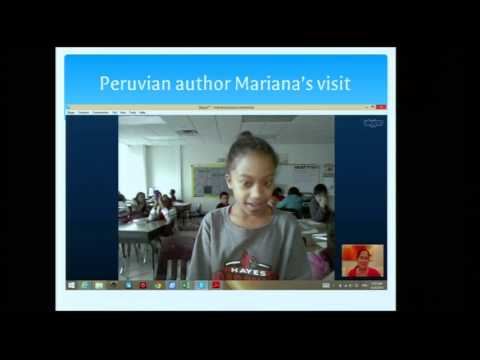
students so I paired them with authors
just like this lady from Peru she’s a
bilingual author she would come and read
the books to the students and both the
languages and she would differentiate
the instruction for me and just like her
I had many other bilingual mentors for
these students and that would help me
meet their competencies and help me
reach these students that I would not be
able to otherwise we got to network with
CEOs of companies this gentleman is from
Community Recycling in Washington this
guy recycled stuff from the United
States and sends it to 40 different
countries so my students were thrilled
one of my students went up and she was
like hey mr. CEO you do some fascinating
work how can I help you
so he’s like you know what I’m gonna
send you a box with shipping paid for
you just put in your old clothes and old
shoes in it and send it back to me so a
few weeks later we sent it back to him
and he Skyped back with us and he’s like
hey look Bella these are your shoes I’m
sending them to the Philippines so for
the first time students at this title
one school had realized that you don’t
have to be rich to make a difference in
someone’s life and we can all make a
difference and we can all serve students
travel all the way from Kiribati to
Bhutan Kiribati our small islands or
atolls in the Pacific Ocean that are
being affected because of global climate
change their schools are underwater so
my for the first time my students had
heard the word refugee and a lot of them
offered they were like mr. Patel can I
open my house to these children because
they’re going to have to move very soon
too
right we had an individual from Bhutan a
very unique country this country was the
last country on earth that introduced
television after they introduced
television they saw a spike in crime
this is also a country with restricted
tourism you have to pay 160 to 180
dollars every day to their government to
travel in that country unless you’re
from one of the exempt countries or in
India national this is also a country
that not only measures GDP or the gross
domestic product but also the gross
domestic happiness of its citizens the
King of Bhutan introduced the world
happiness day at the United Nations a
lot of times educators from all over the
state of Oklahoma they reach out to me
and they’re like mr. Patel because of
these budget cuts we don’t have money to
take our students on field trips so
that’s when we add the world experiences
Foundation established collaborations
with local parks with zoos with fire
stations with police stations that now
children can travel virtually on field
trips in the state of Oklahoma and
elsewhere through their classrooms the
second program that I would like to
focus on that’s incredibly popular among
our schools is the International Day
program international days program
recruits Americans with global
experiences and any international
student or scholar from local
universities in the state of Oklahoma to
go and spend an entire day of service
learning at an elementary middle or high
school so they get to spend the time
dancing performing at the multi cultural
assembly and then they rotate from
classroom to classroom teaching children
about teaching children different
disciplines using their cultures and
using their countries so there’s a lady
from Swaziland we had visitors from
Brazil from India from Nepal from
Argentina from Vietnam from China and
this was an opportunity for them to
connect with these mentors and role
models who were not only students at
universities but they were career bound
they were wanting to become doctors or
engineers so children were seeing role
models in these students and at the same
time traveling around the globe with
these students this story particularly
is heartwarming because this was a group
of Jamin students
jayven visitors at the University of
Central University of Oklahoma and they
developed this incredible bond with my
students over six months that they were
in America that they came to my
classroom the last day
they were in America and they surprised
my students with a soccer ball that they
all autographed so my students still
this day they play with that soccer ball
thinking that they really got a ball
from a soccer ball from these Brazilian
soccer players so not only would they
teach different disciplines they would
also engage in global art global PE
global music and these are just two of
our six programs our other programs the
global ambassadors Leadership Institute
trains high school and college students
to become global citizens our global
citizen Awards Gala honors global
citizens from across the state of
Oklahoma and the world our international
service learning trips take students
high school and college on service
learning trips worldwide and our
professional development trains teachers
professors and principals on how to
bring the world in a standards-based
setting to their classrooms and I work
with global citizenship has now earned
as accolades from the president to
governor mary Fallin to the 2015
multicultural Teacher of the Year the
Human Rights Award
mr. UCO international right here and and
of course for 40 under 40 honors so the
two programs that I focused on today
Global connect and International Day are
programs that can easily be started by
any global citizen anywhere around the
world and these programs can help
children and adults preview their
misconceptions about other cultures
dispel any stereotypes treat everyone
the same and thus help fight and
eliminate racism bigotry stereotyping
and xenophobia from the face of our
planet thank you
[Applause]
Please follow and like us: