
[Music]
[Music]
[Music]
Sonia tell me what’s really good
picture your most recent three to five
hundred mile long trip maybe from
Philadelphia maybe he went to Boston or
Pittsburgh how did you travel there how
did you decide to travel there my name
is Megan Ryerson and I’m a professor of
electrical and systems engineering and
city and regional planning here at the
University of Pennsylvania and I study
how you make intercity travel choices
when I was an undergraduate here at the
University of Pennsylvania in systems
engineering I was fascinated by my new
ability to optimize the movement of
anything along a network a packet of
information along a communications
network or an Amazon box along a
logistics network and this love for
optimization brought me to the dynamic
field of intercity transportation a
question that really motivates me is how
will new technologies everything from
wayfinding and navigation technologies
or to vehicles that talk to each other
and maybe one day will drive themselves
how these technologies will change the
way you and I make travel decisions and
how do our individual travel decisions
add up to have big influences on how for
example an airline might supply air
service at a city or how a local or
federal government might supply
infrastructure to a region now while the
engineer in me loves to optimize
networks the urban planner in me is
interested in how our travel decisions
might influence the environment and air
quality and the economic development of
cities regions and the country now one
disclaimer before I begin which is
particularly particularly relevant given
the given of speaker Jung soo Kyung sook
Kim on his amazing device for for people
who are blind I’m going to be speaking
very freely about making travel choices
but I do realize that not everybody has
such freedom people who are living with
disabilities the elderly people without
the financial resources to have a
vehicle or to buy an air ticket may have
may have
no such freedom now with all that said
let’s go back to picturing your last
three to five hundred mile trip you
likely decided between driving and
flying here in the Northeast Corridor we
also have intercity rail and so there’s
rail is a small portion of trips when we
consider the entire US so we’ll just
consider driving and flying for now and
as you were considered considering your
choice of driving or flying you likely
thought of the interest the entire
travel chain of both of the trips
driving is very straightforward get in
your car and drive flying is a little
more complicated we have the long flight
we also have to access the airport go
through security and and sort of do that
on the other end at our destination as
well while you’re evaluating if you’ll
drive or fly you’re likely considering
how you internalize the time and the
cost of all of the components of both of
the travel chains how we internalize
cost typically depends on our income and
who’s footing the bill for the trip you
might intercede the cost of flying to be
rather high or if your employers paying
for it you might not perceive the cost
at all and the way that we internalize
time begins with our estimate for the
time that each of the links in the
travel chain is going to take but it
particularly depends on three components
of the way we internalize time and the
first component is flexibility driving
offers the ultimate in flexibility get
in your car and drive on your own
schedule flying is the opposite
we’re following someone else’s schedule
in contrast air air travel offers the
ultimate in productivity
dr. milkman just before before my talk
was telling me that she is productive
from the moment she leaves the house to
the moment she gets to her destination
when she flies she is on the phone in
the security line she’s writing emails
while she’s waiting at the gate she’s
working the entire time on the flight
driving offers no such option we are
preoccupied with a rather mundane task
of driving the entire trip and anyone
who has taken a flight or driven to a
faraway destiny
knows that neither option offers
predictability we really don’t know if
there’s going to be congestion if
there’s going to be a road out we really
don’t know if our flight is going to be
on time or if it’s going to be canceled
and we might never get there
we might never get there to be at all so
how did you choose your mode driving or
flying for your last trip how did you
internalize the time and the cost of
both of your options well if you choose
to drive you are not alone 77% of trips
from Philadelphia to Boston are taken in
the car 88% of trips from Philadelphia
to Washington DC in general as a society
we value the flexibility of the car and
maybe the lower cost over the
productivity and the cost of flying but
now consider this now consider that
outside of your house you have an
autonomous vehicle waiting to take you
to your faraway destination how would
you choose your mode of travel and would
you choose the autonomous vehicle you
may have previously thought about how
autonomous vehicle travel might change
the way you move around the city and I’m
going to argue that autonomous vehicle
travel is going to radically change the
way we travel between cities and this is
because autonomous vehicles offer the
ultimate in flexibility and productivity
I leave for your trip whenever you want
I have your vehicle when you when you
get there right depart from your
destination whenever you want but while
you’re doing that you can be productive
you could work you could sleep you could
turn around and play with your children
if they’re there you can you can you can
be productive and flexible at the same
time in addition if enough of us adopt
autonomous vehicles well maybe we can
platoon them on the highway smoothing
out congestion and thus reducing
unpredictability so now we have a mode
that optimizes the three components of
time well if you can’t
wait to have an autonomous vehicle to
take on your next intercity trip we here
at Penn are working very hard to make
that vision a reality
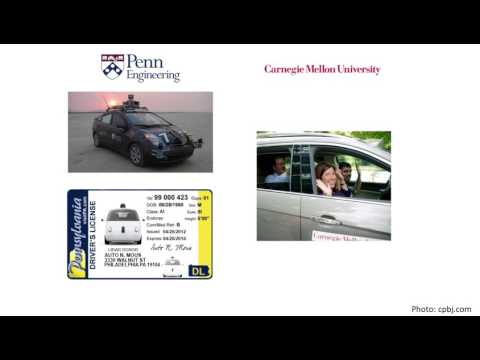
our mobile mobility 21 Transportation
Research Center has been pioneering the
development of autonomous vehicles in
2007 professor Dan Lee of electrical and
systems engineering built an autonomous
vehicle a very appropriately named
little Ben and that vehicle competed the
DARPA urban challenge
professor Rahul Muharram is developing a
driver’s license test for autonomous
vehicles and at Carnegie Mellon
University our mobility 21
transportation a research partner
they’ve been developing autonomous
vehicles and they can be seen driving
around the streets of Pittsburgh
most recently they took our own
Pennsylvania Secretary of Transportation
Leslie Richards herself at Penn grad out
for a hands-free hands-free drive around
Pittsburgh well if we have autonomous
vehicles how will they change the
interests how will they change the
intercity transportation network so
let’s consider the route network for
airlines out of Philadelphia these are
all of the cities that we can travel to
right now nonstop from Philadelphia on a
flight all right Philadelphia is what is
known as a hub airport which means that
passengers come into Philadelphia they
transfer flights and they go on to their
destination and in fact 50% of people
who come through the Philadelphia
Airport are not coming to Philadelphia
and they don’t live in Philadelphia
they’re connecting
they’re connecting through so if those
of us that are taking point-to-point
trips between Philadelphia and another
place Pittsburgh Pittsburgh buffalo or
Rochester if those of us traveling
point-to-point elect to travel on our
autonomous vehicle because it’s more is
because it’s more efficient all right
all of a sudden the airline experience
is a drop in demand on these three to
five hundred mile mile flights
passengers who are looking to connect
passengers who are looking to connect
might find that now instead of five
flights a day to Philadelphia they have
to because the demand wasn’t there
because all of us traveling
point-to-point have moved on to have
moved on to auto the reduction in flight
from the three to five hundred mile
distance could have a very big impact on
our transportation system so a traveler
from Buffalo or Rochester might think
well it’s really inconvenient now to
travel to Philadelphia so instead I’m
going to drive to Detroit or I’m going
to draw it drive to Boston and
Philadelphia loses out on some transfer
passengers so while you might not have
been affected by a cancelling of some
flights to Buffalo or Rochester because
you can get in your vehicle and drive
from Philadelphia now all of a sudden
when you want to go to San Francisco
there aren’t as many flights because
those people from Rochester who want to
go to San Francisco aren’t coming
through to Philadelphia another
possibility is that people in people in
smaller cities around Philadelphia
instead of flying to Philadelphia and
connecting they drive and now all of a
sudden that security line at
Philadelphia has doubled in size and the
number of people who come to
Philadelphia Airport to start their trip
could put double this is not a problem
that is unique to Philadelphia across
the u.s. there are a thousand routes
that are 500 miles in length or shorter
and 37 of our top 70 airports have a
majority of their routes are 500 miles
or less this is a this is an issue that
could change the air service network all
across the u.s. so what do I think is
the future of intercity transportation
in particular aviation with autonomous
vehicles
well Robin Shay’s the founder of Zipcar
talks about a future of a future of
urban transportation with autonomous
vehicles characterized by heaven and
hell heaven being that we all have
autonomous rideshare we’re able to
reclaim urban space because we no longer
need parking because we can shuttle our
vehicle to
far out parking area and we can take all
the the parking space on streets and we
can make it urban space hell being that
we all send our vehicles to run our
errands and we never interact with the
urban environment
well my heaven and hell for autonomous
vehicles on intercity transportation are
a few major airports across the u.s.
being the only points of entry for Air
Service huge security lines huge
congestion points around airports very
very long taxi lines for the aircraft
large unpredictable unpredictability and
service while airports and smaller
cities lay completely underutilized big
disparities in the way infrastructure is
used all across the US so we are all
making rational decisions for ourselves
as we think about our intercity
transportation choices but are all of
our rational transportation mode choice
decisions do they all all add up to an
intercity transportation system that is
optimal for all thank you
[Applause]
[Music]
[Music]
Sonia tell me what’s really good
picture your most recent three to five
hundred mile long trip maybe from
Philadelphia maybe he went to Boston or
Pittsburgh how did you travel there how
did you decide to travel there my name
is Megan Ryerson and I’m a professor of
electrical and systems engineering and
city and regional planning here at the
University of Pennsylvania and I study
how you make intercity travel choices
when I was an undergraduate here at the
University of Pennsylvania in systems
engineering I was fascinated by my new
ability to optimize the movement of
anything along a network a packet of
information along a communications
network or an Amazon box along a
logistics network and this love for
optimization brought me to the dynamic
field of intercity transportation a
question that really motivates me is how
will new technologies everything from
wayfinding and navigation technologies
or to vehicles that talk to each other
and maybe one day will drive themselves
how these technologies will change the
way you and I make travel decisions and
how do our individual travel decisions
add up to have big influences on how for
example an airline might supply air
service at a city or how a local or
federal government might supply
infrastructure to a region now while the
engineer in me loves to optimize
networks the urban planner in me is
interested in how our travel decisions
might influence the environment and air
quality and the economic development of
cities regions and the country now one
disclaimer before I begin which is
particularly particularly relevant given
the given of speaker Jung soo Kyung sook
Kim on his amazing device for for people
who are blind I’m going to be speaking
very freely about making travel choices
but I do realize that not everybody has
such freedom people who are living with
disabilities the elderly people without
the financial resources to have a
vehicle or to buy an air ticket may have
may have
no such freedom now with all that said
let’s go back to picturing your last
three to five hundred mile trip you
likely decided between driving and
flying here in the Northeast Corridor we
also have intercity rail and so there’s
rail is a small portion of trips when we
consider the entire US so we’ll just
consider driving and flying for now and
as you were considered considering your
choice of driving or flying you likely
thought of the interest the entire
travel chain of both of the trips
driving is very straightforward get in
your car and drive flying is a little
more complicated we have the long flight
we also have to access the airport go
through security and and sort of do that
on the other end at our destination as
well while you’re evaluating if you’ll
drive or fly you’re likely considering
how you internalize the time and the
cost of all of the components of both of
the travel chains how we internalize
cost typically depends on our income and
who’s footing the bill for the trip you
might intercede the cost of flying to be
rather high or if your employers paying
for it you might not perceive the cost
at all and the way that we internalize
time begins with our estimate for the
time that each of the links in the
travel chain is going to take but it
particularly depends on three components
of the way we internalize time and the
first component is flexibility driving
offers the ultimate in flexibility get
in your car and drive on your own
schedule flying is the opposite
we’re following someone else’s schedule
in contrast air air travel offers the
ultimate in productivity
dr. milkman just before before my talk
was telling me that she is productive
from the moment she leaves the house to
the moment she gets to her destination
when she flies she is on the phone in
the security line she’s writing emails
while she’s waiting at the gate she’s
working the entire time on the flight
driving offers no such option we are
preoccupied with a rather mundane task
of driving the entire trip and anyone
who has taken a flight or driven to a
faraway destiny
knows that neither option offers
predictability we really don’t know if
there’s going to be congestion if
there’s going to be a road out we really
don’t know if our flight is going to be
on time or if it’s going to be canceled
and we might never get there
we might never get there to be at all so
how did you choose your mode driving or
flying for your last trip how did you
internalize the time and the cost of
both of your options well if you choose
to drive you are not alone 77% of trips
from Philadelphia to Boston are taken in
the car 88% of trips from Philadelphia
to Washington DC in general as a society
we value the flexibility of the car and
maybe the lower cost over the
productivity and the cost of flying but
now consider this now consider that
outside of your house you have an
autonomous vehicle waiting to take you
to your faraway destination how would
you choose your mode of travel and would
you choose the autonomous vehicle you
may have previously thought about how
autonomous vehicle travel might change
the way you move around the city and I’m
going to argue that autonomous vehicle
travel is going to radically change the
way we travel between cities and this is
because autonomous vehicles offer the
ultimate in flexibility and productivity
I leave for your trip whenever you want
I have your vehicle when you when you
get there right depart from your
destination whenever you want but while
you’re doing that you can be productive
you could work you could sleep you could
turn around and play with your children
if they’re there you can you can you can
be productive and flexible at the same
time in addition if enough of us adopt
autonomous vehicles well maybe we can
platoon them on the highway smoothing
out congestion and thus reducing
unpredictability so now we have a mode
that optimizes the three components of
time well if you can’t
wait to have an autonomous vehicle to
take on your next intercity trip we here
at Penn are working very hard to make
that vision a reality
our mobile mobility 21 Transportation
Research Center has been pioneering the
development of autonomous vehicles in
2007 professor Dan Lee of electrical and
systems engineering built an autonomous
vehicle a very appropriately named
little Ben and that vehicle competed the
DARPA urban challenge
professor Rahul Muharram is developing a
driver’s license test for autonomous
vehicles and at Carnegie Mellon
University our mobility 21
transportation a research partner
they’ve been developing autonomous
vehicles and they can be seen driving
around the streets of Pittsburgh
most recently they took our own
Pennsylvania Secretary of Transportation
Leslie Richards herself at Penn grad out
for a hands-free hands-free drive around
Pittsburgh well if we have autonomous
vehicles how will they change the
interests how will they change the
intercity transportation network so
let’s consider the route network for
airlines out of Philadelphia these are
all of the cities that we can travel to
right now nonstop from Philadelphia on a
flight all right Philadelphia is what is
known as a hub airport which means that
passengers come into Philadelphia they
transfer flights and they go on to their
destination and in fact 50% of people
who come through the Philadelphia
Airport are not coming to Philadelphia
and they don’t live in Philadelphia
they’re connecting
they’re connecting through so if those
of us that are taking point-to-point
trips between Philadelphia and another
place Pittsburgh Pittsburgh buffalo or
Rochester if those of us traveling
point-to-point elect to travel on our
autonomous vehicle because it’s more is
because it’s more efficient all right
all of a sudden the airline experience
is a drop in demand on these three to
five hundred mile mile flights
passengers who are looking to connect
passengers who are looking to connect
might find that now instead of five
flights a day to Philadelphia they have
to because the demand wasn’t there
because all of us traveling
point-to-point have moved on to have
moved on to auto the reduction in flight
from the three to five hundred mile
distance could have a very big impact on
our transportation system so a traveler
from Buffalo or Rochester might think
well it’s really inconvenient now to
travel to Philadelphia so instead I’m
going to drive to Detroit or I’m going
to draw it drive to Boston and
Philadelphia loses out on some transfer
passengers so while you might not have
been affected by a cancelling of some
flights to Buffalo or Rochester because
you can get in your vehicle and drive
from Philadelphia now all of a sudden
when you want to go to San Francisco
there aren’t as many flights because
those people from Rochester who want to
go to San Francisco aren’t coming
through to Philadelphia another
possibility is that people in people in
smaller cities around Philadelphia
instead of flying to Philadelphia and
connecting they drive and now all of a
sudden that security line at
Philadelphia has doubled in size and the
number of people who come to
Philadelphia Airport to start their trip
could put double this is not a problem
that is unique to Philadelphia across
the u.s. there are a thousand routes
that are 500 miles in length or shorter
and 37 of our top 70 airports have a
majority of their routes are 500 miles
or less this is a this is an issue that
could change the air service network all
across the u.s. so what do I think is
the future of intercity transportation
in particular aviation with autonomous
vehicles
well Robin Shay’s the founder of Zipcar
talks about a future of a future of
urban transportation with autonomous
vehicles characterized by heaven and
hell heaven being that we all have
autonomous rideshare we’re able to
reclaim urban space because we no longer
need parking because we can shuttle our
vehicle to
far out parking area and we can take all
the the parking space on streets and we
can make it urban space hell being that
we all send our vehicles to run our
errands and we never interact with the
urban environment
well my heaven and hell for autonomous
vehicles on intercity transportation are
a few major airports across the u.s.
being the only points of entry for Air
Service huge security lines huge
congestion points around airports very
very long taxi lines for the aircraft
large unpredictable unpredictability and
service while airports and smaller
cities lay completely underutilized big
disparities in the way infrastructure is
used all across the US so we are all
making rational decisions for ourselves
as we think about our intercity
transportation choices but are all of
our rational transportation mode choice
decisions do they all all add up to an
intercity transportation system that is
optimal for all thank you
[Applause]
Please follow and like us: