
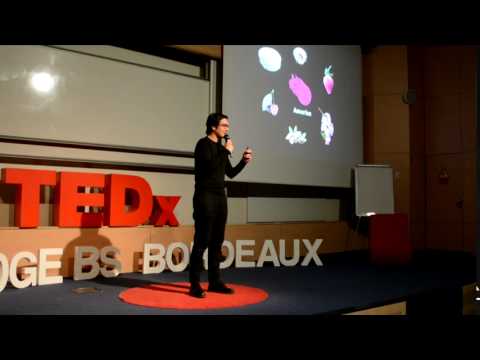
Translator: Geraldine Geraldine Reviewer: Eric vautier
Until the 20th century,
the musicians had at their disposal only
acoustic instruments to compose their music.
They achieved their greatest masterpieces with pianos,
violins, guitars and instruments at the time,
they were enough to create beautiful music.
However, one day, they landed
fundamental for the evolution of music:
what made the sound?
What makes up the sound?
They helped the scientific work,
in part the work of Fourier who demonstrated its famous “transformed”.
And they understood that the sound, the sound waves
were only a superposition of sine waves
of different frequencies and different amplitudes.
See here the white signal which is a sum of all the other color signals.
That is to say that by understanding how sound was made
they used to create their pieces,
they were able to work to try to get his
which was closer to what they hoped.
So they started to work with microphones
and transform this sound, which created the electric guitar,
widely used by all the rock bands at the time.
The sound was picked up by the microphone, processed and attended by speakers.
But what is more interesting is that they have tried to build a sound
of all documents, working on the sinusoidal wave, in the base.
They understood that additionant some waves
they could create any sound, and it was the advent of synthesizers,
that allowed to play music
from sounds programmed entirely by humans.
Synthesizers have made much progress
and nowadays, it is possible to produce almost any sound,
whether it is a sound of an acoustic instrument
or sound completely invented by man.
Electronic music has not replaced traditional music.
She has just completed and brought him incredibly rich.
Many musical genres are born
From these findings, and the work on the sound.
You must be wondering why I am talking about
music of yesterday, while the theme is:
the kitchen of the future? This is because the kitchen tomorrow
is inspired by the music of yesterday to evolve.
It will use the main concepts
that allowed the music to grow
but will apply to food.
We must first ask ourselves what we eat now?
We eat meat, vegetables, fruits, starches.
But what are these compounds foods?
What is the difference between beef and lamb?
What makes the difference between the flesh of salmon and shrimp?
Why a pear, an apple, growing up
both have a tree tastes so different?
Even further, what happens when we cook?
Such meat has a different taste to the base,
but we see that when the kitchen is transformed taste and structure
and the result happens on our plates
has nothing to do with the taste of departure.
Take the example of a loaf of bread toasted in the oven,
it does not taste the same as a loaf of bread not cooked.
We will understand what goes into the food through an example,
cherry, and the work of a great scientist Hervé This,
which laid the foundations of the kitchen I’m present.
The cherry has a consistency, texture.
This texture will be created from pectin that will make a network
in which will be trapped water, this will create the pulp of the cherry.
It has a smell, that smell will be due
to an assembly of a hundred odorous compounds.
They will have different proportions in cherry,
in different varieties of cherries,
and they will have a key role in the taste, and this is what will
allow us, in large part, to perceive the taste of cherry.
When they arrive in the mouth, they will volatilize
and our end,
compounds sprint in the nasal cavity
and it is at this point that we can taste them.
The cherry has a color mainly due to anthocyanins and beta carotene.
What flavor?
The flavor is all that will be captured by language.
sweet are known – there are lots of kinds of sweet –
acidic, bitter, salty
and also the spicy, chilli, pepper, etc.
Nutritional élèments, I will not dwell on it too
because everyone is well aware
Nutrition today and it is no longer debate.
You see that a food as simple as cherry
is still an incredible richness and complexity.
Each compound that constitutes a distinct role,
whether to participate in the smell of the food,
its taste, its texture, all compounds have a role.
Let’s go a little further to investigate another food, it is the almond.
This almond, we will focus on its smell, and compare it to the icing.
Comparing the scent of almond and smell of cherry,
we realize that there are compounds in common, mainly a.
This compound, called it “Amerise”
because it is present in the almond and cherry.
And this creates something incredible,
because now we know that the taste of cherry
is not only the taste of cherry,
but is created from a multitude of compounds.
But these compounds are also found in almonds.
It means that our food is made up of compounds,
and a common basis of these compounds creates all foods.
There are bridges between food,
all foods have in common compounds
and for example, is present in amerise full of food,
whether the nuts Saint Jacques, strawberry, hyacinth, it is present.
Hyacinth is not a food but in all these things,
she participates be much or little, but it contributes to the smell.
This common base compounds, is found in the wine.
Everyone here losque you taste a wine,
you are looking to discover notes of red fruits,
banana notes, notes of leather, foam notes.
Where do they come from?
They do not come from the winemaker, it has not decided to
red fruit in the wine and mix them with leather.
It’s just that the basic grape, during processing,
showed compounds
which is also found in all these things.
This common base compounds is incredible,
it allows us to understand completely
How are made our food, and so far,
we have always used food as an indivisible whole.
We had food, but taking a food,
we take a hundred compounds,
and if you remember the parallel with music,
You see what I mean.
Tomorrow we no longer will cook with food
but we will cook with pure compounds.
This kitchen is called “note for note”.
Each food becomes a palette where the cook
will draw to compose his dishes.
This kitchen is progressive and forward thinking.
It is based on experiments
the greatest chefs who have already started cooking note for note.
The kitchen-note can be enjoyed either at Pierre Gagnaire,
who was the first to develop a flat note for note,
or at Andrea Camastra Franco-Italian based in Warsaw,
which currently has a restaurant that offers dishes
who have at least 10% of matter are composed note for note.
These leaders do not seek to replicate the tastes found in nature.
They have no interest in reproducing the taste of a strawberry tastes like a steak.
Why they have no interest?
Because they have at their disposal the best producers in the world
and if they want the best products,
they will find among producers.
For cons, the kitchen interest note for note,
is being able to create flavors
they want to enjoy their clientele.
This is to create new textures is to create a whole new world,
a brand new kitchen, and really be able to add their artistic talent.
Here, what do you see?
Underbrush.
A forest full of nature full of vegetation,
it’s green, it’s beautiful, it makes you want to walk along a wander.
Yet here everything is natural but nothing is edible.
Through the kitchen-note, you understand now
what facts are the elements that surround us.
And, you do not now see a tree, fern and moss,
but you see thousands of compounds that form these elements.
You see the tree structure. Why we do not eat wood?
Because the structure is not edible,
but everything else, or largely, the rest found in the tree,
could be edible and may be eaten.
Cooking note for note,
one can determine the compounds that are present in wood,
and you know very well that the wood is incredibly rich.
Producers of spirits have understood,
as age their alcohols wooden barrels.
There is an incredible wealth and could use these compounds.
The foam also. This is a kitchen that will be inspired by nature,
but will also be able to seek beyond nature,
because you have all the smells that you like,
eg smell of rain, book, new,
are all odors that are very interesting.
Why we never cooked with the smell of a book, for example?
It would be amazing to determine which compounds
responsible for the smell of a book
and use them in the kitchen.
One would feel to eat something
which would be similar to a book.
At the sight of these endless possibilities
and to develop the kitchen note for note,
we decided to create “Iqemusu”
to make accessible the kitchen of tomorrow for everyone.
Thank you.
(Applause)
Please follow and like us: