
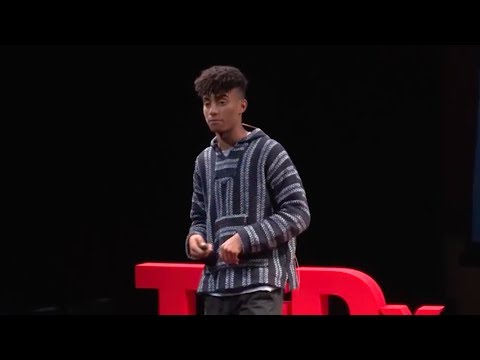
so you may or may not have noticed but
planted on all of your seed on all your
seats or a packet of seeds yes so take
those out you can look at those they’re
a variety of different flowers and this
is my gift to you I want you guys to
hold on to them and think about them not
too much though those small significance
of these items is actually a lacquer
ATAR than it may seem and I’ll explain
that to you later
however in the meantime this is me
around six or seven a primarily
homeschooled kid attending classes three
days a week on a farm in Westchester so
it was here that my mother was told by a
professional in child development that
she should keep me away from the
traditional public school setting
because there I would spend most of my
time in one of three places and that’s
the principal’s office detention or
special ed now this is because at that
age I was extremely as my mother would
put it tactfully loud and opinionated
but as any professional no matter would
call it I was hyperactive a perfect
example of this is a story that
frequently comes up in my household and
much to my embarrassment involves me
forcing myself under a table after class
ends screaming at the top of my lungs
and refusing to come out now this is
completely awful behavior I know but the
reason for this behavior as explained by
my early educators was that I wanted to
continue learning and I couldn’t grapple
with the concept that class time had to
be over it was clear to everyone
especially my parents that I needed to
be in an environment that fostered my
energy towards creative and uplifting
means the name of this program is called
earth school and it is part of the
environmental education organization
called something good in the world
founded by the visionary barbers Harbin
in 1998 here I remember spending first
to fourth grade tumbling around in the
dirt writing poetry in the woods and
composting as a daily routine I was
introduced to something good in the
world’s philosophy on the children’s
peaceful garden and it was the center of
the nature based curriculum and it
served as my early outdoor alternative
to a classroom so the children’s
peaceful garden
takes a large open space in nature and
transforms it into a collection of small
intimate spaces that cater to different
modes of creativity and learning so here
I remember I remember
you know just okay so just to give you a
sense right of how drastically different
this was from the norm as a show of
hands who here in the audience at some
point in their schooling had to memorize
the 50 states in alphabetical order
correct so as you can see this is pretty
much a standard in many schools in this
country and it’s interesting how often
that comes up alternatively I spent my
time building these gardens and eating
some of the produce that I’d contributed
in making and in the process I was
learning about these plants and how each
interact with this environment how they
deter pests attract pollinators conserve
water use only renewable resources and
then composting what I was eating back
into the environment I was learning
about the fundamentals of an ecosystem
the natural world and its processes
excited my curiosity
excited my curiosity and that was
something that was shared by the other
students when we would read literature
or history in those environments there’s
a general excitement and focus towards
the material that pushed us to excel on
the few but legally instituted
standardized tests that we had to take
so the kid that was at one moment
yelling and screaming in the gardens was
at peace and can find focus for his
learning so it turns out that the
research actually shows that this makes
sense in 2004 the human the human
environment Research Laboratory of the
University of Illinois conducted a study
that showed that students as young as
five years old showed significant
reductions in hyperactivity and
attention deficit disorder while they
were engaging with nature
so my rambunctious temperament in any
other setting would have crippled me but
here my energy served to be an asset
so our play spaces were radically
different as well
so as you can see the apparatus is and
outlined areas in which you’re supposed
to play on they offer a pretty narrow
choice of what you can do how you can
interact with
environment and those that you share
that space with rather here where what
we had was open space and trees we have
to learn and cultivate the scale of
creativity and of cooperation and
working towards common ends so another
example on this garden is the garden of
resolve so in the garden of resolve
conflict resolution through peaceful
consultation occurs amongst native
perennial plants that show us how to
live in nature live in harmony based on
the way that these plants actually grow
it was here that I learned how to have a
conversation how to articulate my ideas
on things to others and how to listen to
the stories that people have to tell me
and I learned about the I learned to
value the collective learning and
engagement of the group over the
competition of the individuals so again
the research that observes students in
natural spaces parallels these
experiences that I was having in 2005 an
American institutes for research studies
showed significant gains in cooperation
and conflict resolution skills among
students that attended schools without
door classrooms or programs that utilize
experiential nature nature centered
curriculums the study also showed
improvements in social studies in math
in English and one particular case
involving outdoor science schools
students improved their science testing
scores by 27% now all of this research
is very compelling but my experience in
and memory of this time was much less
calculated for me it was the sharp scent
of compost and chicken coops it was
getting dirt constantly under my
fingernails and being around the
crawling of insects animals and
sometimes dead animals
rotten things these exposures
familiarize me to what is typically seen
in our society as gross I came to these
things as natural as they are so I came
to see these things as natural and being
able to see these things as natural and
normal create
for me a sense of safety of where I was
in that environment and where I was in
the whole world now in a broad sense
this should make sense right we come
from the natural world therefore we
should be our best fullest selves within
the natural world however through the
norms of urbanizing the standards of
what is seen is clean in our society and
issues of liability and public schools
we’ve created a system in which students
become learned out of their
internationalist
we are now a species where more than 50%
of our world population live in urban
settings and our great migration away
from nature has its benefits but what we
gain in industrialization and
urbanization we miss out on in the
crucial developmental benefits that
being exposed to nature has and in the
and it could be the reason for a
collective disregard for the planet as a
society so there is a reason that the
parents of some of the students that
that participated in the app the after
mentioned a study witnessed their
children engaging in positive
environmental activity at home was
because once one feels connected to the
earth they’re more likely to advocate
for its well-being due to an intrinsic
appreciation for it’s worth I truly
believe that being connected with nature
not only bears cognitive benefits but
creates an empathy for the earth that
extends to wanting to ensure its
survival so when it became time for me
to attend public school I suddenly
became incredibly self-conscious about
my lack of what I thought to be official
schooling I thought that my lack of
science and math curriculums would leave
me crippled once I entered the real
world however the most jarring aspect of
that transition was less the academics
than it was the physical environment I
was in so I excelled in every subject
however I rarely ever left the four
walls of a classroom having to walk in
strict lines in the hallways and the 20
minutes of designated playtime on a
rigid concrete playground it was so
baffling to think that for so long this
had been the norm for all of my peers
so how do we reconnect this is a complex
question and the answer is obviously is
well complex but I believe that we can
reconnect through two main approaches
the first is through research so
majority of the research showing the
benefits of exposure to nature on on
children describe correlations rather
than hard cause-and-effect data but
while the science needs advancing we
know at this point enough to act and to
trust the research that has already been
done what we can do to create actions of
research is create the societal interest
that will effectively then drive the
research the second is through avenues
of education so by incorporating the
rugged aspects of nature seamlessly into
our education systems and into our
curriculums what we do is we teach
children not to fear nature as they
already do and we can and through a
connection and familiarity with the
earth we will as a society grow to more
readily advocate for its health the most
exciting aspect of all of this is that
nature centered learning is so easy to
replicate we can begin with something as
simple as building an organic garden in
a vegetable garden in one’s own backyard
and having your family contribute in
building that garden and sustaining it
in my hometown of peaceful New York
projects like this are already underway
so Peekskill while being an urban City a
city nestled into the suburbs the
peaceful middle school has constructed a
greenhouse adjacent to the main building
that and in here so so students get the
opportunity to actually get their hands
dirty gardening and they get to learn
about community agriculture and about
the resourcefulness of the planet and
it’s really inspiring to see these kids
you know take the bite of that first
tomato that they helped grow and and
learn that they themselves can be agents
of this resourcefulness themselves so I
would like to draw your attention back
to the seeds that you were doing earlier
you don’t have to bring them out just
acknowledge them
so when you get home later or tomorrow
when you wake up find a place to plant
the seed be engaged with the survival
and aware of that plants health let that
plant survival represent for you your
newfound connection to the planet and an
understanding that in a broad sense that
plants well-being means your well-being
as well so the seed represents the next
generation nourishment for that plant
represents the natured centered learning
that our children require and the fully
grown healthy plant represents a
symbiotic relationship between human
beings and the earth where nature’s
well-being and our exposure to it are
seen as vital elements of our humanity
thank
you
Please follow and like us: