
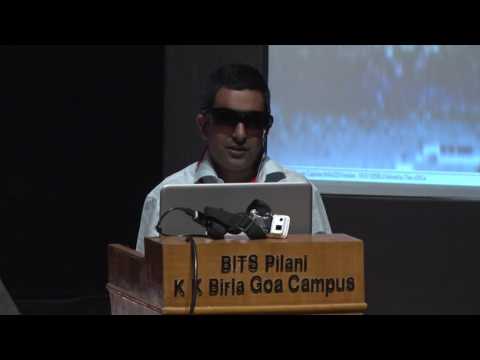
okay I am wired so that I can rewire all
of you okay
so big well thank you I’m going to talk
about rewiring for a sight now a quick
word about the screens you’re seeing me
you are also going to see a feed from
what I am seeing okay
and somebody may want to click on
options and hit zoom in case we are
seeing too much okay so let’s go on
let’s set a bit of the context for why I
would want to see and you know how I
would see biologically this is the
condition of my eyes there is no shape
perception there is very little light
there is no way that I can tell from
which direction a light is coming okay
technically this is called up and since
I’ve had this from both it’s called
being congenitally blind I don’t know
why scientists make up these nice fancy
big words but there you have it well
okay so why bother with vision okay I
you know you can use sounds bats you
sounds dolphin you sounds why do we need
to even see we need to see primarily
it’s about a lot of it is about speed
and a lot of it is acquiring information
you can’t acquire in any other way so
for example you’re talking about how do
you see let’s say a fast-moving car or
how do you see waterfalls
you know the cascade of water as the
waterfalls and the droplets how would
you see those okay well how do you get
vision okay
well you you know the standard answer to
this is and this is true especially in
the Indian context get surgery operation
eye operation miracle everything’s fixed
yay okay but the eyes don’t work so some
people got clever they said okay we will
bypass the eyes we’ll stick electrodes
in your brain like we just saw in the
TEDx video there they were doing it on
the hand they do it on the brain you
have a headphone jack in your brain
which is wired to a computer and so on
little bit tricky very invasive
procedure and you’re talking over a
hundred thousand dollars in terms of
price work however I use again we hacked
the brain is called sensory substitution
where we what the approach involves
substituting encoding information from
one sense into another in this case I am
encoding vision to sound okay so what
are the benefits of this approach unit
eye condition agnostic you know I don’t
care what your eyes can do as long as
you have a working brain I can figure it
out okay sensory substitution can give
you vision okay of course no surgery so
no one opens you up I build my own eyes
with off-the-shelf parts and I can
switch them off when I like I don’t like
seeing something I am tired I want to go
to sleep no problem it’s not about
blinking or closing my eyes I flip a
switch my eyes are off okay so how does
it work it’s not about sound it’s not
about sonar and I’m not saying your
brains are made of plastic either what I
am saying is the brain is a task machine
it’s an infant
and engine I know we all step slept
through statistics class but
unconsciously you have actually been
doing statistics ever since you were an
infant so no excuses what happens is you
have neurons in the brain that are
dedicated to certain functions now if
they are not used for something they get
allocated for something else
there is no ways to make sure everything
gets used
so what sensory substitution does is it
provides the brain electrical you know
everything is translated into electrical
impulses no matter what you sends those
impulses go into the brain and the brain
says mmm wait a minute
I have specialized neurons to deal with
this so let me just flip them back to
what they were supposed to be doing in
the first place and lo and behold you
have vision because that’s how you have
visual cortex and that’s what I’m
showing here on the picture a lot of the
visual areas in the brain are lighting
up when we provide visual stimulus it
so the software I am using is called the
voice it’s made by a Dutch physicist dr.
Peter BL Maya the you know letters in
the middle oh I see are capitalized so
if you use synthetic speech it’s called
voice and is you know that what happens
is it’s a generic application will run
on Windows it’ll run on the cloud it’ll
run on Android whatever else and videos
off-the-shelf hardware okay so how do we
decode vision three fundamental rules as
I look around you can see the scene
change I can also look up you know at
the ceiling all in the interest of
science and what happens is the
placement of the object in the
horizontal axis that shown by stereo
panning which is why I am wearing
headphones okay the pitch of the Sun
represents height
so the higher the pitch the higher the
object the volume of the sound tells me
about brightness so the louder the sound
the brighter the object just these three
mappings now I will late entrant two
vision most of you here are probably all
of you have been learning this since you
got out of the womb what about me I
started learning this in the 2000s the
way I did it is asking a lot of
questions which is what Raul also said
in his presentation you know that the
central core is critical thinking why is
something the way it is how do things
look why is the ceiling you know what’s
this thing these little spots of
brightness here ask questions and as my
like I said tell your stories start
asking and that is how you learn to see
it’s what a child also does but there is
some element of self learning there as
well and that also happens some of the
discoveries I made when I started
learning you know earlier the way I
would learn things is through sound or
through my hands but you know things
like you actually can see more if you go
away from something
now how funny is that if you come if you
touch something with your hands you
actually learn what it is but inside
sometimes you learn more about something
if you step away darkness tell me how
many of us say that we need light to see
well darkness is as important because
that darkness could be telling you that
you’re approaching a nice big wall where
there is absence of light so you better
watch out okay and the same for shadows
shadows are important maybe a lion has
come
in towards you and you got to see the
shadows or maybe here you know you’re
looking at visual effects and I come to
that shortly
contrast is king good contrast get good
vision yeah that’s what we have with all
these lights here brightness good
contrast okay so how do I do photography
while I do photography in the first
place I do it because it allows me to
express what I see so what happens is
when I see a scene I just snap I don’t
think about it too much I trust the
technology a the manufacturer has built
in order focus great job I’m not worried
I decide this is what I want to capture
I load I am the camera I fire I don’t
mind I know it doesn’t matter what the
consequences are what I’ve captured but
that’s the whole idea anyone tell me
what this is it’s a geezer over 100
degrees Celsius some of the photographs
I took here with this approach how would
you touch this Himalayan sky okay down anyone been to Thailand downtown Phuket