
here my process which is to try to
create or scale what is quite literally
a hot approach for making the atmosphere
a carbon source for industries now in
some ways this process is sold in such a
no-brainer
I can only say it’s really kind of
criminal it hasn’t been scaled to
massive proportions before now I might
argue that we’re a little over focused
in society on fossil fuel emissions you
heard me right
the amount of carbon that we jacked into
the atmosphere by the consumption of
fossil fuels for the last couple of
decades we’ve been told to buy less
stuff eat less meat plant the tree
driver Prius do whatever you can to
reduce your carbon footprint and that’s
great how are we doing to that end if we
actually look at the data emissions from
industry carbon emissions from industry
have gone up since 1960 from
two-and-a-half Giga tons a Giga tons of
billion tons of carbon to over 10 Giga
tons of carbon today that’s a lot and on
Sunday I was chatting with a good friend
of mine who’s an atmospheric researcher
at NOAA in Boulder Colorado about this
trend and he said to me says Mike you
know a lot of us in the scientific
community believe that if those
emissions go to zero I mean zero that’s
not enough to prevent the earth from
continually warming for the foreseeable
future I think we need a different
approach I think we did different
approach that first and foremost makes
probably for companies that really think
about building products that customers
want intrinsically and also happen to
subtract a carbon from the atmosphere
rather than contributing to it see if we
only focus on emissions it’s sort of
like thinking about ascertaining the
value of a company by only looking at
its liabilities while ignoring its
assets on its balance sheet are only
focusing on carbon emissions or c3
sources or emissions and ignoring
opportunities to build carbon
sings I think there has to be a better
way to make these products now I’m going
to distill everything down for you to a
very simple denominator in this approach
which is basically the lifecycle of a
match now this match of course is made
of wood it’s plant matter and plants
have been drawing carbon out of the
atmosphere since the beginning of time
you know the basic chemistry of
photosynthesis car plants draw carbon
dioxide out of the atmosphere with water
for the root systems and the help of
sunlight they convert that into
cellulosic structured sugars in in
oxygen and so you might think if we just
let plants grow in fact maybe double the
number of plants that are in the world
that might make a big difference
global photosynthesis of terrestrial
plants on all earth is about a hundred
and twenty Giga tons of carbon a year
that’s a really really big number but
unfortunately half of that folks is
given back to the atmosphere every day
every year because at night plants
actually produce carbon dioxide they
respire another 50 Giga tons that
hundred-and-twenty is further given back
through decomposition of dead plant
matter another nine gigs is then further
fed back into the atmosphere through
disturbance processes which is another
way for saying harvesting burning and
metabolism which we’re all doing in this
room right now and through that entire
process that leaves us with one measly
Giga ton of carbon that has now been
removed from the atmosphere into net
long term storage or what scientists
would call net biome production and so
we would need to massively increase
global photosynthesis to really have a
meaningful impact on fossil fuel
emmissions you see the answer is not in
how we treat living trees or whether or
not we plant more of them but rather and
how we process and treat dead one if we
can reduce the amount of decomposition
if we can reduce the amount of
disturbance from dead plant matter then
we can begin to make a meaningful impact
in the atmosphere but anyway
photosynthesis is kind of boring we
should really talk
about the disturbance of this match
which is the burning you know the
bookends of this process pretty well
once this match is burned it is
converted into carbon dioxide and water
vapor the bookends of this process are
not terribly exciting it’s what happens
in the middle so let me unpack the
decomposition of this match a little bit
for you when that matchstick or is lit
and that flame begins to move along this
lignocellulosic material it heats the
biomass to about 300 degrees driving
from the biomass pyrolytic gases now
those pyrolytic gases and vapors are
then further burned by the way I should
say that pyrolytic zone is that clear
leuctra luminous zone excuse me the
clear luminous zone right along the
matchstick it’s an oxygen-deprived area
those gases are then are further
combusted in the the flame and converted
into carbon dioxide moisture and heat
the heat of course continues the burning
of the match the carbon dioxide is now
available for additional photosynthesis
and that’s a very simple carbon cycle
we’ve addressed the issue we have to
disrupt the carbon cycle so how can we
do that the answer is actually in
removing oxygen from the process if we
can sustain the heat of the reaction but
eliminate the oxygen or air the air from
the process then we can drive these
pyrolytic gases and vapors from the
biomass and maybe sell those to industry
what is the overall process now let’s
think a little bit bigger not from a
matchstick but think of thousands of
tons of biomass set into a reactor like
what you see in the middle in a reactor
like this very hot material is put in a
direct contact with superhot surfaces
and instantaneously heated to about 300
to 650 degrees centigrade which
coincidentally is the average
temperature range of a naturally
occurring forest fire we rate the
biomass across that that metal surface
those pyrolytic gases are liberated from
the feedstock they’re whisked away with
vacuum and then we split cool and
condense those liquids and the
contraption on the right and to higher
value derivatives that can be used for
industry
and there’s a lot of this biomass
available folks the US Department of
Energy
last year confirmed that 1 billion tons
of dry biomass is available every year
in the United States without disrupting
normal forestry and farming operations
and get this that that is enough to
offset 30 percent of America’s petroleum
use that’s a big number
it’s also kind of a meaningless number
unless we convert biomass into
derivatives that are useful for industry
and sawdust doesn’t quite cut it does it
so what are these materials what do we
make out of this stuff from tons of
biomass what is the mass balance of this
overall approach which means how much
product do we get out how much pollution
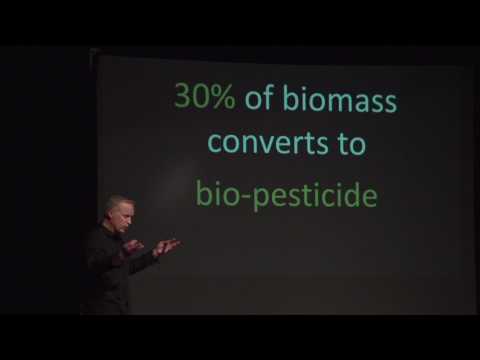
all that kind of stuff well about 30% of
the biomass is converted into a bio
pesticide the technical term of this is
pyro ligneous acid it sounds kind of
nasty until you unpack the name a little
bit pyro for heat Legno for
lignocellulosic residue it’s comprised
of about 80% water I should say it’s
completely non-toxic knock’d
carcinogenic I I hope I get that part
right some organic gases namely acetic
acid which is about the composition in
normal table vinegar but most
importantly a couple of hundred light
molecular weight phenolic compounds that
coincidentally are naturally occurring
flavours and fragrances what’s really
cool about this stuff although it’s safe
for us is that plant didi insects hate
it it drives them away this stuff has
powerful antioxidant capacities and it’s
also a plant growth stimulant kind of
like blood doping for plants we use just
pure heat to drive these materials off
of the plant matter we reapply it to
plants to protect them from insects and
make them grow faster that’s a pretty
good deal for farmers and people have
been using in making their own pyro
ligneous acid for generations in places
like Latin America and Southeast Asia to
mitigate pest pressures and help their
plants grow and also to excel
composting rates four months down two
days and yet in industrial western
farming operations nobody knows what
this is in fact about a year and a half
ago I had a conversation with some top
researchers at the USDA about pyrrha
ligneous acid and their first question
was what’s that
well we embarked on a research project
and I can tell you that we’ve tested
this materials ability to repel some
pretty nasty bugs like Asian citrus
psyllids which have definite devastated
the citrus industry as well as repelled
something called naval orange worm which
attacks almonds why they call the naval
orange won’t attacks almonds don’t ask
me that’s for the entomologist but the
stuff is pretty amazing to that end now
an additional 20% of the biomass 19% to
be specific is converted into an oil a
bio oil industry uses oil folks we all
know that these oil and you can use
these bios to make chemicals and
plastics put them in binders and
pavements use them as it’s heating fuel
and maybe even one day as transportation
fuels now what makes this bio oil kind
unique in this process is that the
oxygenated and the acidic competence
well as most of the moisture have been
stripped away from the oil stream and
collected separately into pyrrha
ligneous acid which as I just described
absent some really good chemical
engineering which I didn’t build I’m not
a chemical engineer those oily and
acidic streams would be collected
together and coagulate into a soupy goop
that is yeardley largely useless for
farmers or industry so that’s 49 percent
biomass yield scuse me yield on the
biomass an additional 30 percent is
converting is something called biochar
which is the recalcitrant form of carbon
that resists microbial decomposition
whereas the original plant matter is
flexible its digestible its aliphatic is
we can call it biochar is rigid its
aromatic it’s largely and adjustable
this stuff decomposes at a rate of a few
orders of magnitude slower than the
original biomass which means about 50%
of the carbon that’s fed into that
reactor is now converted into a form of
carbon that could remain sequestered
from the atmosphere for hundreds maybe
even thousands of years so what are the
applications for this stuff turns out it
does some really great things for
farming operations to help farmer
sustainably intensify their operations
and you should all care about that
because in the next couple of decades
we’re going to approach 9 to 10 billion
people in current fruit production
levels have almost got to double to feed
that world but here’s the rub 40% of the
world’s land is currently cultivated 70%
of the world’s water already goes to
agriculture guys we don’t have enough
land in enough water to double food
production at those current productivity
levels the sustainable production our
sustainable intensification of
Agriculture is essential for all of us
industrial applications for biochar that
carbon material can be quite interesting
it can be an insulator it can be used in
semiconductor applications battery
applications put into pavements where
increases the rigidity and the thermal
resistance of the pavement compared to
its fossil fuel counterparts for the
many applications for that even
including for filtration the reason why
I should say it helps farmers is that
the material is incredibly porous and
slightly charged it holds lots of water
and it holds nutrients which means that
farmers can reduce the amount of
fertilizer and water use on the crops
that spread for farmers as profits and
that’s a good win for profit or for
farmers so we’ve been doing the math we
got 30% 19% an additional 30% that’s 79%
product yield on biomass what about the
other 21% the other 21% of this stuff is
a non condensable gas which is our
energy source that we collect you see
this process produces its own energy
it’s completely exothermic it uses no
energy there is no waste
there are no harmful pollutants produced
by this and in fact as I said earlier
the entire process completely carbon
negative because about half of the
carbon that’s fed in is put into
recalcitrant forms of carbon that cannot
feed back into the atmosphere so what
are some of the challenges of doing this
they’re big ones number one we’ve got to
educate industry in the world about the
benefits of using these carbon negative
derivatives as well as convinced
industrial scale agriculture that they
ought to give these products to try and
offset their chemical use and these
sectors are slow to change
moreover regulators are very slow to
approve products even when they know
that they’re intrinsically safe and
naturally occurring – we’ve got some
engineering challenges now you can make
biochar and a hole in the ground you can
make pyro lignin acid in a little still
but if you’ve ever done an experiment in
a laboratory you know that scaling from
bench to industrial proportions the
nonlinear exercise remember one of the
reasons is is because we’re trying to
recreate essentially the conditions of a
very slow burning wolf forest fire that
produced these carbon negative
derivatives and three of the economic if
you’re going to create a business or any
opportunity that sources carbon from the
atmosphere for industries or frankly
sources anything for any supply chain
process the business has to work problem
folks with most biomass to X businesses
is that the underlying value of the
commodity X rarely covers the capital
and operating costs the riddle to that
puzzle is really instead of producing
one derivative to produce two three four
so think biomass 2x squared X cubed kind
of derivatives it’s the only way that it
can really work and scale and drive the
prices down but these kind of products
can be used around the world so I want
you to think again about that billion
tons of biomass that is available every
year in the United States
that for the most part today either rots
or is burned and fed back into the
atmosphere alternatively 790 million
tons of carbon negative products could
be produced with that biomass supply
industrial supply chains and make the
atmosphere a carbon source for
industries thank [Applause]