
[Applause]
[Music]
last summer I learned what science is
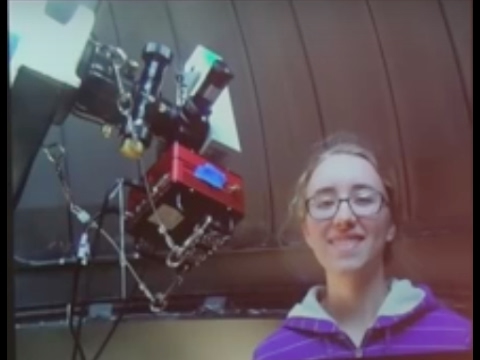
really about I spent the summer as an
intern at the monterey institute for
research in astronomy where i worked on
a small spectrograph and learned how to
translate the light from distant stars
into a graph that can actually be used
to analyze the elements in those stars
essentially spectroscopy is a subset of
astronomy that takes light from distant
stars and breaks it apart like a prism
would into all the different wavelengths
of light from red to blue when you do
this precisely enough with a couple
different lenses and such third and dark
lines appear called absorption lines
each of these lines signifies something
about what elements the star contains
basically different elements absorb
different wavelengths of light so just
by looking at a star’s light you can see
what it’s made of and there are so many
stars out there that is not even all
that difficult to find one that’s never
been thoroughly analyzed you could learn
something about a star that no one else
in the world knows of course all of that
analysis takes a great deal of
specialized knowledge about spectroscopy
which I didn’t have the time to learn in
three months so I didn’t actually do any
of this analysis I just made it possible
specifically what I did was take this
spectrograph make it work by figuring
out the right parts for cameras and
connectors and such focus it and so on
until it was ready to go on the
telescope then one night we actually put
it on the telescope and looked at stars
which was really cool I was taking
spectra of stars spectra which
astronomers could use to figure out what
the star was made of and even a lot
about the size and shape of the star and
this was something maybe only a handful
of people had ever done with these
specific stars
that’s when I learned something about
practical science versus the theoretical
answers in the back of the book stuff
you learn in school I didn’t go back on
the telescope the next night or the next
no for the rest of the summer I worked
on reducing the data from that one night
those ten stars it’s a lot more analysis
and less observation than I had imagined
because in school you go straight from
observation to conclusion without
looking at the enormous amount of
analysis that goes in between so for the
remainder of the summer I worked with a
program called Midas which translates
spectra from something looking like this
there’s something more like this I I
didn’t spend all of my time observing or
working out which stars observe it was
spent on the data after the observations
were done and I didn’t even do all of
that analysis that I just made it
possible no one’s actually analyzed the
data I’ve made yet there could be
information lurking in those graphs that
no one knows right now and that’s what’s
so cool about science there’s so much we
don’t know and it stuff like this that
helps us learn spectroscopy for me which
is such a small corner of astronomy
which is the tiny subset of science
which set which is such a minuscule
portion of all the things that could be
known if you go out on a dark night and
look up at the sky how many stars do you
think you could see it looks like there
are millions but if it’s dark and you’re
away from city lights and there are no
clouds the human eye unaided see maybe
3,000 stars of course telescopes help us
see many many more both the hundred
million in our galaxy and billions more
in others and each star has a spectrum
and each planet around those stars have
spectra
and even if human civilization lasted a
million years we couldn’t analyze them
all there will always be more to learn
that’s what’s so cool about science
science from skier a to know but science
isn’t really about what we know it’s
about what we don’t know we can never
know everything but science will never ever stop trying thank you