
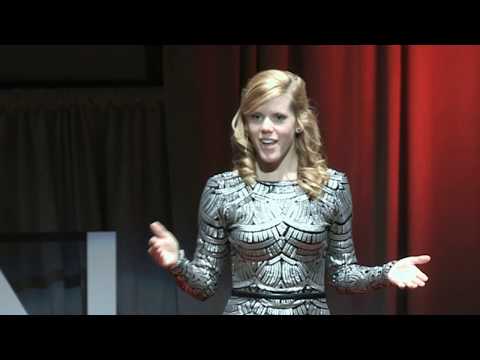
people don’t care what you say they care
how you say it I learned this lesson the
hard way at 14 when I signed up for the
state talent competition the only
problem was I didn’t have a talent I
couldn’t sing I definitely could not
dance there was really only one thing I
could do I remember
peeking through the curtains from
backstage the ballroom was packed with
people and up front was a massive desk
with six evaluators I felt the tap on my
shoulder and I knew that was my cue so I
stepped up into the spotlight vulnerable
and alone just waiting to be judged the
other girls they had sequins and glitter
and flaming batons I had the only thing
I needed a microphone so what could a
girl from Boulder Colorado possibly say
to take home the trophy turns out it
wasn’t what I said it was how I said it
because all the tap dancing in the world
can’t compete against how it feels to
emotionally connect through
communication the secret isn’t great
information it’s great delivery this
explains why it’s not always the most
informed experts who get the TV gigs the
most entertaining one does the professor
with the greatest Theory doesn’t always
fill classrooms the most engaging one
does and the start up with the best idea
doesn’t always get funded the one with
the most compelling pitch does this is
our reality but it doesn’t have to be
our future we can give the brightest
spotlight back to our brightest minds as
soon as we can answer
this question how do you speak to make
people love to listen and remember what
you say answering this question has
become my life’s work you see for 2,000
years experts have depended on their
voices to spread their information
around the world for them oration was a
critical lifelong craft today our
society centers around the written word
we’re so caught up in blogs and text
messages and emails that we’ve conned
ourselves into believing that a speech
is just words on paper it’s not a speech
is sound on eardrums
I watched Diana this brilliant author
give a book talk recently about three
minutes and I look around the auditorium
and I see hundreds of faces looking down
at their phones
Andy is sitting next to me and he leans
over saying listening today Anna talk
just ruined her books for me Diana’s not
alone in fact it’s not even her fault we
have been well trained to write for
reading but no one teaches us how to
write for speaking if you want to make
people listen and remember what you say
stop writing your presentations the way
you write your papers stop writing for
how your speech reads and start writing
for how your speech sounds it’s called
sound writing this method stems from
scientific research and aligns with how
our minds intake process and recall
information so that we can maximize your
audience’s attention and retention at
the heart of all of this is making your
audience feel something because as I’m
speaking to you right now
my words are sound waves and your brain
is interpreting them first for emotion
and second for information that
matters because it means that if I can’t
emotionally engage you my information
isn’t even going to reach you
you’re also not likely to remember what
I say because emotion plays a major role
in how our brains store and recall
memories says research from psychologist
Donald McKay so how do we make people
feel something when we talk according to
multiple studies from Yale University
Michael Krause is telling us that when
it comes to articulating emotion and
judging the emotions of a speaker the
sounds of your voice matter more than
your words and more than your body
language you can see proof of this
basically any Saturday night when dates
get prematurely cancelled because he
said you look fine when what he should
have said is you look fine
it’s the same information but when your
voice sounds like that you communicate
everything she wants to feel when we put
all of these insights together content
is not king delivery is king however you
can’t just deliver nonsense you have to
use words the words you choose and the
way you put those words together impacts
how you can deliver and what emotions
you’re able to make your audience feel
sound writing is how good ideas become
amazing speeches because it takes your
information and writes it in a way that
enables your compelling delivery this is
how when you sound write your speeches
what you say motivates action sound
writers look at speeches the way
songwriters look at music
you can’t just cram in any words you
want it has to have the right syllables
the register all of that and more is
taken into consideration so I wanted to
know how can we make our speeches
is emotionally engaging and memorable as
our favorite music without turning every
boardroom into a Broadway musical the
answer is you follow three simple steps
that form the foundation of sound
writing emotion information and
coordination let’s begin
step one is emotion from the very
beginning I want you to think about how
you want your audience to feel at the
end of your talk
maybe that’s fired up maybe that’s calm
down choose any emotion you want we’re
gonna make everything else align with
that goal step two is information what
are you going to say I recommend that
you Bowl it out your key points and then
record yourself talking through them
pull that transcript and we’re going to
use it as the foundation of your speech
this is how we’re going to protect you
from the number one cause of awkward
public speaking which is trying to
deliver words you never use embrace all
of your contractions the cans and won’t
if it makes you feel comfortable
it’ll make your audience feel
comfortable and that is half the battle
all that’s left is step three
coordination
this is where we take your intended
emotional outcome and we align it with
your information so that when you
deliver what you deliver pleases the ear
and reaches your audience’s brain you
can think of sound smithing kind of like
ninja level word smithing where we’re
going to take your information and
fine-tune it not just for meaning but
also for sound how it forms the music of
your overall message by the way you
don’t have to sound right your entire
talk doing even just a few sentences or
your thesis this way will still pack a
serious punch for you inside
coordination there are so many tools I
could give you but for right now I want
you to focus on these two first letter
sound
and pacing letter-sound is how I
described the way a word sounds in your
ear based on its letters and
pronunciation that matters because
certain sounds VOC certain emotions so
if we want to make your audience feel a
certain way we need to make sure that
the words you’re choosing are creating
the sounds that actually achieve that
emotion let me give you an example if I
want to soothe or endear an audience
choose words that are pleasing to the
ear like luscious and if I want to rile
people up add cacophony those are words
like jolting and chastise now I want to
give you the power of pacing just like
in music that drum beat sets your
heartbeat and when I pick up the pace
I’m affecting my audience’s pulse if you
want to keep people on the edge of their
seats you’re going to need short
sentences short syllables and strategic
clauses and if you want to calm people
down make them think a little bit more
add more rest notes because silence can
say as much as sound extend your
sentences then land your thesis in 9
words or less this is how we’re going to
make your audience’s brains think wait a
second one of these sentences is not
like the rest and that’s where they’re
going to throw their attention right on
top of your takeaway it’s that simple
the 3-step sequence for sound writing is
emotion information and coordination now
you have a choice – you sound writing or
to have it used against you because
nobody cares what you say they care how
you say it and today your great idea
it’s not enough because until you can
get what’s in here out here no one will
ever hear you so join me and sound
writers around the world to ensure that
when you
you will be heard [Applause]
Please follow and like us: