
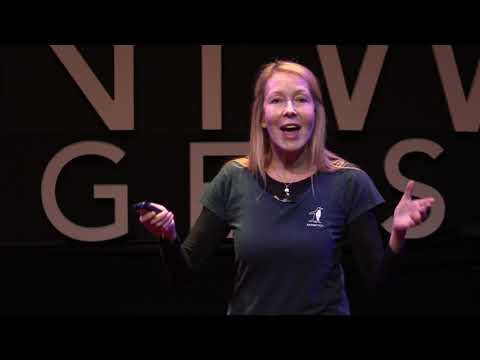
this was a moment that was life-changing
for me I saw this polar bear swimming
when I was on an expedition in the
Arctic and he wasn’t swimming for
leisure I was watching him swimming for
hours and hours and he was swimming
because he couldn’t find any ice and he
couldn’t find any food I was devastated
for this bear I felt so sorry for him
and at the same time I was also ashamed
at my own ignorance about the extent of
global warming and I thought to myself
if other people don’t know the severity
of this is this something that we need
to be sharing and talking about is this
a picture the truest sense of picture
speaking a thousand words I’m a
photographer and this is a typical day
in the office for me actually it was an
extraordinary day I like to refer to
myself as a documentary photographer
capturing the soul of the planet and I
travel to the remote polar regions of
the world the Arctic and the Antarctic
I was recently in Greenland and as well
the Swiss Alps and I document the
changing nature of these landscapes and
the animals and species that inhabit
them and on this particular journey I
found myself in the Antarctic surrounded
by thousands and thousands of penguins
and if you’ve ever been around penguins
you know that they’re really funny
they’re very photogenic and they’re
extremely curious and these penguins
kept on coming to me and some of them
were even trying to crawl on me and as I
looked around I realized that I was in
the midst of a colony and it was mating
season and there were penguins at it
everywhere I think they mistook me for
one of their own
my photographic journey into the wild
began 3 and a half years ago when I
found myself at a crossroads of life
everything as I knew it had changed not
by choice
my mother died my marriage ended and
even my 17-year old dog died and I found
myself in a really deep despair and
grief and so I decided to go into the
Swiss Alps and go on a walking journey a
healing walking journey nature is my
source whenever I need to reconnect with
myself and get back in touch with things
I go into nature so I went on this walk
and I walked and I walked and sometimes
I couldn’t even see the trail through my
tears but I just kept on going and what
I discovered was a renewed sense of love
for myself but more importantly for this
planet and everywhere around me I saw
the beauty and the abundance of Mother
Nature
from the mountain peaks to the valleys
below it was stunningly beautiful what I
saw but in contrast to all of that
beauty I also saw the devastating impact
that we as a species have on this planet
and I saw this most perceptibly in the
scarring moraines of the glacial retreat
the glaciers that had retreated for
kilometres and this really awoke the
curious and activist mind in my in my
head and I discovered that 95 percent of
glaciers worldwide are in retreat and I
realized that if we as a species are
responsible for the demise of this
planet we can reverse that but what’s
going on exactly why are the lands the
landscapes changing so drastically why
is the ice melting so rapidly well we
are currently dumping a hundred
ten million tons of greenhouse gases
into our atmosphere daily every day
every 24 hours like an open sewer and
what this is doing is it’s causing these
greenhouse gases to get trapped in our
atmosphere kind of like a blanket
circling around the world warming the
temperatures and these warming
temperatures are causing the ice to melt
and as well the ocean levels to rise
scientists are predicting that by the
end of the century ocean levels will be
two meters high and two billion people
will be displaced as climate change
refugees meaning that they will have
lost their homes because they will have
lost their lands we’re already seeing
the devastating effects of climate
change with respect to the catastrophic
weather patterns that we’re seeing the
increased incidence of from hurricanes
and tsunamis and typhoons and even the
wildfires and I know that climate change
can seem overwhelming at times
even a concept that is completely
abstract and I get that so I want to
show you the beauty of what I see in the
landscapes with my lens through my eyes
and also the fragility of what we stand
to lose I want you to fall in love with
this planet we call our home I first saw
that noticeable signs of global warming
in the Swiss Alps and this stopped me in
my tracks this is the famous Rhone
glacier which feeds into the Rhone River
and eight years ago the Swiss scientists
did an experiment where they wanted to
cover a small part of the glacier with
blankets to see if it would reduce the
melting so what you see on the right
side of the picture is not snow covered
mound that is the part of the glacier
that is covered with these blankets the
middle part
dark it’s covered with debris that’s the
main part of the glacier and that part
melts on average 10 centimeters a day in
the heat of the summer months the part
that’s covered is reduced it only melts
50% but that’s still a lot glaciers are
a vital source of drinking water for
communities all around the world and a
slight increase in temperature has a
significant impact a 1 degree Celsius
increase in temperature is the
difference between ice and water and in
our bodies a 1 degree Celsius increase
it’s the difference between it’s a fever
we can’t go around covering all of the
glaciers on the planet with blankets and
it would be futile anyway because
covering glaciers with blankets is kind
of like giving an aspirin to someone
with a brain tumor it’s not gonna work
after seeing what was going on in the
Swiss Alps I was really curious and I
wanted to see what was going on in the
Arctic so I went up to the land of the
polar bear and I saw this amazing big
male healthy polar bear and he came
walking very slowly very gracefully as
they do right up to our boat and it was
amazing
this was breathtaking experience for me
it was my first polar bear and he stood
up right at the bow of our boat and he
put his paws on the bow of the boat I
put my camera down at this point I
couldn’t even get him in the frame of my
picture and I looked down into his eyes
it’s amazing and I felt as though he was
pleading with me to save his habitat
this is what a healthy Arctic looks like
this was in the early spring when I was
there and there’s ice everywhere sea ice
it’s plentiful and healthy and the Bears
can go out and get all the seals and
hunt but scientists are saying that by
2020 the Arctic will be ice-free in the
summer that’s in less than two years
this is what it looked like when I was
there there wasn’t as much ice as there
should have been and bears were swimming
more and more to find the ice they
needed to find their food bears can swim
for long distances in fact the longest a
bear was recorded swimming was for ten
consecutive days but bears shouldn’t
have to swim for days for their food and
the additional tragedy here is that
their Cubs cannot swim for so long so
they’re drowning and after spending time
here I really needed something to make
me smile so I went to the land of happy
feet the Antarctica it’s home to
millions of penguins and they really are
funny I love penguins and the entire
time that I was there I was covered from
head to toe in penguin poop and it’s
very smelly but I loved it and I loved
spending time with them but the
Antarctic is also seeing increased
temperatures which is melting the ice
and this is problematic for these little
guys because they live off krill these
tiny shrimp like little crustaceans that
are also adversely affected by the
increased temperatures of the ocean so
these little guys are at risk just like
the rest of us the only difference is we
can do something about it
but before I take you into possible
solutions and there are many there are
solutions I want to offer you a
different way of looking at this issue
for example what do you see in this
picture who sees a mountain range who
we all have a different way of looking
at something we all have our own unique
perspective it’s kind of like our own
DNA and when we look at the issue of
climate change we often think of it as
something that’s happening to us but I
suggest that we do a paradigm shift and
look at this in an entirely new way I
love Paul Hawkens perspectives that
climate change is something that’s
happening for us not to us the climate
change is a wake up call a wake up call
to our species to become motivated and
mobilized and engaged into action and
when we reframe what we think about
something it changes the way we respond
to it and whether we act or not so let’s
take a new path to adopt this paradigm
and ask ourselves what can we do to
become the agents of change there are
solutions there are so many that we have
that we can choose from for example we
all know the famous three RS reduce
reuse recycle but how does that look in
our everyday life well we can start by
reducing our consumption sometimes I
think that consuming has almost replaced
soccer as becoming the 21st century
sport all the shops are full all the
time we’re consuming and consuming
another really important area to reduce
is our food waste did you know that 40%
of food production globally ends up in
the trash that’s massive and food
production has a really large carbon
footprint from agriculture to packaging
transportation and refrigeration it all
adds up so when we can reduce our food
waste that goes a long way and reusing
we can reuse many
that we already have or repurpose them
we can gift items we no longer need and
recycling pretty much everything can be
recycled these days from plastic and
paper and got a cardboard and and glass
and I like to take it one step back and
ask myself I don’t even need this excess
unnecessary packaging I refuse to buy
things that have unnecessary packaging
and everyday solutions can also look
like having our own reusable water
bottle so we don’t have to always buy
plastic water bottles and having our own
reusable shopping bag that we can take
to the grocery store so we don’t need to
take plastic bags from the shop and
let’s not forget to turn off our lights
we just need to be mindful and our
planet can heal itself
in fact regeneration is our planets
default mode when nature’s left alone
life renews itself there is hope we are
an intelligent and adaptive species and
we can get ourselves out of difficult
situations including global warming but
we need to act now and we need to be the
agents of change we have the power to be
the difference that we want to see in
this world like these penguins here
let’s dive into action because it’s not
game over it’s game on so let’s make our impact a positive one thank you
Please follow and like us: