
well mine is the story of a woman
who since childhood dreamed of doing what
now it makes it’s basically tell
stories I’m not the only one nor a
exception in fact there are many
women who every day go out to the
street to look for the faces that few
they want to see or hear the voices that
can be silenced the work of
these women are observed in networks
social is on the cover of newspapers and
of magazines you listen to on the radio and you
watch also on television there began my
path in which many consider the
best trade in the world when I was
little girl I sat to watch the news at
side of my mom and I asked how she
called the work of these women that
they visited strange places that
they talked with famous people who
in one way or another they told us how
It was the world out there, my mom
he said are journalists and I repeated it
insistently
I want to be a journalist 28 years later
is the age that I have now I am a
journalist seven years ago I stepped on
first time a newsroom
I did not leave anymore I have traveled averages
great by means guys and in these
spaces the importance is ratified
that has women to build
stories this is determinant of
made a woman is to blame that I
now he can be here when he was
little one knew miracles aguirre one of
the most prolific feathers this has
country from my perspective and when I grew up
the milá gave me a number of reasons why
which was a good idea to study
journalism for many years she
was the editor of newspaper culture ‘el
trade ‘told me I could write about
whatever I could travel I did
case and I dedicated myself to study journalism
once in college I realized
that most of my professors were
men and this was a reality that
then it was replicated in in the means of
communication is to say
journalism is still a profession
where there is male supremacy and
figures give me the reason
for giving an example in college
central of the equator the second most
the country’s largest women enrolled in
the social communication career
they represent around 55 percent
of undergraduate students and the 46
percent graduate however the
moment when one reviews the figures of the
cordic kong and the number of women who
this works in the media
it is absolutely distant
that is, about 17,000 workers
of the media barely 36% we are
women
in which it translates into these figures in that
women still have to fight
against limitations such as the
sexual harassment and exclusion by
pregnancies within the means of
communication at the same time we are very
few women who are in positions
of leadership and that we have the
possibility to define the line
editorial of a medium I think a
image or a couple of images are going to
ratify what I am telling you
when I just officially started
as a journalist I did it in the appeared
avant-garde magazine and at a given moment
between 2012 and 2013 in the meeting of
planning involved seven men
and the desire I was the only woman who
I was at this discussion table of the
topics that we published week by week and
also I started in the space of
trends talking about cinema culture
interviewing celebrity characters
because there is this prejudice that the
Female profile fits better in these
sections between meals more light than
they require less rudeness or less
courage
I also earned three times less than the
rest of my colleagues in the same
charge and also as I had the
intention to tell stories of
depth or long journalism
weekly encouragement also proposed
other topics that were accepted that were
added to my work load and also
he was in fourth semester of university
in this era of my life in the forefront
one of my bosses told me that I was the
world’s most stupid journalist
surely he did it because I do not accept one
as an answer and it’s very difficult for me
stay with if done or so has
always done in fact this concern
this desire to do things in a way
differently they allowed me to perform
reports that became the
cover one of the best means
positioned at the time of the equator
to travel alone through quite places
inhospitable but above all to do what
that I always wanted to do was
basically do not stop learning
Undoubtedly, in recent years in
the last decades we women have
charged a relevant role in the
construction of information without
However, this is the result of the work
of the need for persistence of
nonconformity forgiveness of other women
dating from a lot earlier I think that
this type of spaces should work
to rescue the memory to dig
in history and in that way it turns out
determinant highlight what was in his
at the moment the work of zoila ugarte de
landivar the first woman journalist of
this country for 1905 zoila founded the
magazine the woman where they were published
texts developed by narrators
thinkers poets women who also
They reflected on feminism and on
the rights of women for 1906
Zoila published the type in the newspaper
daily the typographer that the woman has
right to work because he needs to live and
you do not live and you get amenities
without working
111 years later is a fact women
we are part of the means of
communication but again stressed that
there are very few of us who have the
opportunity to be at the head of
these spaces
vanessa teherán she is a journalist and
she is also editor of the platform I am
the one where they spread
the work of women in different
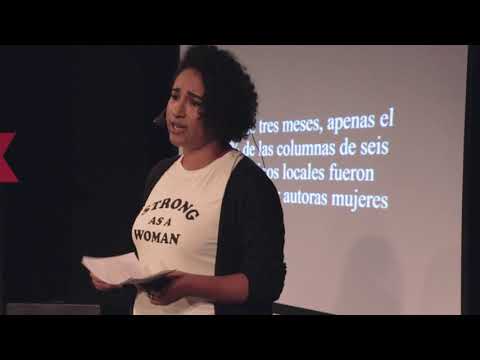
branches and for three months she
monitor the opinion columns that are
they published in six media in six
local newspapers and the result
it is also a determinant of just 22
percent of the columns were
signed by authors by women authors
in that sense for me it is determinant
what historically meant for the
Oriana journalism fallaci considered
one of the best journalists in the
history and his attitude also to the
journalism and how to do
things for her disobedience towards
the arrogant was the only way
use the miracle of being born I
I use that nonconformity also in the
time to do my work and has
tried to follow one way or another
my convictions so that the
journalism that I do serves something
I have tried to generate discomfort and
I tried to invite the people who read to me
to think or to reflect then on
around different issues and this bet
for following my convictions has also
meaning in very many cases that no
you always win
in 2015 I left a means of communication
pretty stable where they paid me
monthly my salary something every time
less common in the media
Ecuadorians
and I decided to bet on the life of the
freelance because he felt that this was the
door to talk about the issues that I
I wanted to, I did it, but the way was
quite difficult because of the obstacles
proper to this working mechanism that
I did not know and also because of the crisis that
it seems year and I was going through this country
paradoxically I published in several
national and international media
however economically I was
broken and the only thing that kept me in
That moment was the desire but to look
what in one way or another things are
lined up to arrive a year after the
2016 as a journalist to rio de janeiro goes
to cover the Olympics this came in a
super critical moment as I told you
because I questioned a lot the
way that journalism was done in
this country where journalism is done in
this country when you decide to do it from
independently because you do it
almost as a survivor in terms
economic
however, I bet on the possibility
that the public agency opened for me
tell stories about human rights
around this sporting event
apply public agency or means of
communication also independent in
Brazil accepted me and I came to Rio de
janeiro public agency is a space
interesting because it is also a medium
which is run by women the year
past one of her directors one of her
natal directors had viana Natalia
became the winner of the award
gabriel garcía marquez in category
text one of the most important prizes
of the region the life me along with her and
with his way of doing things in
Brazil we talked a lot about the
conditions in which right now
does journalism in Ecuador we talk
about why keep telling stories
that hurt and for me the answer is
always the same
as I told you a moment ago I think
that journalism has to serve to
give voice to those who have no voice and has
that serve to portray those that the
society in general is reluctant to see
until brazil we arrived six journalists
of quite prestigious media such as
are the ‘time’ magazine or the clinic in
Chile- and this opportunity was converted to
turn in a response to the crisis that
I was going through that moment
turned
in an invitation I think not to give me
do not give up in that sense I think
that from my work I have tried
somehow unseat the idea that
exists that women can be
very fragile or very delicate in the
moment of exercising an office that enters
quotes historically demand for
rudeness and courage and I think there are
lots of women every day
they show us that journalists
Ecuadorians are brave and in this
moment I will allow myself to quote some
of the names that come to my mind
Monica Almeida Mariana Neira Guadalupe
sandro iron began to Janet Hinostroza
tania patricia tinoco Estupiñan ensure
stream thalía flores
mónica mendoza iván guzmán and surely
I miss many more names
I think they are very clear examples of what
away that is the idea of the
delicacy or fragility in the
time to do journalism
the Ecuadorian journalists in fact
I reiterate once again we are brave and
I believe that right now life is
forcing also more than forcing me
is teaching
brave because I’m at the head of the
first half that is dedicated
exclusively to the verification of
data in this country in ecuador ‘check
every day we monitor the phrases
pronounced by politicians and
we try to determine who is lying
because this requires being courageous
because I think that facing the
unworthy lie and from the means of
communication you have to take a position
about it and from journalism
obviously you also have to do it
also as women we have to
prove permanently because we are
able to do the work that
do our partners and because
we also have the ability to give the
face by a means of defining your line
editorial and to be able to carry out the
work of a team in addition
it’s not about giving us these
spaces by the simple fact of being
women however if it comes to that
do not close the doors for that same
reason
although it seems exaggerated in the heat of century
21 we still have to emphasize
permanently we should still repeat
permanently that women
Ecuadorians we also do journalism
many thanks
[Applause]
Please follow and like us: