
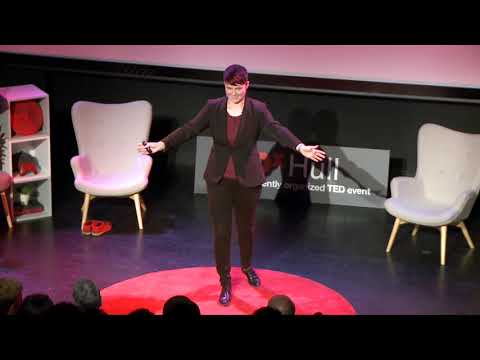
[Applause]
let’s just start by being honest with
you
I didn’t actually start to write this
talk until last week because if you ask
anyone that knows me they will say that
Cass is a chronic procrastinator and
it’s gotten to a point now that every
talk that I’ve given in the last couple
of years I wind it you see I love the
rush it makes my heart beat fast you
don’t know what I’m gonna say next and
neither do I it’s a surprise for
everyone and I fed this to the Teddy
Millie no you got to get this perfect
this is timed it’s gonna be on the Ted
channel write something down and so I
set about the task of writing a talk and
it’s been so long since I’ve done it
that I needed a bit of advice and a
friend lent me a book how to give a TED
talk I was flicking through and I came
across this top tip just jumped out at
me said tell a story that reaches
people’s hearts
now I’m an anatomist I study the
structure of the human body
I literally reach hearts every day but I
don’t think that was the point they’re
trying to get across you see to me
professionally the heart is an organ in
the chest it pumps blood around our
bodies that’s what I have to teach them
that’s the end of that but to society
the heart is so much more than that
it’s in our language in our culture it’s
our perception of health it’s where we
feel intense emotions it is what it is
to be alive it’s how hard it’s the heart
of everything so when they say tell a
story that reaches people’s hearts or
they actually mean a tell a story that
reaches the soul that changes people’s
minds inspires engages makes an
enthusiastic and so I’ve got to try and
reach your hearts now and I thought what
better topic than the heart itself where
is it what is it doing in there because
at its basic the heart is a very simple
yet super effective piece of kit
the blood around our body it starts
beating before we’re even born and it
will continue to beat until the day that
we die with no brakes no KitKat’s
it is our constant in life it is the
rhythm of our bodies I’m gonna start
simple with where is it the in the lines
in the English language we have a phrase
if something is at the center of a
problem or a situation we describe it as
being at the heart of the matter
and it described despite using the heart
as a synonym for center there’s a
pervading myth that it’s on the
left-hand side it’s not it’s in the
hunter that’s where the phrase comes
from to demonstrate this to you I’m
going to invite onto the stage my lovely
model Phil now in the break I painted
the heart on to Phil’s chest and I did
it with UV paints I think it looks
awesome but also I’m hoping that because
it’s like this everyone at the bat can
also see it now the hearts been painted
on in the anatomically correct position
I don’t think you can argue with me and
this is in the center it’s a dove point
off to the left but actually it is a
central organ and it is perhaps a little
bit higher than you think you are if and
you think it is if you want to find
where the heart is on your own chest
invite you to feel for the jugular notch
which is the bony dent in between your
collarbones run your fingers down a
little bit further than inch and you’ll
feel a ridge on the bone they call this
the sternal angle and that is where the
top of the heart is it’s where the big
blood vessels are coming out if you run
your fingers down even further until you
feel the sternum start to drop off
that’s how the base of the heart is
sitting and so it’s perhaps a little bit
higher than you originally thought it
was in the chest it’s a muscular organ
it’s made up of four chambers and we of
these we’ve got two atria the atria
comes from the word atrium Muse in
architecture if ever you enter a big
building like a town hall or a library
or even the
that we’re in today you would have
entered via the atrium it’s a big space
for receiving people now in the heart
that atria receive the blood right and
simple so on our right side we’ve got
blood coming in to the right atrium
which is coming from the body
so our body’s used up all the oxygens
this blood is very low in oxygen on the
left hand side we’ve got blood coming in
from the lungs it’s very high in oxygen
and from the atria the blood gets pushed
down to the ventricles and the
ventricles are a muscular powerhouses of
our heart they’re the ones I’ve got to
pump the blood back out so on the right
hand side on that right everything cool
it pumped the blood up to the lungs and
little one have to be very strong to do
that because thinking about it your
heart here and the long said they’re not
very far to go but for the left
ventricle it’s got to pump blood around
the body with such force that it can
reach the top of your head and the tip
of your toes and still have enough power
to come back so a left ventricle is very
strong and the weird thing is I can’t
actually show it to you on film very
well because when the heart forms we
have a very nice left and right and as
you develop more inside your mother the
heart actually twists and what you can
see on phil is we have our rights atrium
here then the right ventricle and then
all the left have kind of hidden around
the side it’s twisted around the back
when the left ventricle contracts it’s
pushing that blood around our body and
that’s what we feel as our pulse
so our pulse is essentially the tide of
our body it’s the waves of blood pushing
through our arteries and we can feel the
pulse anywhere that the artery is close
to the surface of the skin so in the
neck you should be able to feel your
pulse but also at the base of the thumb
in your wrist I think you’ll see there
are many other places that a pulse can
be taken and the pulse is adaptable our
heartbeat is adaptable as we as we’ve
taken exercise or have a very intense
emotional state our pulses will change
they will adapt with us now the healthy
human adult has a heart rate of about 60
beats per minute give or take and that’s
about one beat per second but if you
exercise really intensely you can ramp
that right up to more than triple get up
to 200 beats per minute if you really
try for it and that makes sense because
when you’re exercising you’re using your
muscles they’re working really intense
they need energy they need oxygen the
only way they get oxygen is from the
blood and it’s using it up fast so the
heart has to beat faster and faster and
faster to keep up with that demand it’s
a basic supply demand equation and your
heart will get better and better at
doing this it’s just like any other
muscle the more you work it the stronger
it will become and the stronger it is
the better able it is to sustain you
throughout your life but it’s not just
exercise that raises the heart rate you
can have triggers from emotional states
as well things like fear and your love
attraction these are responses to stress
or arousal they can affect our heart
rate bring it up or down in the case of
stress that elevates the heart rate I’m
a very good example of this right now
[Music]
favor my resting heart rate is about 60
beats per minute it’s gonna be where I’m
at now okay nearly at double back and
there’s nothing I can do about that I I
don’t actually feel particularly nervous
but my brain sees a hundred people
staring at me in silence I have to just
leg it off there’s a possibility if I
can happen okay my brain is being the
stressful situation is going okay you’ve
got two options you’re either gonna have
to fight or flight so I’m not standing
up against 100 of you and fighting you
well yeah I could potentially run away
and so my heart rate has increased
because my brain saying any second now
you have to leg it and if making my
muscles ready because increasing the
oxygen that’s going to my legs or my
arms if I were to try and punch and kick
my way out of the situation so you can
see how our emotional state changes our
heart rate it’s not just our heart rate
that responds to emotion you quite often
feel intense emotions in your chest and
the reason for that is that the areas of
the brain that perceive emotion and
physical sensation especially pain are
very close to each other and those
signals get confused sometimes so say
you’re very in a lot of emotional hurts
and you’re grieving for someone that can
feel like a pressure on the chest heart
ache and that’s because of these
connections between the brain and the
heart and also the connections within
the brain getting confused but because
we have this confusion we have come to
associate strong emotions with our
hearts and that is what has allowed this
symbol to become the symbol of love we
will recognize this other heart to the
love heart you feed all the time
especially on
time today someone sends you a card with
that on it you alright but if not
anatomically accurate but you can see
that there are some similarities so sort
of like our that takes her a long time
to draw let’s just make it look like
fine that’s fine
so we associate our the heart with love
and we learned this from a young age get
up Saturday morning you’re watching
cartoons Tom and Jerry come on Jerry
fallen in love with a lady mouth full of
fun whose hearts coming out this chest
beating fast look at his pulse rate he
is clearly in love and so we think of
the heart of our connection to other
people how we experience emotions about
the people around us but our heart
especially our pulse it’s very closely
tied into who we are as people you see
we have an internal rhythm our pulse is
ticking away
and our brain is very used to that it’s
used to this tide these waves of blood
coming through the brain once every
second and when you take that away often
the brain gets weird so we talked about
how the heart gets weird because of the
brain but now this is going the other
way around it’s not very often the heart
gets weird without something being
seriously wrong and that’s what I am
talking about if someone ends up on a
bypass machine the reason why they’re on
that is because they’re having open
heart surgery and so if you’re having
open heart surgery now imagine you’re
not the patient imagine you are the
surgeon and you’re trying to make very
small cuts do very fine stitches on an
organ that won’t sit still it’s
difficult yes dangerous so we put people
that need open-heart surgery on a bypass
machine because it allows the heart
should be stopped safely and call it
heart-lung bypass that’s because the
blood gets taken out of the body and put
in to the Machine and we get the gas
exchange going on in there oxygen carbon
dioxide that we have in the lungs and
then it gets pumped back into the body
and we’ve been using these machines for
it
decades more than 60 years which is
longer than I realized and then I looked
it up we’ve had them for a really long
time and it seems that no matter how
sophisticated they are becoming they
still can’t quite mimic the natural
rhythm of an individual’s own heartbeat
because we are all slightly unique and
this results in a weird thing in about a
third of patients it’s called post
perfusion syndrome but it’s better known
as pump head and I think that’s a better
name and pump head is what happens when
the pulse is disrupted that internal
rhythm is lost while they’ve been off
under the knife and when they come round
they’re different for a while it takes
quite a while from to come back but this
disruption in the pulse has changed
their cognition and their mood and you
sometimes find people they might be
uncharacteristic needs Emmure or
aggressive just downright inappropriate
it’s also quite common they have changed
because their brain lost their heartbeat
for a while and it didn’t know how to
cope it was being satisfied
physiologically of getting all the
oxygen and energy that it needed but it
had lost that rhythm and so I hope I’ve
kind of showed how lonely our heart our
connection to other people is intrinsic
to ourself we lose our heart and our
heartbeat we lose our sense of self a
pulse is our measure of life and it will
adapt as you go on life’s journey with
your activities with the connections
that you make with other people but we
are most alive when our hearts are
racing and I say that we embrace that
that we get as many beats as we possibly
can that we go out there we push our
boundaries we try new things we meet new
people we make waves and we allow
ourselves to reach people’s hearts but
also allow them to reach ours we live
thank you [Applause]
Please follow and like us: