
[Applause]
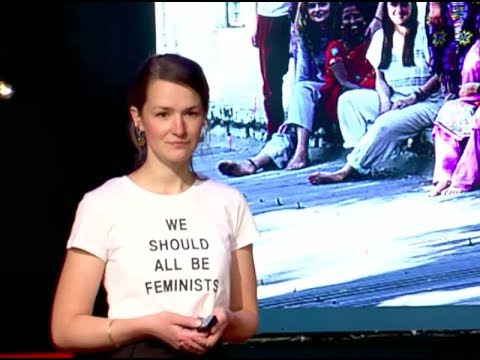
we should all be feminists t-shirts like
mine promoting feminist statements are
very sorry t-shirts like mine promoting
feminist statements are a very recent
trend produced by the so-called
fast-fashion industry an industry that
allows more than 80 billion garments to
enter the market every year and whose
workforce is composed by more than 80%
women have you ever wondered how these
women the women that are producing
t-shirts like mine feel about fashion
brands being celebrated for promoting
these messages just as these messages
the rapid growth of the textile industry
has promised emancipation emancipation
not through social movement but through
economic growth
however the only outcomes that can be
observed today are nothing but immense
environmental pollution and horrific
exploitation my name is Shannon and when
I was small I was what you would
probably call a true fashion victim I
love to dress to shop and to discuss the
latest outfit with my friends I just
enjoyed clothes without ever really
thinking where they might come from this
fashion however were thoroughly
shattered when I volunteered in India
about nine years ago I visited textile
factories and I got to know the woman
producing the clothes I loved so much
and all of a sudden the term fashion
victim developed a totally new meaning
to me however today I do not want to
talk to you about the horrible incidents
like the collapse of the textile factory
Rana Plaza because I believe that in
order to truly understand the horrendous
condition the textile industry is in
today we need to rather focus on the way
it emerged and how it developed as you
might guess by now seeing my t-shirt
the question that come
sends me the most than that and the
question that I think sheds light on the
problem in general is why is the vast
majority of people working in the
textile industry woman the first time I
actively wondered about this question
wasn’t when I visited a textile factory
in the South Indian town of Tirupur it
was only a few days later when I was an
urgent need of somebody to repair my
trouser and all everybody who was
engaging in tailoring in whom I was able
to find we’re men how was it possible
that everybody inside the factories as
you can see on the slide was female
while everybody engaging in tailoring
outside of the factories we’re men I was
sure that there must be a specific
reason and in fact there is have you
ever wondered why you can buy a t-shirt
for less than what you would pay for a
beer buying clothes for the incredibly
cheap prices that we are used to today
is a very recent phenomena and has only
been realized through dramatic changes
in the way our clothes are produced let
me take you onto a journey back until
the early 70s when neoliberal capitalism
was on the rise and textile companies
were faced by ever-growing competition
of course trying to survive this
competition textile companies eagerly
trying to reduce their costs of
production and as labor or in other
words workers are the most important
input used for the production of
textiles the easiest way for them to do
so was to search for the most
exploitable worker or in other words the
worker that could be paid least but at
the same time still delivering the same
quantity and quality they needed what
they found we’re women women in
countries like India and China or
Bangladesh countries in which the lack
of labor laws or strong trade unions
enabled these same companies to enforce
in labor conditions characterized by
uncertainty low income and limited to no
social benefits but why women
of course there is no one answer to that
question as it depends highly on the
context however there are a bunch of
commonalities that can be found in areas
marked by this feminine phenomenon let
me go back to the tailor that helped me
repair my trouser whom you can see here
on the slide confused by what I had
observed I asked him was it why I wasn’t
able to find any female tailors outside
the factories he laughed at me and said
that of course I couldn’t find any
female tailors because the job of the
tailor is really complex and needs loads
of skills over which women clearly do
not possess working in the textile
industry or in the textile factories
inside does not require loads of skills
if any because every worker has to
complete only one little step along the
assembly line for example adding the
buttons finishing the side or the arm
seams or as you might be able to see on
the slide
adding the labels so it occurred to me
that one reason I’ve only seen women
inside the textile factories might be
that they were believed to be less
skilled and hence in a weaker position
to demand higher wages a second reason
can be detected when observing the ways
in which pantry our constructors
attribute certain roles to men and
others to women while males identity for
example is closely connected to a man’s
ability to care for and control over his
family woman’s identity in most cases is
closely connected to their role as
housewives if there is a financial need
however for a woman to engage in any
kind of wage labour outside the
household and I can tell you for most
families there is her work her work will
in most cases be depicted as merrily
supplementing that other male family
members but to conclude we can say that
social structures and local discourses
that depict or even cause women to be a
less educated and be not in the position
of having to feed an entire family are
used as a
if ocation for paying women less so um
the let me introduce Shaheen to you
Shaheen is from a small village in Tamil
Nadu at the age of 14 she had to move to
Tirupur the city I was talking about in
the beginning in order to work in one of
its textile factories controlled by
mainly male managers she has to work on
the horrendous circumstances often
exposed to sexual and psychological
abuse she earns hardly enough to finance
her living and has no chance to make any
savings for future investments hands she
depends she remains dependent on her
male family members support and thus is
now captured in not only one sphere of
male domination per household but in two
spheres of male domination the household
and the workplace or said differently
she is captured between patriarchy and
capital a very recent trend so-called
home-based textile production is taking
these structures to a completely new
level labor-intensive processes that you
can see on the picture like embroidery
knitting or rack weaving a more and more
often outsource directly to the
households and again the major targets
of work women like Swan that do oh yeah
that household adversity says it has
loads of advantages for them they for
example do nominally
families they they are not exposed to
any plague illogical of physiological
abuse and the factories and they do not
visit their lives to work in an
insecurity rotten buildings and second
glance however it becomes obvious that
again it isn’t really woman but rather
podge miracle and capitalistic
structures that profit most so Anna in
the picture for example and worked for
an international renown rap producer and
she had to buy all materials in
machineries herself of course unable to
afford those she was more or less forced
to take a loan from her employer and
hands in his depth was unable to
discipline to you over even though she
hardly heard anything
integrating her work into her everyday
duties for example doing some embroidery
world rice was still boiling or in
between cleaning the house in doing the
dishes nobody really realized that she
was actually working so well hidden from
the eyes of labor unions and labor
legislations and even those of society
she was not only stripped of any legal
protection but moreover wasn’t actually
or wasn’t seen as an actual worker as
you might imagine this did not really
improve the situation but rather
reinforced her sub Oh denied position
summed up we can now say that the ones
who profit from outsourcing through the
households are again a textile companies
and be patriarchal structures that are
strengthened rather than challenged by
this nutrient the ones who lose are
again women making their work invisible
excluding them from contractual
relations and hence neglecting the full
integration to the world market further
facilitates their exploitation or said
differently patriarchy and capital from
a perfect symbiosis reinforcing each
other to the disadvantage of women
tired of discussing all these issues on
a theoretical level I founded the fair
fashion label Jyoti fair works in
collaboration with an Indian NGO in 2010
our aim is to produce socially an
environmentally friendly product but do
not only bring joy to our customers but
Morris or most importantly to everybody
involved in their production starting
from the cotton farmer through to the
weavers and the seamstresses today
savanah is no longer working under in
labor conditions marked by exploitation
not only is she
earning a fair wage and enjoys decent
and stable working conditions but also
has she been trained in all steps of the
production as well as in the fields of
administration and management – having
gained these new skills she was able to
become self-confident and moreover to
actively participate in negotiating the
way she wants to work of course
Jyoti cannot influence whether SWANA and
her coworkers are going to use their
skills in order to renegotiate their
position in society as well as in the
household however what Jyoti can do and
what I think all fashion brands should
do is to bright to provide them with the
right basis to do so today we can
proudly present that Sue Anna and many
of her co-workers have been able to
actively change their position and
especially about of their girl children
to the better so Anna and many of her
co-workers for example and Ava were able
to send their girl children to school
Halima one of Savannah’s co-workers just
recently told me that instead of
arranging her oldest daughter’s marriage
she’s now making sure that she can go to
university in order to become straight
strong and self dependent so to conclude
work itself is not the problem
but can actually constitute an important
step on the way to individual liberation
only it isn’t built on structures of
exploitation and oppression so you might
ask yourself but what is my role in all
of that what is my position in what can
I do about all of this even though I do
not believe that we as consumers have
the power to change the entire system I
think that we have a lot of power to
actively and consciously choose the
brands that we want to support with our
money what is for sure is that wearing a
t-shirt like mine that states we should
all be feminists but at the same time
has been produced and through exploiting
women’s oppressed situation does not
help at all which is why I’m going to
try to take it off now without releasing
my microphone ok that worked um so what
I do in my everyday life – yeah go about
this challenge and to – yeah come up to
my own expectations is follow a very
simple sentence once introduced by
Vivienne Westwood buy less choose well
and make it last translated into your
everyday life
this could mean if you feel the urgent
need to buy a new t-shirt and I know
that neat just ask yourself do you
really need the new t-shirt or do you
maybe already have enough in your closet
if you decide that yes you do need a new
one maybe just go to the nearest flea
market or invite your friends over for a
close weapon party if that for any
reason doesn’t work for you go to the
nearest fair trade shop and if there is
none in your time because it’s maybe not
that popular yet in your the place you
live or if you live on the
countryside go to the Internet and our
promise you find t-shirts and every
sizes shapes and colors you can only
imagine that is actually not my last
sight okay problem um so um now that
brought me out of control
but what I wanted to say is that if you
yeah look for these t-shirts I promise
you that you’ll find um yeah them in all
sizes and shapes because fast a fear
fashion today is just as beautiful as
conventionally produced fashion with the
only difference that it will not only
please you and the environment but at
the same time will support its producers
and hands can lead to actual gender equality now