
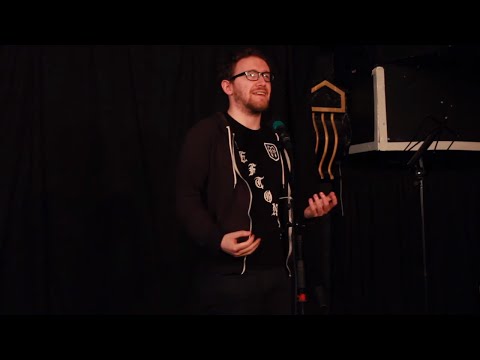
thanks to Irish for the wonderful
introduction
as I stated I’m one of the team here so
I’m more than used to being on the other
side of the curtain so permit me a
little bit use notes rather than
speaking of a perfectly manicured speech
if I can remember crystal clearly the
first time I was called a in
school it was a sense of confusion more
so than anything else I didn’t know what
the word meant I was 8 years of age the
only thing that struck me was the venom
with which this older kid in school just
love this word at me for absolutely no
reason and I remember the confusion
escalating even more when I asked my mom
would admit because when she explained
it to me and it turned out to be
absolutely nothing that should be an
issue whatsoever my only question is why
were people following this insult Alison
why was this word being bandied around
in school like it was an absolutely
terrible swear and the more and more
they kept battling around as we grew
from 8 year olds into teenagers and the
more that people just got you know used
of saying so swearing and you know not
being told by an adult what to do or
what to say without any thought or
recourse as to how hurtful your words
were we weren’t taught that authoring
was a thing we weren’t taught that these
that these words that were being thrown
around this kind of jokey symbols of
masculinity were being told that we
weren’t told that they that they were
someone else’s lived experience were
told that they were somebody else’s
feelings and I think in retrospect it
kind of all turns back to hot were
taught about masculinity and what a man
should be going ahead forward I think
early outset of the planning of this
night we have a little joke the idea of
or I haven’t enjoyed the idea of okay
what if we had like a little night
upstairs and like the spalpeen or some
other place like that woods going to sat
around talked about our feelings and
what Saturday morning cartoons
afterwards and obviously that that was
permissive to the
tedx format as possible but what started
as a joke and as an excuse to over the
words cogmed and isto on Facebook to see
who would react became a proper thing
violation lot of people jumped out in
the comments section it became an idea
that people literally hopped on oh yeah
that’s nice that’s something that we can
put on file away for something we can do
in the future but a funny thing happened
as that discussion was going on and you
know we need people started talking
about a need for a male mental health
space and for a discussion on what
masculinity in particular is today and
tackling the concept the legacy of
support of the austerity and of the
recession really really hit home in
terms of mental health services
available to men and discussion of the
men share came up in discussion of other
mental health aspects and ideas that are
available to two men now that weren’t
available a generation ago cuz talking
about what we were taught as kids what
we were taught and the classic Irish man
I’m sure everybody when they all that in
mind what our grandfathers were like
because of the strong silent types you
know of devil eras isolationist agrarian
policy the last went of the devil eras
ideal you went up near toilet 12 hours a
day in the fields you said not to feel
your feelings and what-have-yous kind of
felt good things as they came along and
this is obviously played on our this
this amplifying social issues are
already existed in the irish constance
post famine post occupation that sort of
that sort of thing and as time wore on
and as ireland become became or the
current ireland that were currently kind
of escaping with current social
liberalism has as that war on became
more founded or its foundations were
built really the problems for male
mental health became you know they
became crystals we think of our
grandparents we think of our parents and
we think about them being quiet and we
think about them kind of just being
steely in in terms of their result but
we also think then about my Ireland
became more globalized and about how
international media became a thing and
by the time my childhood rolled around
in the late 1980s
you know Ireland has had its George best
which was pretty much like their
equivalent of Beatlemania you know we
were beginning to see the chinks in the
armor a little bit in the church’s piety
with the ongoing struggle with
contraception and so on and so forth so
by the time our childhood camera
satellite telly had come in and not only
had we kind of inherited the idea of the
strong silent type as an archetypal
Irishman we’re also dealing with brash
and loud masculinity archetypes from all
over the world and you know my childhood
personally was spent every Saturday
morning in to the neighbor’s house to
watch pro wrestling with all due respect
one of her speakers tonight
Blake Norton and it was always in to
watch these larger-than-life bulk top
steroid it up mastodons like Hulk Hogan
and the Ultimate Warrior and Stone Cold
Steve Austin and all of this so a
restrictive form of masculinity was
countered by this hyper real alternate
masculinity that we were given that
didn’t really that just as much as like
the strong silent type wasn’t
emotionally realistic neither two was
the Ultimate Warrior turning up and
talking gibberish about the power of the
Warriors and the elephants ramping up
his back and so on and so forth so as
that time went on and you know our
generation went from kids to teenagers
and you’ll de première Lee became a big
thing all of a sudden as a child it
became a thing to trend your pattern
yourself after soccer stars and all of
this you know kids will drag bits and
pieces of their identity from everywhere
because it’s packed learning curve and
as generations of Irish men wore on what
your masculinity and the male identity
became ever sort of more warped really
but as we became grownups and the great
you know the great worldwide recession
turned into a domestic depression we
found that the strong silent type that
devil era had pushed for so much in his
ideal Ireland had been supplanted
I mean like his people had brought along
her had at least helped along a
recession that you know it in
combination with cultural changes really
made his
vision of Irish masculinity obsolete and
where we find ourselves now in terms of
male mental health is picking up those
pieces and re-evaluating traditional
masculinity and the filters to which we
we look through and as the evening wears
on a lot of our speakers will be talking
about their personal struggles with
traditional masculinity and these
monoliths of expectations of masculinity
with which they were faced and compared
themselves against but it’s only in
recent times that we’ve seen the effects
of it that in three generations of young
Irishman we are now seeing the point
where it is completely unsustainable
than the old days in the old ways and
the old stoic strong Irishman that never
betrays his feelings or represses
everything and then it means it
unfortunately has always manifested
itself in other ways let’s talk about
institutional drinking but also again
where a provider or we’re supposed to be
providers with restricted if not
non-existent means of provision you know
the lack of jobs unpaid internships you
know massive steer or the deaths of
certain major industries all of these
things have snowballed and I’m going to
break over I’m going to break off a
disaffected millennial stereotypes here
and say that it’s only been in recent
times that people like blind boy
ballclub who uses comedy so expertly as
a means of saying whatever he wants you
can cut straight down to the bone of an
argument talking about male feminism and
you know obviously I don’t want to take
this into male feminist territory but
essentially what we’re doing is with
masculinity and particularly with the
night tonight I’d like for us to kind of
look at traditional masculinity and the
archetypes with which we are handed and
really kind of reevaluate them you know
really kind of examine what we’re going
to do to tackle them and most
importantly how we’re going to carry
that tackling of the issue forward
because it starts with our young men
coming up and it starts with kind of
instilling in them and empathy that
maybe wasn’t there or maybe was less to
the forward you know we teach children
that you know calling someone a
or using racial epithets or so are being
edgy on the Internet
it’s denigrating people’s lived
experience probably not where they kind
of refer to my notes yeah that we kind
of rebound reevaluate our traditional
masculinity inside but we kind of
examine our own relationship as men with
masculinity and kind of see what we can
do with our own selves look at it
compared to our own circumstances and
realistically what we can achieve which
is important but also we can start the
conversation and this is what TEDx cork
salon is all about my vision Joe and
Tina have have have enabled in there a
year running this event is that we can
reach out to others and we can see
people that are suffering we can see
people that are obviously struggling
under I suppose to the weight of
traditional masculinity or struggling on
to the weight of expectation is the
whole ships you carry themselves and
this much is like not a call out culture
where we look at ourselves and our
mistakes and we call other dudes for
that you can’t do this you can’t do that
but rather engage in respectful debate
and do what powerful people do of any
gender and that’s held each other up as
opposed to knock me to the done thank you very much