
and I will be speaking about my homeland
that will speaking I will be speaking
about momentum I think you might
recognize I am the only boy in that
picture and instead of looking out to
look at these very beautiful ladies
around me I’m looking inside my magical
books and what I’m going to tell you
what I have seen inside that box so far
I come from the southern part of Syria
where the great great Syrian Revolution
in the 1920s started but when the French
my uncle I never met he used to find
these bones dismantle them and make
spoons out of them so imagine this very
interesting conversation between an
object of destruction an object of
nature and I would like you to keep this
image in your head because I would like
to come back to it he was inspired by my
grandmother and she used to collect our
old clothes and she used to make very
beautiful blanket out of them so we
could survive the cold weather in the
southern part of Syria so again look at
the way how she is using objects and
transfer their meaning to something
totally different so these two
characters how much they influenced my
life without them knowing that I studied
painting in Damascus and
I studied architecture in st. Petersburg
and I studied theater design in
Wimbledon in London and I live and work
in Cambridge for the last 27 years and I
have done many many many exhibitions and
at one stage I really being in Cambridge
you have to turn to books and papers
being inspired by my uncle and my
grandmother so this is a project I have
done in 2003 as the starting point for
this project was the Iraqi or the
invasion of Iraq and this piece
currently in the British Museum it’s
called sound palimpsest made out of
found paper and found x-rays the British
Museum exhibited this piece few times
once in 2009 as part of the Iraq past
speak to its present to the present and
the second exhibition was exhibited at
the modern Syrian art and this was 2011
and I just would like to emphasize it’s
2011 it is worm the Syrian uprising
started I was given I was invited to
give a present or presentation at that
exhibition and at the end of the
presentation somebody asked me are you
that was Shimon was such an important
question I really could not understand
it I could not take it I could I could
not take the news to my studio to us
such a very difficult question to deal
with but I thought I would like to take
this question and work with it and that
question created a fantastic momentum in
my life for the last few years and it
invited me to look backwards to my
previous work
and to look forward to start digging to
start excavating so this is what I have
done it is 20
I believe it’s 2012 I took the map of
all Damascus and this is my first
attempt to deal with this idea of the
Syrian crisis and one year later I did
this one which is 2013 totally different
Damascus then in 2013 it was my first
attempt to make an exhibition relating
to Syria called excavating the present
so I took x-ray images made this skin
out of them they are photograms and I
took them to the darkroom and I made
another photographs out of them
therefore it is excavation and
excavating the present specific and I
said I am reflecting back to my past
pieces this is a piece I have done in
2003 in relation to the invasion of Iraq
and I took my son’s tricycle while he
was looking away i squashed it and this
is what I have done and it was quite a
very interesting piece to have it
actually in this exhibition recent
exhibition and art exchange it was
actually in the window for three
different rows of this exhibition called
movement of the people so part 1 part 2
part 3 and always in the window there is
this piece a squashed bicycle tricycle
movement of the people you could see the
message where it’s coming from the
connection between the two now talking
about childhood and my child when I went
to visit my culture in 2004 I have been
talking to my mother
about my two boys and she was insisting
that is they should really learn Arabic
but she had only one month of schooling
and that one month of schooling gave her
a great insight to this idea of drawing
letters so this is her drawing of
letters trying to teach my two boys the
Arabic writing the Arabic alphabet and
Arabic numbers but even if you read
Arabic you could see how much she is
really struggling to articulate her
thoughts with her one month of schooling
so I really like the idea that is with
her very simple tools she is trying to
articulate a feeling so I took this idea
and I made it as a starting point for a
few of my pieces so the first one M ap
is called counting and alphabetizing
it’s actually this is a fragment of a
piece which is about 18 meters long made
out of found object of course so the
second one it is called after image so
this piece particularly which was really
quite interesting the way I have done it
it is I am right-handed by the way I
took this idea of writing with my wrong
hand and upside down so again this is
the child for me this is the adult I am
visiting my childhood I’m trying to be
the primitive I’m trying to put myself
in the position of my mother’s way of
articulating her feelings
and in my culture like in many cultures
when somebody dies you would tell
pictures on the walls and you put a
mourning ribbon so this is an
installation to do with this people that
they never had any chance to be mooned
if you like by the relatives because
there is so many people died and nobody
knew that they are dead so this is a
piece that’s again travelled to
different locations and had different
meaning but they are all made out of
found books being in Cambridge you have
many book binders and they throw many of
these rubbish
I collect the rubbish to make my art out
of when I exhibited it in totally
different location in a church in
kettles er the location started to give
new meaning to this piece but of course
I am really interested in seeing my
culture from distance so this is a
calligraphic plate that’s I felt that is
actually it could it could be revisited
this calligraphy but in my understanding
and this is what I have done this is the
piece was exhibited a with group of
artists and architects and dill stone
grow in London and what is the magic
about this piece actually it’s called
the dark side of the unknown ray the
unknown ray is the X ray and it has a
clock in the middle but the clock is
stopped at 2011 and the game 2011 is the
Syrian uprising and this is what have
happened with my recent forget I had
this project dealing with Syrian
refugees and I looked at the Syrian map
plotted the Syrian refugee locations
around Syria try to match them with
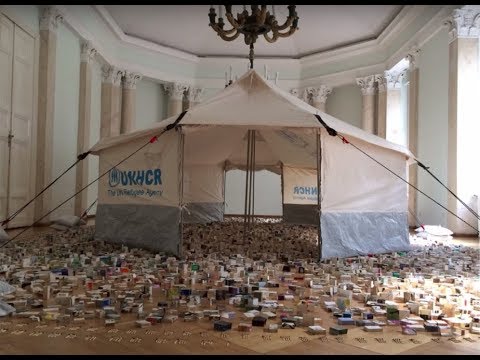
locations in London so this installation
which is called another day lost and if
you look at I just would like to draw
your attention to the number that number
relates to the number of days since the
Syrian uprising and in this exhibition
my introduction I wrote in a very bold
letters life lives are on hold and many
are becoming citizen of a tent and this
installation I worked with very talented
curator
Luisa’s Macmillan and with many great
helpers Nezumi is one of them I think he
is in the audience
helping with this wonderful event and
what we have done we went to all of
these locations and we installed these
camps the camps of course made out of
recycled material and there is the fence
around the camp made out of these
matches so every day I burn one match
and of course the amount of matches
relates to amount of days since the
Syrian uprising so I am going to show
you very quickly now where this piece
travelled around the world so this is
London Hampstead goldwyn Road get the
institute st. james’s because early
church refugee tent and inside that if
you returned
I had a camp I thought it’s over but
actually I was invited few months later
to exhibit it written a very interesting
location in the top of a Navy ship at
the time when many Syrian refugees could
not make it two less was to Greece so
the idea of exhibiting it on the top of
the ship was quite a very interesting
location contributed to the meaning of
this piece but totally different times
or days if you look at it then invited
to Trinity Wall Street Church in New
York again in a tent Philadelphia Dubai
again look at this scale suddenly this
camp is not anymore a camp
it is the city and look how many burn
and uh none burnt matches in this
location New York again Cambridge and
put the bed and look what happened to
the tent they start bleeding out of the
tent
that was the final piece of or the final
location for this piece another devil
it’s difficult to finish project always
you are in search for a new meaning new
thoughts I was thinking about looting
and a very difficult question for me
what is the future of my past and that
was really quite a difficult thing to
deal with and I started looking at
possibilities so I came across this
figure ring which is tiny tiny small
figuring and what struck me is Acree the
title of this figurine it’s called
standing figure Syria and I was thinking
what can I do with this speech full time
is more figuring the fragility of the
female figure so I thought can I do this
a camera obscura images and call it
falling figure Syria all imagine if I do
a 3d print out of it take it to an
airport and make an x-ray images of it
and it’s called
in limbo or friend figure Cydia imagine
Assyrian artists and antiquity 3,000
years old and between in limbo between
one to another country and of course I
couldn’t achieve it I couldn’t do this
x-ray machine image and I hope one day I
will be able to but I came across
totally different stories and I came
across this beautiful ships in the
Fitzwilliam Museum look what happened in
300 BC 400 BC my country used to send to
the scene look what I have done with
these pieces I would like just to remind
you of my uncle again he used to
transfer bones to spoons this is what I
do with mud guards so if you have a
bicycle
and you lose the mudguard you know that
I was after your mud girl so I take
these mud guards and I make out of them
boots and I just installed this piece in
Cambridge and it’s going to be it’s
called dark water burning world and it’s
going to be in collaboration with a
British poet called Ruth Bedell who is
working with Syrian refugees in lesbos
and so she will be reading her poetry
and I will be exhibiting my mudguard
when she came to see me she built this
beautiful beautiful very moving very
powerful images of these Syrian refugees
that they never had the chance to make
it to the shores of safety so when they
arrived they’re dead with nothing on
them but they’re pieces of clothing but
they need to be buried how what would
you write on somebody grave if you have
no identity whatsoever of course you
will write unknown but what else you
will write so this is what I have done
this is the project I am just going to
install in the classical archaeology
Museum in Cambridge and this actually a
piece of clothing dipped in plaster and
written on them unknown girl aged for
blue dress and the date of barrier and
the idea that is it’s going to be
exhibited in the classical archaeology
museum against this magnificent buddies
and idealized by this and this kind of
is called lost so the conversation
between the old and the new now I am
going to finish my talk with this last
two slides and I just went to the pen
Museum in Pennsylvania and I installed
seven pieces I’m going to share with you
these two
of this exhibition which I’m going to
open in April M this one called strike
and it’s performance for one hour
burning many matches global warming
started in my in my action probably and
but it could be easily instead of strike
it could be easily titled a rager
and this is the last piece I would like
to share with you
it’s called Aleppo soap Aleppo in Syria
is famous city for many many thousand
things one of them is soap so I took
this idea Aleppo soap don’t wash your
hands and this is actually a cry for you
and the world not to forget about Syria
thank [Applause]