
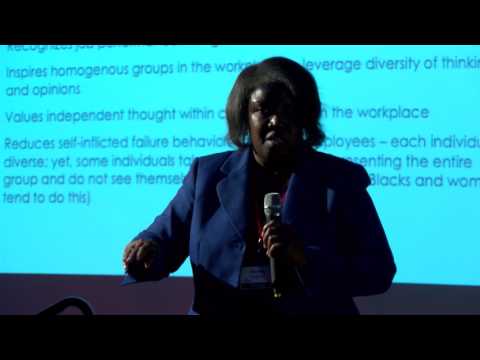
for understanding equity and leader
diversity leadership capability and when
you hear the word diversity if you like
me it’s like oh my goodness not once
again not that word when I moved to
Arkansas it’s been 13 years almost I’ve
heard the word diversity more in the
last 13 years and in my entire life and
I was born in South Carolina so the
southern accent isn’t going anywhere I’m
not a diversity researcher my passion I
teach human resource development and my
passion is valuing people in technology
in the workplace and that passion
derived from my very first job I was a
chemist I started out as a chemist from
Clemson University and my doctor told me
find another career because you can’t
breathe these chemicals I could not talk
from after a day of work around
chemicals so I said what am I going to
do I’ve got a chemistry degree this is
my passion I know I want to be a college
professor at some point how do I get
there and so what I decided to do is I
did a pros and cons list what are the
pros of every job I’ve had and what are
the cons and the cons weren’t things
that I would never do there were just
things I preferred not to do if I had a
choice and so after making that list I
said you know I could be a trainer I can
train people on how to use chemicals I
can train people on processes I can
train people on systems because I worked
in manufacturing or operations and so
that valuing people and technology
concept came from my experience as a
chemist in a manufacturing facility and
watching employees market X for their
paycheck in 1991 I couldn’t believe it
you know I graduated in 91 I go in this
facility with 1,100 employees never
thought that people couldn’t read and
write and they were working in a
high-tech performance company and so I
started looking at how we were investing
over 30
a million dollars in equipment but we
were investing virtually nothing in
people development but we were going
after certifications and you’re going to
need people when the auditors come in
because they’re not going to talk to
managers they’re going to talk to
everyday folks that you have working for
you so I came up with five common values
between people and technology and those
values are location use maintenance
modification and time value and the
example I use is before you buy a piece
of equipment or in common language if
you buy a computer you know where you’re
going to put it even with the laptop you
might buy a case for you you know where
you’re going to put it to keep it safe
you’re going to you know how you’re
going to use it you know how you’re
going to maintain it and in major
corporations they may hire an entire
maintenance staff just for that one
piece of equipment you guys know if
you’re on a college campus you know
where the computer technical support
people are because you want to maintain
your computer and you know how are you
going to modify it as things change a
organization isn’t going to buy a piece
of equipment that can’t modify they
can’t modify as their processes change
excuse me change and so with computers
you buy it you want enough RAM you want
enough so that there’s things change you
can adjust the same with time value with
equipment they know they’re going to
depreciate it on their balance sheet
people don’t have that same option you
either retire you work in a state as
at-will where you can quit at any time
or they can fire you for no reason so
with that in mind I realize that
technology development has a head start
on people development in organizations
and so my focus is not to say that
people are less than technology you need
both to exist my research looks at how
do you value the technology development
and the people development you hear a
lot about robots when I was in industry
robots were already there you know so
people have to have the knowledge to
operate the robots the Japanese tried
90s they tried to run an entire plant on
an off shelf with no people it didn’t
work you have to have people so when you
read a lot of the articles today and
then talk about robots are going to
replace people they may replace some
jobs but that as long as you have people
development you can still maintain your
jobs in organization and that’s what I
do I help students learn how to design
training programs to leverage both
technology and people in the workplace
and out of that came my term in to
personnel diversity and when you talk
about interpersonal diversity I look at
computer programmers look at Google SAS
Institute um Microsoft Facebook they
have all sorts of computer programmers
orlimar technically in the same job
however they look at the variety of
skills that these employees bring and
they leverage that another example is in
teams force we March Madness now so
basketball teams most of them have about
three guards on the team even though all
of them are guards they’re allowed to
leverage their strengths even across the
organization but sometimes in
organizations like call centers you give
an employee a script a script to read
and that’s their only option you don’t
allow them to think you don’t allow them
to be creative and in a lot of jobs and
that’s why a lot of manufacturing jobs
left the u.s. all the people were in the
same job category but you didn’t give
them the flexibility to think and make
adjustments and they only did what they
were told to do and so when I talk about
interpersonal diversity I’m talking
about using those five values to analyze
each person and not as if you analyzing
a piece of equipment treat them like
human beings and recognize that job
performance strengths even though
they’ve got the same title you paint
them the same thing they bring a
location value that may be of an asset
you they may bring a use-value that is
not just what’s on their job description
they matched the job on their resume
they match the job description that you
provided but they bring other skills and
you have to maintain those skills but if
the employee goes out and all of you
college students when you go out and you
get your first job when you decide oh I
want to go back and get a certification
I may want to go get a master’s degree
your organization may not value that
they may pay for it with our tuition
assistance but there’s no guarantee that
you’re going to be able to use that
skill on that job because some of them
just want what you can provide at that
moment what they need in order to get
the job done and I think I’ll speak
earlier this morning alluded to that
some but what it does is this helps if
you can maintain their skills let them
modify their skills and their time value
to your organization if they decide to
retire early it makes room for new
employees but if they decide I want to
stay here and retire you need systems
and some of those systems are like scale
based pace system performance phase
phase systems and when I manage the
skill phase phase system for an
organization I would have older
employees come to me and say look I
don’t want to do anything else and I’m
looking at them I’m saying well you know
if you don’t go through the system you
don’t get a pay raise and they’re like
I’m okay with that so we had to go in
and develop a grandfathering clause
where we could grandfather them into
that particular position but they still
had to meet the demands the productivity
demands as they increased without having
to go through that particular system but
new employees they had no choice they
had to go through the scale phase phase
system the way it was designed but
without that in a personnel diversity of
thought about each individual employee
that works for you you lose value
because either
get frustrated and leave or they stay in
they’re miserable and they make
everybody around them miserable and so
you got a miserable organization and as
I continue to work on this valuing
people in technology in the workplace I
evolved to the term diversity
intelligence and I define diversity
intelligence as the capabilities of
individuals to recognize the value of
workplace diversity and use the
information to guide their thinking and
behavior
I know people saying well you’ve already
got diversity training
you got diversity education and my
opinion is you’ve got failure and the
reason I say it has failed is because
you’re still spending despite spending
multi billions of dollars on diversity
training and diversity education you
still have you see complaints that Equal
Opportunity Commission complaints you
still have legal settlements daily
Department of Labor dis settlements
based on discrimination the other reason
I say it fails is because the diversity
training focuses on awareness they’ve
added inclusion access has always been
there but the pieces that I describe as
missing are is the understanding the
equity and without those two you don’t
have the diversity leadership capability
and if once you achieve that then your
follower well-being the people that work
for you as a leader will be protected
from discrimination you will be the one
protecting them and you’ll be protecting
your organization from it you have
reduced turnover you have improved job
productivity nobody comes to work
miserable and do a good job I don’t know
anybody that does I mean you might know
people that come to work and they lolly
jolly every day and they’re miserable
after being treated bad and increase
motivation if you treat it treat them
well there motivate others to do well
so when I look at DQ and understand and
I talked about how to traditional
diversity training focuses on awareness
and inclusion but all of diversity needs
to be applied in context because when
you look at diversity the word just
means different there’s no nothing else
to the word is just different and the
overarching context of diversity for
understanding in America and I’m putting
this in American context because that’s
where the versity originated in the
workplace in a global conglomerate you
see at all and it came through manifest
destiny manifest destiny when it was
first introduced in America it was from
the settlers when they came over to
North America their goal was they felt
they were ordained or destined by God to
conquer North America to settle the
entire continent of North America and
they never racialized it until after the
Civil War and after the Civil War it
became more racialized and you had the
diversity the separation of the American
Indians the blacks as slaves this
ideology then migrated from society into
the workplace they haven’t separated it
out and that’s why you see what you see
today is there is no separation between
that thought that we are better we are
superior and we are deemed by god to be
superior not all but that’s where it
originated and so diversity in context
is vital you can’t just separate it out
and say oh I’ve got diversity
you’ve got difference you don’t have
diversity of action and behavior and so
it was introduced into the workplace
after affirmative action and affirmative
action was designed to protect
minorities and women and it was only in
workplaces that have federal
contracts and even today if you’re not
in a workplace that has a federal
contract you are not obligated to do
affirmative action and that’s that lack
of understanding that a lot of people
don’t have and they think every
workplace in America is protected by our
firm intervention and with my students I
only teach working adults
I teach master’s and doctoral level
students and even our undergrads are
required to have at least three years of
work experience so they are working
people and so when I give them an
assignment they arm submit something
about affirmative action I never tell a
student they’re wrong I just don’t I
just say can you verify that can you
provide a reference that supports your
position so when they go out and they
start looking it up and they come back
and say well dang I didn’t even know
that there’s not a law in America that
says you have to have diversity in the
workplace there’s no diversity law none
there are legal actions that protect
different groups of employees in the
workplace and I’ve listed them there if
you want a copy of this you can have it
but when you really look at who’s
protected in the workplace
there’s only one unprotected group in
the workplace and they are white males
and not all of them you got to be under
40 because at under 40 you at age 40 and
above you’re protected by age
discrimination non-religious if you
don’t have a religious belief
non-disabled you have no type of
disability you’re non-veteran you non
LGBTQ and you’re not protected by Title
7 so when you look at that there are
very very very few unprotected employees
in any workplace specifically those with
federal contracts I am protected by
federal law
other workplaces often use on state
local laws or internal policies but a
lot of this misinformation leads to
inequity and a lack of diversity
leadership capability
because if you don’t know this you see
it on every job application at the
bottom but most people don’t read it
they just want the job they fit you know
they have it hanging up on a on the wall
in the workplace for you to read your
workplace rights but how many of you
ever read those posters I haven’t ever
read them I’m being honest but I teach
legal and ethical issues so I read the
textbooks and some of the laws but most
people don’t even look at it so you have
a lot of misinformation and so when I
started looking at how do I get all
employees protected in the workplace I
said well the missing piece is the
intelligence because you got a whole lot
of ignorance but you have very little
intelligence around diversity and so
without leaders having that capability
to utilize what they learn because the
education and training does not equal
intelligence I promise you it does not
so my premise is that you need to
integrate diversity intelligence
alongside intellectual intelligence
emotional intelligence and cultural
intelligence and I get a lot of pushback
saying oh you got diversity with you got
diversity covered under cultural
intelligence most of the culture
intelligence literature focuses on
international you’ve got diversity
within culture and a lot of people don’t
take the time to understand the
differences across cultures or within
the cultures so in order to treat all
employees fairly honesty and with
integrity you need the intelligence to
understand all of these laws and rules
and policies so that everybody who’s a
leader of employees and those who aren’t
you might be a leader without a title
but you’re still a leader in an
organization you need to recognize the
difference between yourself and others
without it being an obstacle just
because you’re different doesn’t mean it
needs to be an obstacle to performance
and reflect on your actions your
personal action I don’t talk about the
bias and the institutional racism
because I deal with each individual and
I think if we all deal with each end of
and understand who they are using that
interpersonal diversity and diversity
intelligence and knowing what the facts
are then we can value the differences in
employees without attempting to make
everyone alike and then embrace the
differences as strengths rather than
weaknesses and stop trying to fit
everything and everybody into every
diversity initiative I’m I like the word
inclusion but everybody doesn’t need to
be included in everything and a lot of
them don’t want to be included you know
so just because it’s a diversity
initiative does not mean that you need
to be a part of it and so from my
perspective growing up in South Carolina
moving to Arkansas and some of the
experiences that I’ve had I just feel
like I don’t believe that there’s that
much difference between people we’re all
human beings we all want people to like
us we all have passions and beliefs we
just need to make sure that those
passions and beliefs are harnessed in
factual information versus opinions and biases and stereotypes thank you