
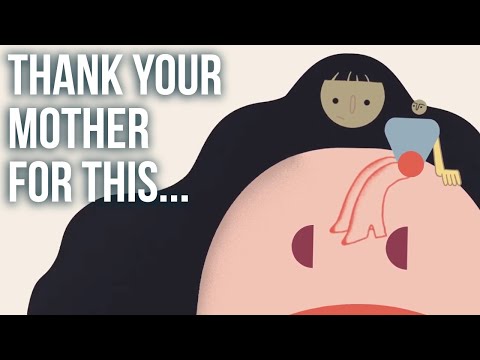
one of the most basic features of being
a boy so well entrenched that we forget
to notice its strangeness is that after
a certain point mothers become
embarrassing and need to be surrendered
and denied not just mothers but all that
mothers tend to stand for in a boy’s
life tenderness vulnerability and need
to become a man is to grow into the
creature who says not now to his mother
and doesn’t look back as he walks
towards his friends in a schoolyard
mother’s become so-called embarrassing
because they know all the areas in which
one is not perhaps quite the man one
claims to be to the world mothers have
the map to forbidden aspects of one’s
personality they know where one is
afraid in need of reassurance playful
and easily moved by small and delicate
things the mother stands in the symbolic
imagination as the guardian of the
denied male self of all that was
renounced on the path to that dishonest
brittle state we term masculine
adulthood the denial of the mother is
that the root of what makes so much of
adult society heartless we refused to
nurture one another because we have
refused to face up to the way we were
once nurtured we behave like people who
were doing their very best to forget
their own less robust and more dependent
selves in the summer of 1978 the French
literary critic Rowland barked wrote a
fascinating letter to his good friend
the novelist Philippe Solea
he told Sola that he’d been spending the
month of August rereading Proust and
that he had drawn from the experience
the courage no longer to refer to his
mother as my mother but rather to call
her publicly mama he was at this point
63 years old the passage needs to be
unpacked the French language is
particularly and instructively clear
about mothers there are two ways to
refer to this figure in French now
meaning mother and maman a far cozier
word more dignified than mummy but more
intimate and less offhand than mum still
redolent of childhood dependence and
care mum is someone you occasionally
send a card to maman is someone whose
caresses you miss one of the many
remarkable things about marcel proust
the greatest writer that France has ever
produced is that throughout his novel in
search of lost time he constantly refers
to his mother as mama he does not as all
serious French writers had done hitherto
for her Mamere he deliberately and with
calculated intent sticks to the far more
vulnerable maman insisting thereby on
acknowledging the simultaneous existence
in his own mind of adult and child
selves he performs a major
rehabilitation sketching a new ideal of
masculinity that is properly in dialogue
with childhood need what is so revealing
is that bath speaks of stumbling in late
middle age on what he calls the courage
to refer to his only mother as my mom he
admits that it takes bravery to be open
to his boyhood self he has to lean on
the prestige of another writer to take
an apparently insignificant but deeply
symbolic and daunting step that of
daring as a grown up man to make a
public declaration of his previously
denied longings for his mother or to put
it another way
bath is learning that real men do not
shun
mothers that grown-up men can be mummies
boys he is along the way
giving all men encouragement to travel
with greater ease between the masculine
and the feminine sides of their nature
and those of the adult and the child
rather than denying split partition and
then stamp on the denied parts we become
real men when we know how publicly to
proclaim with pride and tenderness that
we are mummys boys
[Music]
thank you for watching liking and
subscribing if you want more why not
visit us in person and attend a class or
take a look at our shop at the link on your screen now
Please follow and like us: