
photography to explore the world around
me in the words of the Navajo running is
about pushing yourself physically and
mentally to find out more about what
lives inside you running is a prayer a
form of moving meditation it is a way to
celebrate life for me the manifestation
of my art through running is that
celebration and I want to share with you
all today the hope that I see when I
lice up my shoes and embark on the road
or a trail often in the early hours of
the morning I woke up two years ago to
find a few inches of snow on the ground
it was 5 a.m. and there were no cars out
dissecting the clean white powder on the
streets where shoes
footprints meandering along the
sidewalks of the road it was magical and
the cold made it even more exciting as
my breath floated towards the sky you
may remember that scene in Bambi when
there loping around in the clouds
running up the arch arching ramp of the
big four bridge covered in snow as flex
continued to fall felt like that for
many people running in the cold is a
non-starter let alone in the snow but
these runs and many like them have led
to a lot of good conversations they
often start with you must be crazy and
then lead to expanded understanding of
how you can view activities as an
exploration rather than a duty or chore
I see running and my art as both rooted
in tenacity curiosity and exploration
you have to be agile in how you approach
things willing to change course and
improvise it must be must have trust in
the process even when the outcome is
curiosity also allows you to see details
like do on a spiderweb in southern
Indiana or on the blades of grass in New
Orleans Crescent Park the interplay of
light in shape during sunrise at the big
four bridge and the reflections on the
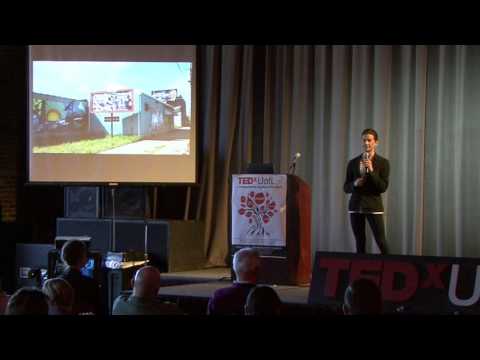
Ohio River the graffiti on an abandoned
building in Smoketown or the
hand-painted fishing boats on the coast
of Senegal West Africa and the outline
of the Renaissance monument overlooking
Dakar you see I explore the world
through panoramic landscapes and
mirrored patterns because this for me is
where one plus one equals three and I’d
like to hear from you all I’d like to
know if you have had a perspective
changing experience with art like let’s
see a raise of hands if a story or a
poem or a song maybe a meal has impacted
the way that you interact with and
understand the world around you look
around I think that we can all agree
that the power of artists to create
opportunities for expanded understanding
is immense because I believe the artists
are a catalytic force who make new
options visible and this is the mantra
we believe at ideas xlab the artists
innovation company I co-founded with
Theo and our partners Chris and I yell
it over four years ago you see we we
believe that artists are an untapped
resource for moving a community through
radical healing toward hope hope as a
way to drive equitable policy changes
and through our partnership with our
nonprofit arm for training artists
creative agents of change foundation
we’ve embarked to validate that belief
over the past four years we’ve
prototyped artists innovation projects
with corporations like GE s first build
and Humana and nonprofits including
YouthBuild Louisville we’ve seen how
artists artistic practices can expand
capacity with
organizations within the way that people
think about how they use their equipment
and how they approach situations and
within the workforce our latest
initiative project heel is a three year
process that engages artists across the
communities five social networks where
people live work worship learn and play
we’ve seen that artists can help us as
we work toward health equity in a
community helping people achieve the
highest attainable level of help that
they can that allows them to do the
things that they want to do on a daily
basis and by engaging in training
artists to understand health equity and
qualitative data collection we’re
so while quantitative data may tell us
the what in terms of health barriers or
health and disease issues we need the
qualitative data that tells us why to be
able to get at the root causes the
Stanford Social Innovation review
recently released an article about the
need demand fallacy and they talked
about how there may be a lot of need for
a program but if there’s not demand for
it it doesn’t really matter so if you
think about diabetes prevention for
example there are 86 million Americans
with pre-diabetes in the u.s. except
only 20,000 or so are enrolled in DPP
programs that’s a really big discrepancy
between need and demand so as we think
about how context determines what we
look to tackle quantitative data may say
that diabetes is what people should
focus on but engage in qualitative data
may show that people are more worried
about the safety of their children or
the forty-five minute bus ride that they
have to take to get to the grocery store
because they live in a food desert at
ideas we believe in both health and
cultural equity we know that artists of
color are underrepresented and
underfunded so as an artist that is
white and working
in many communities of color it is part
of my responsibility to leverage the
white under that I have to bring
resources to bear as we work with
communities to improve both health and
cultural equity moving forward the
community that we live in is called
smoke town it’s the oldest
african-american community in the city
of Louisville with over 150 years of
rich history and culture and a growing
number of partners and stakeholders
within the community coming together to
create positive change at the same time
smoke town is located 50 feet across the
street from the highest concentration of
medical and health-related services in
the state of Kentucky yet our residents
in smoke town have a 9 year difference
in life expectancy than the Louisville
average there are two projects as part
of one as part of Project heal that I’m
going to talk about today the first is
one poem at a time and this is an
initiative developed by artists and
ideas xlab team member Hannah Drake that
we launched last Saturday April 1st 2017
and through a year of community
discovery and arts and culture
interventions we came to understand how
negative and predatory advertising and
messages in the community are social
toxin so the same way that lead puts
environmental toxins into an environment
so do negative messaging you may have
seen some of these signs before cash for
your diabetes strips this is a
multi-million dollar black market
cash for your house billboards that talk
about gun shows cheap lawyers abortions
all of these things continue to
reinforce a feeling within the community
and impact the perception of the
community from those outside it that
come to visit or drive through so as
part of one poem at a time we’ve
replaced over ten billboards in the
smoke town neighborhood with positive
images and poetry we created with the
smoke town community we thrive when we
work together live long friendships
begin in smoke town this one says
healing begins one step at a time and
this photo is from the smoke town peace
walk that happened last summer we had a
series of shootings all within one week
and hundreds of smoke town residents and
community members came together to
support each other so the man in the
middle of this image is Henry Booker and
he is the grandfather of a 14 year old
named trevone Tay his friends and family
called him fat daddy and he was one of
anything is possible with hope this is a
group of young men from the community
and the image on the right is from the
one poem at a time launched last week
rebuilding but never forgetting our
history don’t count the days make the
days count this is another one of the
photos for my runs in smoke town and
this is the smoke town unity Monument
which sits a few blocks from where we
live it represents the history and
heritage of boxing in the neighborhood
this is where Ali first learned to Train
and symbolizes a love for the people in
our community as part of the launch of
one poem at a time the goal was to bring
together community residents and
stakeholders with policymakers using
arts and culture as a language to engage
in a conversation around policy change
how do we limit or mitigate these
negative and predatory advertisements
and billboards from being president our
neighborhood that is what we’re working
on with one poem at a time another
project that’s happening right now is
called the smoke town lifeline project
and it was created by project heal
artist Andrew cousin a sculptor who came
to see that his artistic practice could
be leveraged to engage community members
in smoke town in conversations around
trauma while visualizing it’s
multi-dimensional impact
each rod that you see represents a life
in Smoketown 1.25 inches equals a year
and every Bend is a place where an
instance of trauma occurred Andrew did a
seer a few months of community discovery
and research and then stood outside on a
corner in smoke town for a full month
talking to residents listening to their
stories and hearing the details of where
trauma had occurred the different bands
correlate to different types of adverse
experiences that the community has gone
through and you can see patterns where
one type of trauma triggered another so
Motown lifeline also shows aces the
adverse childhood experiences that
happened before age 18 and can have a
lasting negative impact on health so as
we think back to the nine-year deficit
and life expectancy Smoketown lifeline
helps to visualize that and give us a
platform for havoc on for how to have a
conversation about moving forward
identifying the disparities and creating
an action for change
andrew is one of the examples of how an
artist practice was transformed by
participating in project heal through
the training and through engaging
community members hearing their stories
and being out immersed in the community
and doing that research fundamentally
changed how he thought about his
practice and how he is training the next
generation of artists in the US and it’s
these type of projects one poem at a
time in the Smoketown lifeline project
and others as part of project teal that
we’re seeking to evaluate over the next
three years through our through the
Center for art and health innovation
which is our partnership with the
Commonwealth Institute of Kentucky at
the University of Louisville and we’re
doing that through a measure we’re
calling cultural ROI so we’re not
talking about how many artists how many
paintings and artist cells or how many
people attended perform
mints we’re talking about looking at how
when you train an invest artists and you
implement a multi-year arts and culture
framework how these things can impact
social connection isolation and expanded
critical consciousness all with an eye
towards policy change my challenge for
the artists in the room is to think
about how your artistic practice could
be deployed and expanded as a way to
help communities move toward improved
health and well-being and for our
partners and friends and the Civic
corporate and governmental sectors I
challenge you to think about how these
types of Arts and Culture strategies
could be leveraged to expand your
ability to help our cities move toward
building a culture of health that’s accessible to all thank you