
in the face of uncertainty most of us if
you take a look over here on the left
when we win we’re young and you can just
imagine that you’re on the diving board
over here and somebody’s really happy
about jumping others that need to be
pushed and so we’re kind of find
ourselves you’re probably one of those
four persons and over here to the right
as we mature as we get older it becomes
a little bit more difficult to be able
to make those decisions and in fact you
may have seen this clip recently from
the New York Times who did this actually
they didn’t sponsor it but was on the
New York Times they paid the study was
done where a series of strangers were
paid approximately $30 to jump off of a
ten meter diving board and so and then
they of course they filmed it’s about 16
minutes it’s really a great way to look
at just and see how it is that we make
these decisions now they’ve never jumped
before and you can see here this is this
woman that’s just trying to convince the
guy look if I don’t my arms don’t come
off then will you jump and and there’s
just just a series of looks at what it
takes for people to deal with a certain
amount of fear certain amount of
uncertainty that’s just basically just
the kind of ordinary things that we do
in life when we’re faced with
uncertainty but once in a while events
in life will present this the march on
Selma in this example it happens in
March is an example of where folks are
going to be challenged to cross the
Edmund Pettus Bridge this is a part of a
historical movement within the south and
which segregation is being challenged
it’s going to challenge the white folks
who live in the south it’s going to
challenge the black folks and you can
remember if you’ve seen the video of
where John Lewis is leading the March
Andrew Young is leading the March dr.
King is leading the March those are the
ones that you see on the front lines but
when you look at the video you’re going
to see they’re ordinary citizens who are
faced with the challenge of what do they
do when they try to change their
community
and you have policemen who have billy
clubs their horses they are threatened
with their lives and they’ve got to make
a decision so you’ve got the leaders
we’ve got to make a decision and you’ve
got the ordinary folks who’ve got to
make a decision
both the ordinary black folks who want
their rights and then you’ve got the
white folks some of whom are a part of
the police department everybody’s got to
make a decision and when you see this
video clip you’re going to see them come
together and at some point the billy
clubs are going to come out and people
are brutally wounded for just a basic
right to be able to congregate to vote
the basic elements of a citizenry and a
democracy well that’s what happened to
that was going to have an impact on a
little boy who was age 13 who lived in
the city called North Augusta South
Carolina and that’s the letter that my
mom received is May 20th I was 13 at the
time so the impact of what they were
doing these citizens who were actively
participating in changing the future
uncertain it was going to have an impact
on a little boy who was age 13 and a
social studies class that afternoon
decided that he along with 12 other
young kids black kids would integrate
the schools of North Augusta South
Carolina which up until that point
wall white this is 1965 and I’m age 13
so there’s the letter that says to
inform you of the actions taken by the
County Board of Education concerning the
request for transfer of your child as
indicated on the enclosure and you see
the next part of it is it has been
approved however it says continue the
pun under the assumption that the Aiken
County freedom of choice plan for school
integration would be approved by the US
Office of Education prior to September
1st 1965
so they were still hoping that it would
not go forward but that’s not the whole
story so now we’re talking about
uncertainty on the part of the cops what
were they going to do I can imagine that
there were some of them who didn’t think
that was the right thing to do then I
can imagine that there was some of the
people who had marched had no idea that
they may possibly get physically hurt as
a result of making that choice then of
course way down the line here it is a
thirteen-year-old comes to his father
and says that I want to integrate the
schools of North Augusta South Carolina
so there it is there I am of course you
can figure out I must be the black guy
over there on the right hand side I had
made the basketball team this will be
later but this picture is from a column
I had written some years later
celebrating the experience but there I
am the young black kid oblivious to this
there’s my father to the left who at the
time was a teacher in two all-black
Jefferson High School which is where I
was attending which was the Jefferson
Elementary the middle school there was
no middle school just thought 1 through
12 right so imagine this you come home
and you tell your father dad I want to
integrate the schools I have no idea
however what impact my decision is going
to have on my brother or my sister I’m
the oldest my father is the breadwinner
he’s the teacher surpassed what he’s a
teacher but I have no idea until later
many many years later that my father had
to make a choice he had been told unless
your son changes your decision his
decision you’re going to lose your job
so there it is my father facing
uncertainty has to find the guts to be
able to say job a no job my son has made
this decision so here we are deal
uncertainty brought one by the decision
of a thirteen-year-old which is exactly
the way the future comes to us in
surprises now I set a little deck to set
up this notion so now I have put you
those of you who are going to be
managers in the future I put you in the
place of the jumping off of a diving
board which is a relatively safe
position to be and then here you are
between Selma have it to make a decision
which is a life-changing event probably
your life is going to be somewhere in
between so let’s take a look now as a
futurist into where you are going where
we are going we now know about that most
of us now are very familiar with being
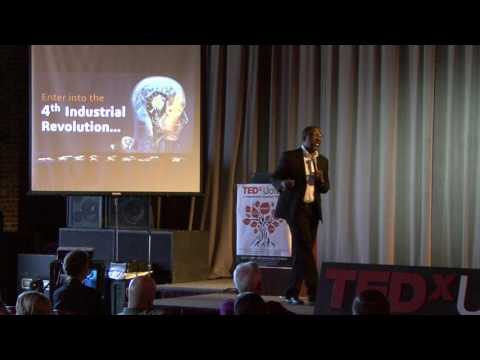
in what’s called the fourth Industrial
Revolution the first revolution being
the time when we would move things by as
a result of mechanization basically
machines with a water and steam
eventually they had electricity to them
in energy and able to do mass
productions we get to the third
Industrial Revolution where we bring
information and Technology all together
and then we connect all these things to
where we are now with the fourth
Industrial Revolution but you know all
of that happened rather quickly if you
look at it in context of human history I
have lots of favorite books but these
are some great books to look back just
quickly summarize how did we get to
where we are right now and why does this
matter to you as future managers so you
see there’s our Peter Bernstein’s book
against the gods which is just a
marvelous book about how around the
eleventh and twelfth century we develop
a new type of mathematics that allows us
as humans to be able to for the first
time to be able to calculate probability
and risk something that all of you are
not quite comfortable with but before
that we didn’t have that we had to kind
of throw dice we had to kind of go to
the to the gods we had to do all kinds
of different ways of trying to
anticipate what do you do with
uncertainty but here we develop
mathematics and then there’s this
wonderful book by our go black which is
a green black which is the swerve which
you have if you
is a wonderful book and looking at how a
poet whose name was Lucretia’s wrote
this wonderful piece very long time ago
called on the nature of things which
postulates that the world is really
random and that is a series of atoms
that come together and it becomes so
powerful that the church dares you to
even touch it but it would eventually
Greenblatt argues would set off the the
Renaissance which leads us to being able
to then develop the scientific method
which is a part of how we think about
things today then of course I love this
book the most powerful idea in the world
by Rosen which looks at for the first
time we get to a point and by the way I
met I left this off in terms of against
the gods the reason why that’s important
is because that’s where we begin to use
mathematics to launch a modern economy
we can predict how things might happen
using mathematics so but then we get to
the most powerful idea in the world
which is a wonderful idea a wonderful
book about how did we take something as
abstract as an idea and patent it so you
guys get an idea of where we’re going
because this is all part of you this is
all part of us this is a part of what’s
going to happen because now we get of
course you know I add in the book about
stealing God’s thunder which is of
course if you know the history of how
we’ve come to understand electricity we
should think that it came from the gods
and of course everybody was Stanfill of
that until we understand it’s a natural
phenomena all of this is changing the
way eventually we’re going to see
ourselves which we find now wonderfully
described in the gene wonderful new book
which looks at our codes we as human
beings are starting to understand the
codes that make us who we are and now
we’re going to be able to in the same
way that we manipulated atoms the same
way that we were able to manipulate
bytes and cells
now we get to manipulate genes which
presents for us a very different way of
understanding which is captured by all
you’ve all know Aurora in his new book
called homo dales when we might become
gods it’s a very interesting book now
here’s where you are right now and why
is this important for you
every industry and every organization
will have to transform itself in the
next few years
why does Tim O’Reilly say that it says
that and this is the issue here when we
think about the future work what is it
that it’s disrupting well it’s because
we have these very powerful computers we
have artificial intelligence the kind of
we’ve never had as a species but of
course you’ve seen how we’ve done it
okay over this long period of time but
in presenting an interesting challenge
for us in a modern society in a
community like Louisville in a place
like the University of Louisville you as
MBA students you as undergraduate
students you its master students you who
would lead us into the future you have
to begin to think about the combination
of all of these factors together there’s
no exception dealing with dealing with
uncertainty so you have to ask yourself
what does it mean to leave live to work
to think to believed to lead learn and
to innovate in a very different world
than the one that you’re in now so let’s
do this really quickly because I only
have a few more minutes later left which
is that’s what you engage in a few
thought experiments that are going to
challenge you challenge your notions of
uncertainty and where your guts are
going to come from so here you probably
have seen this one why in the world
would Bill Gates say that we should tax
robots why would up to a man of such
intellect why would he say something as
radical as that Justin wonder why you
would say that that we should tackle
wrote that we should tax robots
well in part because our machines are
starting to do so much of what
previously human beings have done in the
first the second the third industrial
revolutions that they don’t do as much
they do something very differently now
in this different time and it is going
to impact you when we look at the jobs
now you can just look and see we talked
about artificial intelligence impacting
what journalists will do what lawyers
will do what doctors will do financial
analysts stock traders assembly line
workers field technicians call center
workers you can see and this was a
Oxford study done 2013 Mackenzie’s come
out with another and they’re all looking
at the impact of
how work is changing and what do we do
so now we can have a conversation about
the future of an urban community maybe
we should think about a universal basic
income that is in your wheelhouse I
don’t know what your views are but
you’re going to have to deal with it in
major cities now or dealing with that
issue of course what gates says is this
right now the human worker who does say
$50,000 of work in a factory that income
is taxing you get income tax Social
Security tax all those things if a robot
comes in to do the same thing you think
that we tax the robots at a similar
level you agree with that you’re who
Gary Hill agrees with that ah have some
agreement well the National Federation
of robots robotics group in Europe
disagrees says that it would impact
productivity and we shouldn’t do it
that’s fine but here’s the thing if you
look in the Wall Street Journal recently
looked at the end of employees which is
again looking at the future of work
you’re going to see and this is going to
impact you that when we start talking
about the kinds of jobs that are coming
up a lot of them are temporary in fact
if you look at the Google project which
I’m not referencing here 70,000 people
that work on the Google project the
driverless car none of them work for
Google there are temporary employers so
we’re talking about the change in the
nature of work which is going to change
the economy which is going to change
communities this is not abstract when we
start changing the future of work we
change everything the other thing that
happens is right in your wheelhouse is
the notion that we’re using big data and
being able to now being able to possibly
predict what human beings might do what
they might do and the fact that you
might be able to do that the question
then arises should you do that these are
no longer abstract questions now so
here’s one right here just using a
thought experiment what if a prenatal
test predicted your child could have an
IQ of 80 points well below average
unless you undertook a little editing we
talked my CRISPR technology now one of
these
limited the only and wealthy to the
wealthy people is this not an issue for
public policy is this not something that
every community should be talking about
now this is something only the elite
should be talking about chin every high
school will be talking about this now
should this be a part of every urban
communities discussion about what do we
do with these very powerful technologies
they’re not abstract it is now coming
now are we ready for this with a
morality pill this is a very interesting
discussion because we’re learning so
much more now about how we make
decisions and about how chemicals impact
the brain so the discussion which has
been going on for about five maybe seven
or eight years we’re not quite there yet
but here’s what it does it raises the
issue of when you can alter human beings
behavior as a result of a different kind
of a drug that maybe perhaps creates
more of an empathetic person a person
who’s more giving geared to our
community I mean to our empathy or more
cooperation is that’s something worth
exploring correct but what if it turns
out that people who we put in jail
really had a chemical imbalance and all
you had to do was change the chemical
imbalance by a pill and if they didn’t
want to take it should we force them to
take it should we give them what how do
we deal with technology like this this
is not abstract this is going to impact
our communities how about this one
algorithms are now very and I recommend
all our graduate students to read
weapons of mass destruction by dr. Cathy
O’Neill which looks at the impact that
algorithms are having on every aspect of
our lives being able to predict whom we
will hire how they were hired it is
having a disproportionate impact on say
the West Side of Louisville this is not
abstract this is for real should the
Khronos test I gave this to my high
school students is central to be able to
debate this very simple test that can
discriminate on the basis of how you
would answer five questions to determine
whether you get a job at Walgreen an
entry job an entry-level job at Walmart
an entry-level job at McDonald’s
should we use these kinds of tests now
being questioned in the course whether
or not it’s actually a violation of the
Disabilities Act of 1990 how about this
one what if you can use information from
a digital and an algorithm system that
suggested an employee has the potential
to commit fraud how you can make a
decision on that it’s not an abstract
let’s see what else we have here oh
here’s one people who do counseling my
wife does counseling marriage counseling
here’s a question should a credit-card
company be entitled to raise a couple’s
interest rate if they seek marriage
counseling if so should the card holders
know this this is from Frank Pasquale’s
book the black box society these are not
abstract ideas these are apps these are
ideas that you as future managers
current managers have to deal with even
here in the justice here in the justice
system should we use algorithms to
determine the possibility probability
that a person should serve 10 years
versus 15 years was more likely less
likely to commit a crime okay we could
probably come up with some data to
support one way or the other is that
better than having a judge who win at
11:15 or 11:45 gets hungry decides to
give her a more tougher sentence because
his oxy to the chemicals his brain his
or her brain has changed it’s a fairer
to do that what about data that already
is predisposition
predisposed toward giving poor folks a
bad rap what do we do about that
untangling all that those are the issues
that we’re going to have to be faced
with and then is there something like
this aging population we don’t have
nearly enough younger people to take
care of the older people but what if and
this is a debate in Europe
what’s the obligation why should
children take care of their parents why
we know why in the past but why in the
future what if the parents have been
assholes why different kinds of
questions we’re going to have answered
well I want to end here I think I
probably run over my time we’re going to
end up reinventing what it means to have
a human
seiyya tea and I wanted to leave with
this question for you do you have the
guts to change your mind I want to tell
you a story about a friend of mine who
was reading a story he’s 77 years old he
decided he was going to read a story to
some kids at the public school reason
actually they were in a preschool so you
can imagine he had chosen this friend
he’s great great great friend white guy
70 something years old he chosen the
story of the ugly duckling so he’s
reading the story of the ugly duckling
in and and he’s going along it’s a
fabulous story about the transformation
of one little duckling to another kind
of a duckling you know the whole story
it’s a great story right but here
suddenly as he’s reading the story he
realizes that the kids are all mixed up
that is so very racial diverse group of
kids and as he gets half way into
reading the story he realizes how the
story is going to turn out that there’s
going to be a white duckling at the end
and so now he’s stuck he’s got to make a
choice and he kind of stumbles on
through at the end and regretfully he
says he tells the story this little
black kid comes up to him afterwards and
says I didn’t like that story I didn’t
like that story then he runs on/off
little kid does and my friend said to me
because he wanted me to know this story
he said he right then he knew that in
the future we’re going to have to tell
different stories I just write stories
but we have to tell different stories
now I open up with this little clip
about being on the diving board so some
of you going to be like the guy on the
Left hope this works
god I hope it works and some of you
going to be like this little girl I hope
this works
oh it’s night anyway so here’s what
happens the guy on the Left stays on the
diving board with a little kid she
thinks about it for about a minute not
even a minute a few seconds she says
alrighty and she does this
boom jumps off the diving board and goes
into the future thank you all so very much