
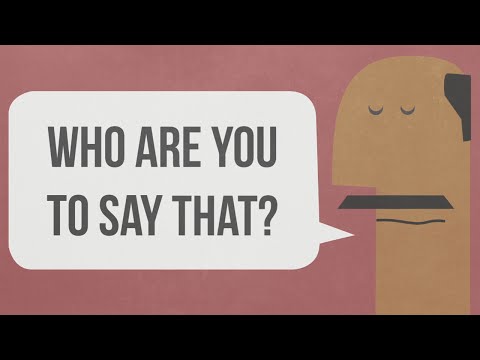
nowadays anyone putting forward a value
judgment that is anything other than a
rock-solid scientific fact is likely to
come across the following complaint
pretty soon after who are you to say
that you might hear it if for example
you try to argue that Shakespeare is
probably a lot more interesting as a
writer than the guy who wrote the prose
on the back of the cereal packet or if
you say that Louie Kahn’s Salk Institute
is for sure better-looking than average
Holiday Inn or that box mass in B minor
is more technically accomplished than a
Basu per trooper or that the Economist
is a better news source in the Daily
Mirror quite early on in the discussion
anyone who doesn’t agree is simply
likely to shut things down by saying
that no progress on these questions can
ever be made that no one knows how to
settle such disputes and that therefore
anything goes and any further attempt to
persuade is just bullying or those
electrifying and awkward words elitist
and snobbish and if you’re not careful
they might also quite quickly be a
Twitter deluge coming your way to
understand why such responses are so
common we have to look back at history
and some pretty unfortunate developments
which have led to a collective trauma
from which we’re still suffering for
most of the history of humanity we are
intimidated by some pretty dodgy
purveyors of half-baked value judgments
religions used to sell us all sorts of
nonsense under the notion that God told
us it was so kings and dictators would
justify their abuses by spurious notions
of their inherent right to Authority and
members of elite groups like doctors and
academics or just wealthy people would
justify all manner of odd practices on
the basis of their authority and fancy
uniforms as societies have gradually
become more democratic and people have
learned to stand tall in the face of
authority so to that patience for value
judgments has collapsed so much so that
now anyone who lays forth an idea with
any kind of confidence or simply says
anything about this all that being good
or bad
can swiftly rewrote the worst of the
traumatic old days and will therefore
stand to be shut down at once the only
exception to this is science here
respect remains paramount we’ll accept
an idea if it’s a scientific truth if
it’s come from a lab result we’ll take
it on trust but anything else and we’re
in the area of relativity and who are
you to say that ISM now unfortunately
this is really problematic as there are
some very important questions out there
that like utterly outside the realm of
science and can’t ever be settled with a
formula or experiment for example you’re
always going to struggle to mount a
scientific argument when trying to make
progress with these sorts of questions
what should children learn at school
what’s a good relationship how should we
build nice cities
what’s an attractive building what
should businesses concentrate on how
should bosses behave towards workers
unfortunately these are essential
questions to try to reach intelligent
conclusions on and yet because by their
very nature these questions admit to
doubt and disagreement it can seem as if
nothing solid can ever be said around
them but here’s our line that a question
can’t be answered to finit of Lee with a
hundred percent accuracy shouldn’t be a
reason not to try and address it there
is such a thing as a good and a bad
argument outside of science one can
speak better and worse answers to big
questions no one’s talking about trying
to impose conclusions on anyone else in
the way that the Pope or the Emperor
used to do it’s all about trying to make
sound arguments proceed logically and
attempt to persuade others of your cause
through reason and a bit of charm
rational democratic discourse depends on
people engaging with one another trying
to figure out ideas and not running away
from complex issues by dogmatically
shutting everything down with the
insidious and slippery retort who are you just say that
Please follow and like us: