
would you believe it I mean let’s put
you on to the side because I do think
you’ve on something what makes you so
sure that we’re not right do we have any
concrete evidence do you tell me for a
fact that they’re not a video game so
we’re not a simulation
well the boundaries between the virtual
and the real world are becoming more and
more blurred we may need to a point
where nine times per second and the
exact pixelation of computer of GG X
1080 Nvidia machine can truly immerse
you there’s a constant presence and
embodiment which effectively means that
you’re no longer short whether you’re in
the realm of the virtual world
dress and it’s unreal that when you woke
up you can tell whether it was reality
or I have to see you couldn’t believe it
if it happened or not I’m here easily
about identity presence and what I think
is the biggest informative shift since
the personal computer now me as a child
I used to dare and dream and hope until
stories I believe virtual reality holds
the key for the next generation of
storytelling we see the Syrian refugee
crisis and it’s on a screen where we’re
merely possibly digesting the content
we’re not we’re not immersed in in the
sense that whereas the participants with
virtual reality we can at the end of an
experience this is a project called
Project Syria led by Johnny Gill Opena
and and founded by the by the
but did you know that after seeing this
over 70% of people donated within with
within 30 minutes and did you also know
that in any TV set campaign after after
seeing it it always happen the time that
people took to donate to support a
campaign because they felt like they
could be them not just see an image or
screamed but actually see what it was
like from a first-person narrative and I
wonder how how long is going to change
for us to be able to tell our own
streams for example when I was 10 I is
also be nice to death in front of you
Brazil and I can stand here on stage and
I can tell you with words with gestures
I can kind of debate in motion but
you’ll never truly know a feeling to
stand but it was like unless you are
actually there and the closest I think
now needless to say this is possibly
very needed right now
empathy is is what Barack Obama said is
the greatest deficit at the time I’m
just gonna scare interest don’t want to
get into politics
now stereotypes meet text this picture I
don’t know if you’ve seen it of oculus
and Mark Zuckerberg walking into a room
and no one realized that he was actually
there but also if you notice it’s open I
mean what the number of computer science
graduates that are female have actually
half from 30 about 32% about 17 these
days now tech meets breaking down
serious op and empathy machines be
another as a world we burn out
open-source Creative Commons project
that aims to bridge the gap between
people quite literally
build bridges and not walls we are
effectively played into the body of
someone else
we bought a camera on some of your hands
so when you look down and see the body
of the camera like they look down they
see your body and you mirror movements
so essentially you get to experience
what it’s like to be a different race
and different sex a different age you
name it I also have about this project I
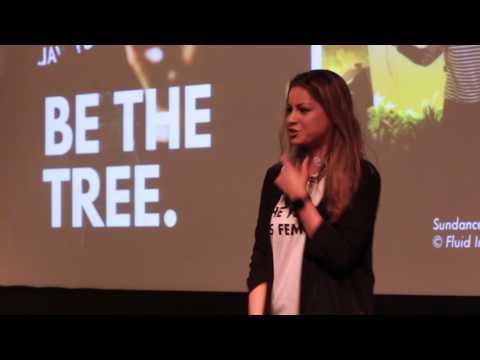
am HP’s open map just hold beat the tree
it premiered at Sundance this year I’m
going to be a tremendous festival and
essentially what it does is put you in
the whatever tree you’ve got having suit
and as you move you go through an entire
experience of what it’s like to be
seedlings grow you to full-grown tree
and then what it’s like to be chopped
off this it’s possibly the way that we
can help and it counteracts certain
someone’s contention that climate change
exists but this is also a way of raising
awareness in a much more sophisticated
complex and poignant way than we have
seen before with traditional media now
how are we able to do this you might ask
and in not getting too technical this is
the idea of embodied cognition which
which means that your your physical self
is a combination of your your
environment of the different
interactions and the give-and-take
basically and I think the easiest way to
explain is a rubber hand illusion I
don’t know if you come across it but
essentially you put up your hand and
you’ve got a rubber end and you
basically hide your your actual hand and
your brain receives is trying to make
sense of what
because you will because you’re my man
and as you’ve struck it it actually
sends the same psychological and
and neuro physiological signals to your
brain like that to real half and that’s
essentially what happens in virtual
reality who identify with an avatar wait
be it an animal a superhero so that’s
been shown to increase empathy and how
these are real time where the tree it
effectively puts you in the shoes of
another in the most limiting that we’ve
been able to exaggerate
they’ve been pioneering this technology
for over twenty to thirty years working
in psychology but also working to
counteract biases they have quite
significantly analyzed the impact of
family can creates virtual worlds or
learned that the effectiveness of what
is what is real when is virtual so one
of the impacts of children that are
growing with his hands a six-year-old
that is diversity under was an
underwater system and get to play with
whales what what is that child going to
to understand or to retrieve from that
memory is it going to be a memory of
something not visible or physical and
what they found is fifty percent of
children when asked among two weeks
later to recall the experiment said that
they were cool that as happened in the
real world they could not distinguish it
from reality and inspects is different
what are the implications for
potentially you know changing our the
minds of tomorrow
potentially changing influence
manipulating huge expensive sovereign in
I guess the most commonly known ways of
applying virtual reality that out girls
like gaming they’re also in in the
realms of psychology and they have been
successfully treating nations who have
intense phobia
so arachnophobia there’s a there’s a guy
who created a start-up Tom who off with
about two weeks ago saying that within
six months of his own app and created to
get over the fear of funds which is a
gradual exposure therapy tube to his
father he was able to hold the travel
anytime for the six months and he says
that he effects all that can be true
within one session owners irrational
phobias like in all suites research
tackling those with severe paranoia and
put into real-world scenarios in a safe
and controlled environment would then
able to within two three sessions go out
into the real world and experience
decreased sensitivity and he’s got it
right also fear of heights there are
apps today in steam an oculus for all
the different headsets where you get to
literally be on top of a ledge and
heckle you hear quite hit on also stroke
patients those kinds of maybe these are
all addition even being supposed to a
bar and reality to be able to deal with
the substance then these are all case
studies that where we’re trying to to
come to grips with but also understand
the effects that it has on on your body
on the for your perception of self and
your relationship with others and also
does it have
not manifest funny unintended
consequences it’s too early to know we
don’t have any longitudinal studies even
for children children and out of life we
also don’t know if the effects as VR is
now becoming more and more as I said
immersive and real and we’re using props
we’re using haptic students which means
you’re effectively in its employed suit
and if you get to feel the vibrations to
feel a bullet wound or you get to hold
the machine done and really kill virtual
avatars what is when is the cognitive
impact of that on teenagers with
children you see all has been toying
with the idea of avoiding you in a
virtual avatar where you’re you identify
with the body and then you see an image
of a grieving child cry and you go
towards a child and comfort them in
whatever way you feel like you need to
and and then they switch first-person
narrative so you become the top and you
see an image of you coming towards you
saying those words of compassion in 15
participants nine percent ninety nine of
them reported reduced levels of
depression within two weeks this was
done about three times a week for four
years weeks and within a month they were
put in higher levels of compassion hold
together and not only self compassion
but compassion for others difficult
people project was won by Jonathan he
went back a year ago in London and had
survived the severe ADHD and he called
that it was incredibly hard to let
people know what it was like to be him
in a situation that for others was
completely normal so he created being a
filmmaker a short video explaining what
it was like being a business meeting and
having severe
attention deficit disorder the girl in
the bottom who she can’t see very well
emily is not a criminal but wanders
and he’s terrified on a daily basis
about being arrested for a crime she’s
his mom she suffers from severe
kleptomania so he created the short
video as well we can go into a grocery
store and experience what it’s like
within five six minutes to be in her
eyes in her shoes and experience
increased anxiety frustration tension
the inner chap that owned that before
this video only Emily was able to
experience I like to ask and leave you
with the with a call to action to use
simple every part of this technology in
a way that we are focused on building
bridges and not walls in a way that is
humane that were really focused on the
power of the mind as soon as that we
become only thing and given these tools
which we should be naive enough to think
they’re always going to be in good hands
we’ve seen the past strong bonds of 2016
and filter bubbles and Facebook and
Twitter and you know that’s that
divisive mess so I asked is technology
making us more human or is it dividing
us is it
the force for good and I believe it is
given how is it so please be conscious
let’s use it let’s use our eyes as possible thank you