
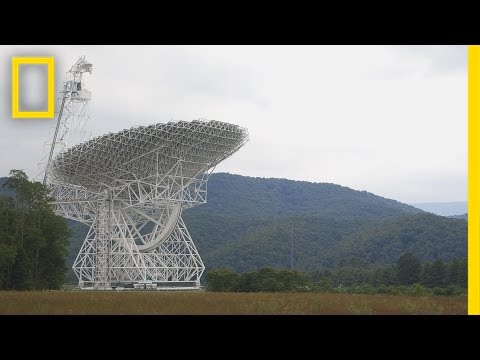
gbt is the largest fully steerable radio
telescope on the planet it’s one of the
largest moving structures on land it
stands 485 feet above ground level which
makes it taller than the Statue of
Liberty weighs almost 17 million pounds
so with 16 wheels more than a million
pounds per wheel is transferred to the
foundation like a bigger bucket collects
more raindrops the gbts large surface
area can collect more radio waves from
space the reflecting area is 2.3 acres
so a football stadium would fit inside
of that so radio telescopes are just one
window onto the universe so you think
about astronomy often people think about
your classic optical telescope something
you can stick your your eye up to and
you can look through and you get to look
at a picture of a galaxy a radio
telescope is the exact same idea only
instead of looking at the optical waves
the stuff that you can see with your eye
it’s looking at radio waves
we’re trying to take the principles the
things we understand about chemistry
from the laboratory and apply those to
molecules in space understand how you
can build up things that lead to the
formation of maybe life from what we see
starting out in the earliest remnants of
dead stars and the birthplace of solar
systems the light coming from the
galaxies we’re looking at is about as
old as the earth is now the G BT is
especially good for this it’s so massive
it’s beam is very small it’s incredibly
sensitive for this kind of work
the sensitivity of the gbt is ten to the
minus twenty nine watts per square meter
per Hertz now to put that in a term that
you can understand it can detect an
energy level that’s equivalent to the
energy given off by a single snowflake
hitting the ground
a typical quasar in space gives out a
billion of a billion of a millionth of a
watt so it takes very sophisticated and
very sensitive receivers to detect those
signals and be able to process them in a
manner that the astronomer is needed how
many kids have it looked up at the sky
and just said what’s up there and
astronomy is able to talk to them about
that and keep that curiosity going so
that kid who is curious about astronomy
may turn out to be the next best
physicist they may turn out to get a
Nobel Prize solving something in
medicine but it all started because
there was somebody willing to answer
their questions about what’s up in the
sky
you
Please follow and like us: